Building invisibility into digital public services
Digital Hungary Agency is striving to make services as seamless as turning on a light, says the agency’s deputy CEO, Zsolt Bányai.

DHA's Deputy CEO Zsolt Bányai, believes digital public services should be a seamless as using electricity. Image: DHA.
Government is at its best when it’s invisible, and this invisibility is the superpower that the Digital Hungary Agency (DHA) has been building as it develops one of Europe’s fastest-growing digital public services.
DHA's Deputy CEO Zsolt Bányai, who is also CEO of IdomSoft, the agency's main delivery subsidiary and the unit behind its most important solutions, says the agency’s long-term vision for digital public services is for them to be as seamless as using electricity.
“You walk into a room, flip a switch, and the light turns on. You don't question the utility. It just works,” says Bányai.
Operating under the Ministry of Science and Technology, DHA is the central agency responsible for driving Hungary's digital transformation and operating with a mandate to build user-centric, mobile-first public services for citizens and businesses.
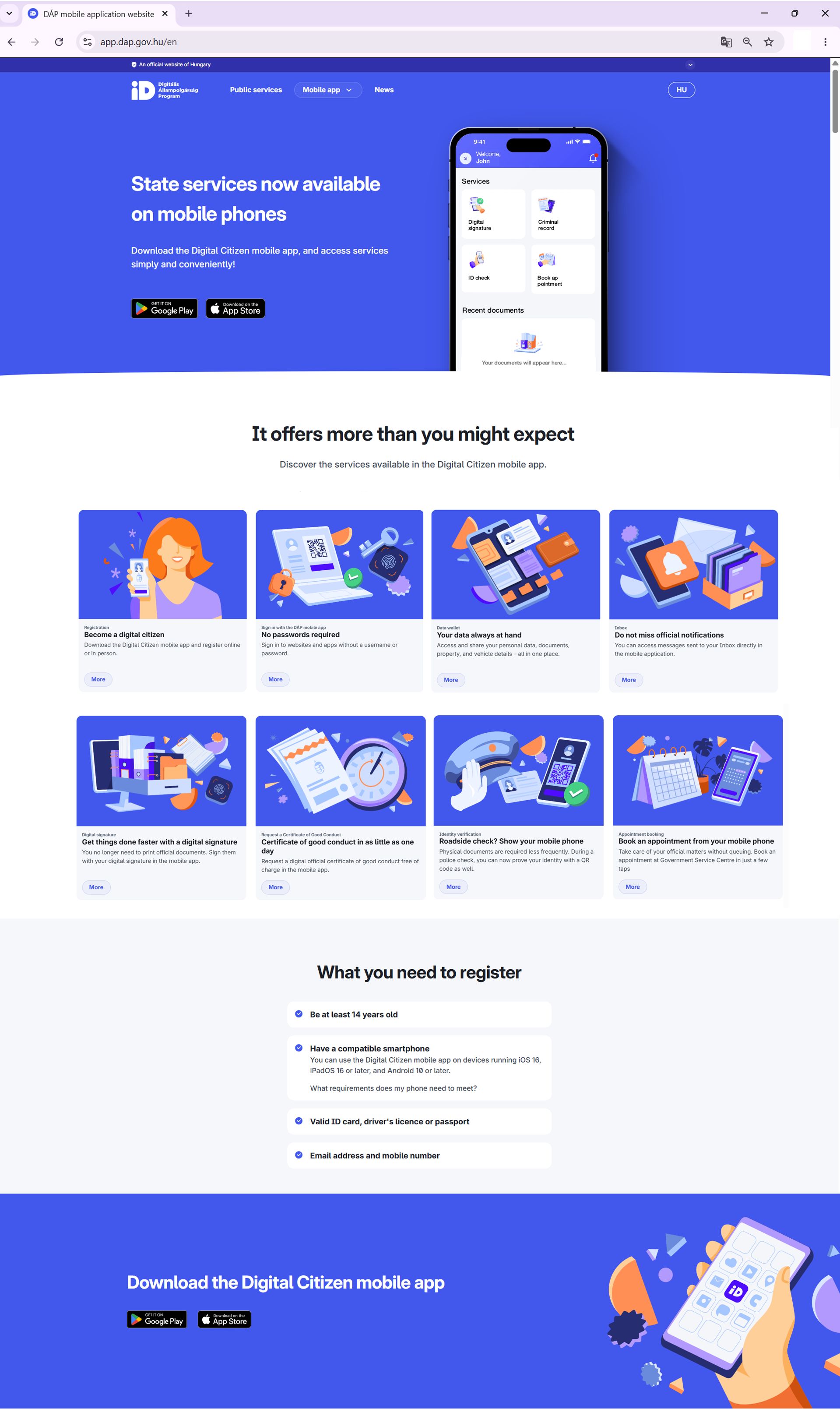
The agency’s Digitális Állampolgárság Program (DÁP, Digital Citizenship Programme) mobile app provides user access to a plethora of government services.
The app has seen 1.9 million registrations since its launch almost two years ago.
The success of the DÁP app is one of the reasons behind Hungary achieving the second-largest improvement among 38 Organisation for Economic Co-operation and
Development (OECD) countries in user-driven public service development, surpassing France, Austria, Finland, and Sweden.
The DÁP app received a Special Award in the Digital Society category at GovInsider's Festival of Innovation Awards 2026 earlier this year.
In an interview with GovInsider, Bányai shares the thinking that went behind the app.
He notes that for decades, Hungary’s public sector followed the norm of experts dreaming up theories in dark rooms and passing documents back and forth between ministries.
“I once received a 3,000-page system blueprint where page 174 contradicted page 2,725. Nobody could read it, let alone build from it,” he notes.
The result: more than 4,500 digitised services that citizens couldn't find, didn't understand, and often couldn't get done even when they tried.
Bányai and his team decided to try something different.
Talk to people who use the service
“We replaced [the existing] culture with something very simple: before you build anything, talk to the people who will use it,” he says.
The department now runs a formal discovery phase with citizens for every major service.
“For DÁP, we conducted more than 4,000 deep-dive interviews before writing a single line of code,” says Bányai.
But a new way of working cannot depend on conversations alone.
DHA also changed its organisational structure.
“You wouldn't run a company without a chief financial officer (CFO).
“[And] yet it was entirely normal to run a public digital service without anyone representing the user at the management table,” says Bányai.
The team fixed this by appointing design directors to the boards of DHA and its subsidiaries, establishing what they believe should become standard practice across the public sector.
As with all digital transformation projects, the biggest challenge has been cultural.
“We have learnt to seek out hard feedback actively. When a citizen tells you something doesn't work, it stings, but they are almost always right. And that discomfort, it turns out, is exactly where good design begins,” says Bányai.
Breaking habits
He notes that government agencies need to break two habits to build products that delight users.
The first is generational disconnect.
“Our research showed that for 16-to-18-year-olds, traditional government terminology is meaningless. They don't know the names of the platforms their parents use; to them, it is all just some vague ‘government thing’.
“If we want the next generation to engage with public services, we must be mobile-first and speak their language from the start,” Bányai says.
The second habit is internal.
“The instinct across government is always to build something new. We keep telling other agencies: stop. We have more than enough systems.
“The priority now is consolidation, integration, and making what we have work well together, not adding yet another siloed database.”
Bányai says DÁP's growth has exceeded expectations. The app is open to anyone aged 14 and over, and take-up is close to one in four of that eligible population.
It has been used for authentication almost 65 million times, with around 200,000 daily active users and growing.
But as is usual, numbers tell only a part of the story.
Quality non-negotiable
“What I am most proud of is that we used design to make quality non-negotiable,” says Bányai.
DÁP is the first government application that speaks to citizens in plain Hungarian, not the language of legal codes and administrative jargon, he adds.
“The visual side is just as deliberate: we built a unified design system, publicly available, so that every official service is instantly recognisable.
“Use of the design system is now legally mandatory for all state and municipal digital services, giving every provider a shared foundation for quality and consistency,” he adds.
That focus on quality has drawn European recognition: in 2026, DÁP received a Good Practice Certificate at the European Public Sector Award (EPSA), the European benchmark scheme for public-administration excellence.
DÁP is built on a set of framework services: electronic authentication, electronic signature, secure document storage, and authenticated data sharing.
One of the most impactful of these is the qualified electronic signature every user receives, free of charge and valid across the EU.
In 16 months, DÁP has issued more than 2.3 million signing certificates; Hungary's previous hardware-dependent system
produced roughly 15,000 a year.
Like Singapore’s Singpass, DÁP lets citizens use a single secure identity to access more than 200 government systems and authenticate with banks, insurers, public transport operators, telcos, and a growing range of other private services.
Life-event-based services
Following the global trend of developing life-event-based services, DÁP is designed around the moments that matter most to citizens and maps the stress that accompanies them, even the positive ones like having a child.
The first fully digitalised life event went live in March 2026.
Private citizens in Hungary can now complete a used-car sale entirely on their mobile phone, from drafting the contract to registering the ownership change, without visiting a single government office.
More than 820,000 used cars change hands every year in Hungary, so the impact is immediate and tangible, says Bányai.
As many life events have private sector components, the DÁP ecosystem already includes 29 market partners, including the country’s three largest banks.
Currently, more than 300 additional private entities are testing in the system.
Bányai adds: “We are building consent-based data services that let private companies access verified citizen data directly from state registries, with the citizen's explicit permission through the DÁP app.
“Citizens remain in full control of what is shared and can revoke consent at any time.”
When someone's personal data changes, the system can update connected service providers automatically. Citizens no longer need to go around notifying every bank and utility provider separately about a move or a marriage.
For a bank performing customer due diligence, this replaces stacks of paper documents with a single, secure, real-time data query.
“I am not aware of another country that has built this kind of consent-based, citizen-controlled data exchange between state registries and the private sector at national scale.
“We are digitalising the next wave of life events: relocation, starting up a business, job loss, and the birth of a child. We're also bringing artificial intelligence (AI)-assisted plain-language summaries to help citizens understand official documents,” Bányai adds.
Integrating services with EU
To a question on what’s next, Bányai notes that Hungary is preparing to be among the first European Union member states to announce a certified national EUDI Wallet solution.
He adds that DHA's development subsidiary IdomSoft has helped shape the European Digital Identity Wallet.
“We are also a founding member of IMPACTS-EDIC, a multi-country consortium officially recognised by the European Commission for interoperable digital public services.”
Noting that EU citizens who live, work, or do business in Hungary also use DHA’s services, Bányai admits that serving them “as well as we serve our own citizens is genuinely challenging”.
It goes far beyond translation: it means enabling someone from another EU member state to share documents or verified data sets from their home country, have their credentials recognised, and use Hungarian services with the same ease as a local.
“We are actively committed to this through the EU's Once-Only Technical System and Single Digital Gateway. There is a lot still to do,” he adds.
This progress is being recognised beyond Hungary's borders. In the European
Commission's 2026 Digital Decade country report, Hungary scored above the EU average on digital public services for citizens, recording one of the largest year-on-year improvements in the Union.
The report also credited Hungary's strong position on secure access to digital health records, underpinned by the national eIDAS node that IdomSoft brought online at the end of 2025.
Bányai notes that starting its digitalisation journey later than some European peers turned out to be an advantage for Hungary.
“We could learn from what worked elsewhere and design around what citizens actually need today,” he adds.
Ultimately, Bányai says, the ambition goes beyond making interactions with the state simpler. It is to remove them altogether.
"Imagine a child is born," he says. "The state sends the parents a message of congratulations, then asks whether it can pay the benefits they are entitled to into the same account as before. They tap yes. No forms, no office visit, no paperwork."
The state, in other words, already knows what is needed and has prepared everything; the citizen only has to approve.
For Bányai, that is what invisible government looks like, and what DHA is building towards through DÁP.