Meet the matchmaker between innovation and public sector healthcare
By Sol Gonzalez
The Alice Lee Centre for Innovation and Excellence provides a safe space for healthcare innovation, where public-private partnerships are an essential element of the journey, says the centre’s Director, Assoc. Prof. Ang Shin Yuh.
-1757412076647.jpg)
ALICE's Director, A/P Ang Shin Yuh shares about how the centre is fostering a space where both industry and healthcare professionals can create solutions together in a meaningful way.
The healthcare innovation space faces a dual problem.
On the one hand, new and innovative solutions cannot find the clinicians who need them, and on the other, medical staff can not find the solutions that could help in their work.
“A lot of the times, the solution is out there, but because the companies don’t know how to come into the healthcare market, our clinicians don’t know that such companies are already out there,” says Alice Lee Centre for Innovation and Excellence (ALICE) at Singapore General Hospital (SGH) Campus, Director, Ang Shin Yuh.
“That is when ALICE acts as the matchmaker, getting the two parties to make friends, and hopefully get a win-win collaboration.”
The centre was launched in 2023 as part of the SingHealth Duke-NUS Academic Medicine Innovation Institute (AMII) and SingHealth Division of Innovation and Transformation (Do-IT).
There are dedicated centres at SGH, KK Women's and Children's Hospital, and Changi General Hospital.
Since its start, the centre has aimed to deepen innovation through external partnerships and collaboration across diverse clinical specialties.
Ang says that she sees ALICE as the “shop front” or “gateway” through which companies can begin to penetrate public healthcare.
“Depending on what their product or which sector they’re playing in, if they [the companies] want to have a chat with our clinicians, that’s where we’ll link them up and organise certain sessions.”
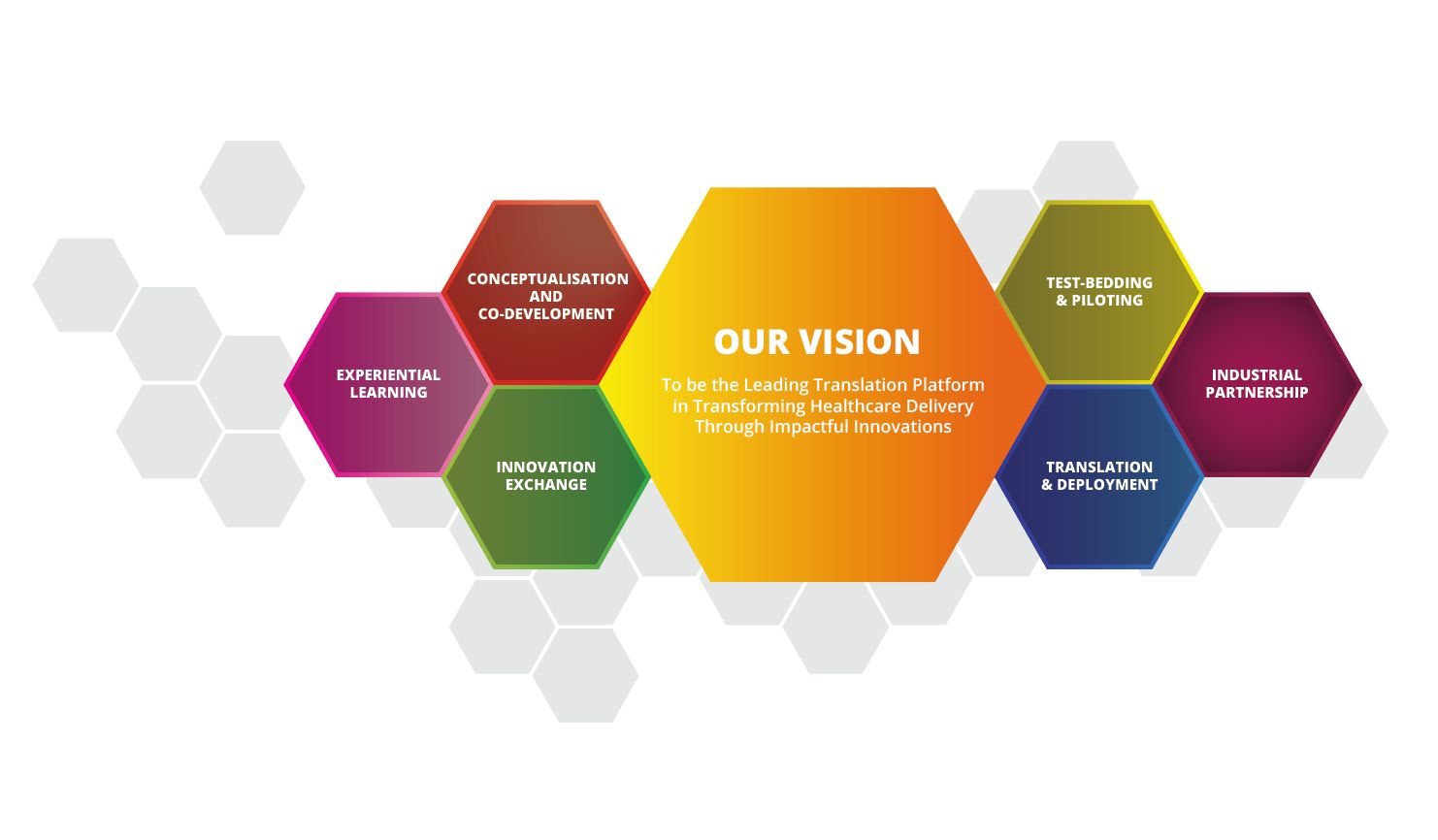
The centre can help clinicians get a solution to a clinical problem, either by tapping on an existing product, by linking the clinicians to industry partners to co-develop a new solution, or even approaching research institutes to start solutions from scratch, shares Ang.
“We always pride ourselves to say we support all the way from technology readiness level (TRL) one to nine and beyond,” she says.
Talking to GovInsider Ang shares about the link between research and innovation, and the importance of opening doors for partnerships with the industry to obtain solutions, and how ALICE stands as a safe space for both clinicians and industry players to share ideas and work together.
To subscribe to the GovInsider bulletin, click here.
Industry collaboration is key
The centre hosts sessions to connect industry partners and healthcare professionals as a way of fostering collaboration and networking.
The sessions could be centred around a theme, like dementia for example.
“We get all the companies that have some solution in dementia to come in. Sometimes, our clinicians will give them open feedback to see why this solution could work, why this solution might not work,” Ang says.
“Sometimes, this will evolve into a co-development, other times it will be a direct adoption [of the solution] and skilling.”
Sharing an example of a thematic session, Ang notes that on the last day of a nursing conference in Singapore, ALICE gathered industry players with innovations in nursing care to do a showcase of their solutions.
“Delegates from all around the world had the chance to see what kind of innovations can be done in the nursing space. And it gives companies access to get feedback, get some kind of market sensing,” she adds.
According to the matchmaker, the relationships that end up working best are those where companies and clinical teams are responsive and nimble.
This is because a successful collaboration requires agility to adapt to problems, fresh ideas to continue innovating, and openness to learn what works in specific contexts, says Ang.
The light at the end of the challenges
For healthcare sector, data collection and sustainability are two major concerns to balance when talking about innovation, Ang says.
As many devices and new solutions in the health tech space come with data collection, this information overload is sometimes alleviated with the use of artificial intelligence (AI). But this impacts the second concern, about sustainability.
“For every prompt that we put into generative AI we are drawing energy from some server, and healthcare is already known to be bad for the environment, which comes back to a full circle, because as the climate gets worse, we are going to see more healthcare problems,” she notes.
As a result, she’s starting to see a trend in the healthcare innovation space, which is “frugal innovation”.
Clinicians are starting to see that their needs might be best fit to a simpler solution, rather than the complex or overly saturated solutions that tend to drive up costs, she explains.
What keeps Ang optimistic is that ALICE is fostering a space where both industry and healthcare professionals can create solutions together in a meaningful way.
“Our leadership is very pro-partnering [in] industries. As a public sector, if we don’t commercialise, we can’t put the solution into the doctors or nurses’ hands, and they won’t reach the patient’s hands.
“Now, more and more people are starting to be enlightened about [these partnerships], that if we don’t have an industry partner, we don’t have a solution to put out there.”
Despite the remaining challenges, there is a light, Ang says, as the centre supports co-creation and partnerships looking for solutions that not only benefit the industry or the clinician, but that positively impact patient care as well.
To subscribe to the GovInsider bulletin, click here.
Understanding transformation from the ground
Ang’s background in research and first-hand experience as a nurse were the foundation for her role as a Director of ALICE at the SGH Campus.
She recalls conducting her own research early on in her nursing career with the constant support of her bosses, who sponsored her to pursue a master’s in business administration (MBA).
“Having been in the wards, seeing how nursing is run, seeing how my seniors struggle… I told my bosses, I want to be able to read a profit and loss statement, I want to be able to pitch, I want to be able to write a business case to fight for resources,” Ang says.
Coming back with an MBA, Ang spent two years in Health Services Research, before returning to Nursing where she helped to set up the Nursing Research Unit.
“Research and innovation are very tightly knit. In recent years, with the ageing population and the manpower crunch, I was asked to really look more into technology and into transforming nursing as a whole.”
Beyond research, it was her experience on the ground as a nurse that exposed her to the challenges, she says.
“I got to know what we’re not doing so good yet, and that’s when I tried to get the most updated evidence to influence our practice. Then, also realising that evidence alone is not enough.
“Sometimes we need a new device, sometimes it is something better than what the companies could sell us… we also need to innovate and solve problems that people experience day to day, or problems that might not be so obvious to industry players.”
She adds that this helped her to gain a more systematic perspective: different wards shared similar problems.
“I started to join the dots together and realise we need to transform. We can’t just solve one ward’s problem; we need to go more upstream to solve the entire problem.”
Concurrent to her role as a Director at ALICE @ SGH Campus, A/P Ang Shin Yuh is the Director of Nursing at the National Dental Centre Singapore, Deputy Director of Nursing at SGH and SingHealth. She will be one of the speakers at GovInsider’s Healthcare Day on September 16.