Singapore digitised 99% of government services. Why do citizens still fall through the cracks?
By ServiceNow
When a citizen loses their job or faces eviction, they shouldn't have to become their own case manager. Civil servants should move beyond acting as "human middleware" between disconnected systems.

AI orchestration layers can solve critical bottlenecks in service delivery where public officers often have to act as "human middleware" between disparate systems. Image: Canva
The statistical success of digital government in Singapore is undeniable with over 99 per cent of government services available online.
Yet, availability is not the same as usability.
When life hits hardest, such as a job loss or a natural disaster, citizens still face a patchwork of agency portals, each requiring separate logins, separate forms, and separate queues. The burden does not stop at the citizen.
Civil servants tasked with managing these interactions, spend much of their time acting as human middleware: manually reconciling data between systems or chasing case statuses across departments.
“The hard truth is most agencies have digitised their processes and systems, but I think one key gap here is really about not reimagining the services here,” ServiceNow, APAC Innovation Officer, CK Tan.
"The underlying logic - how departments work together and how different central systems are not integrated - hasn't changed,” Tan added.
He was speaking at a recent webinar that explored how artificial intelligence (AI) provided an architecture system where digital services could be made more responsive and coordinated.
Connecting digital silos
The diagnosis points to a missing layer in the digital government stack. Agencies have digitised individual processes, but nothing orchestrates the handoffs between them.
A citizen's life event – be it bereavement, job loss, a natural disaster – cuts across multiple agencies simultaneously, yet each agency still operates its own workflow in isolation.
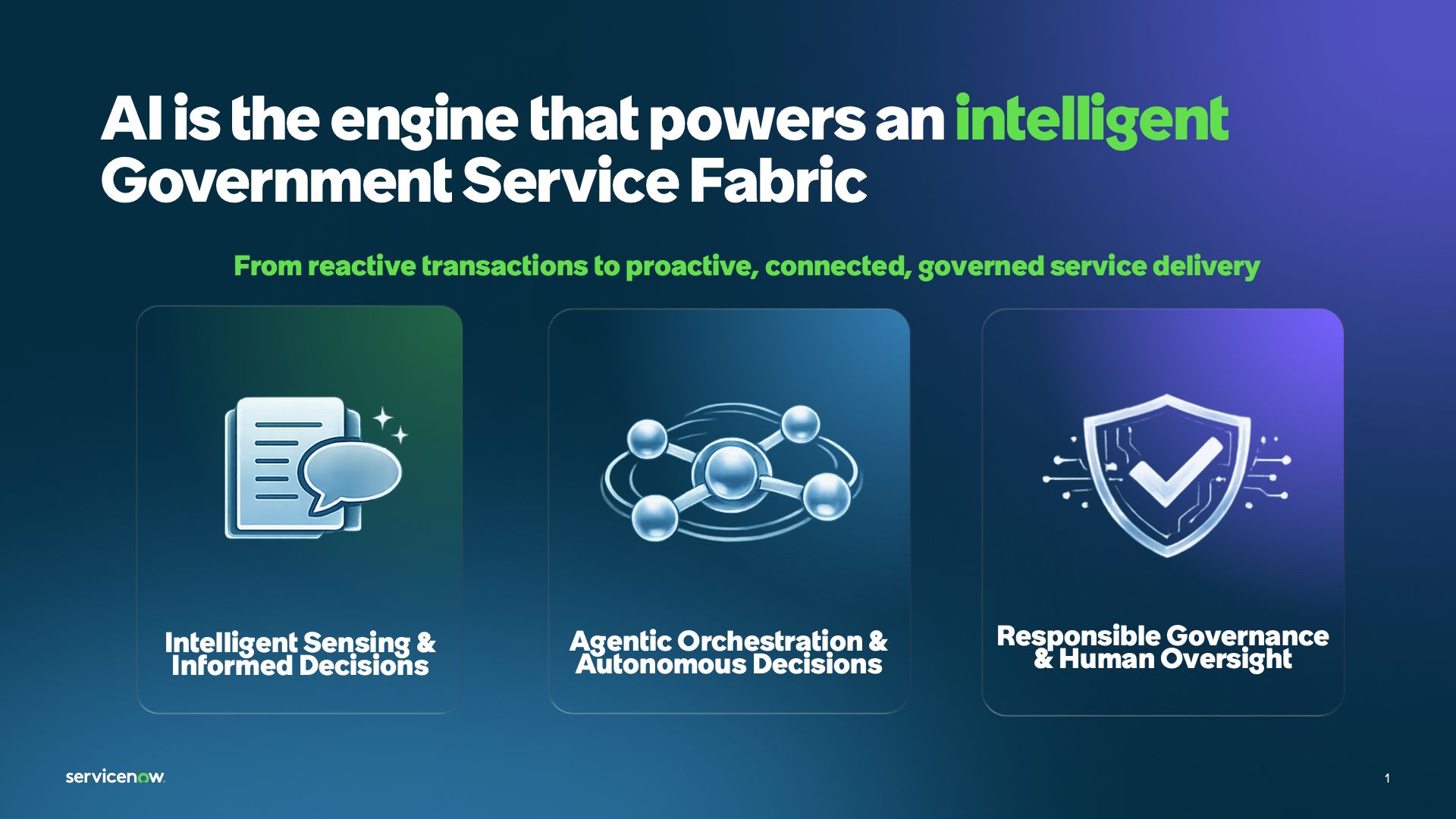
Tan proposed the concept of a “Government Service Fabric”, a middleware that acts as the connecting tissues between different systems, processes, and people, to bridge digital silos.
The ambition is not just efficiency. It is a shift from reactive case management, where the ultimate goal of this architecture was to transition from a reactive posture to a proactive one.
Tan emphasised that the true value lay in providing civil servants with comprehensive situational awareness across agencies.
Instead of seeing only their own slice of a case, officers would see a unified operational view, which includes every action tracked, every handoff visible, before they intervene.
What this looks like for a citizen in crisis
Consider “William”, a father who had lost his job and faced eviction.
Under the current model, he would need to navigate multiple agency websites, fill in overlapping forms, and wait for each department to process his case independently. Under an orchestrated model, the experience looks radically different.
-1776825668309.jpg)
In a demonstration by ServiceNow’s Advisory Solution Consultant, Priyanka Jadhav, William instead engaged in a natural language conversation with an AI agent that gathered his ID, location, and housing requirements to build a case in the background.
The case officer then received a triaged dashboard on her backend where AI had already scored and prioritised William’s application based on urgency and budget availability.
The officer was left to review the recommendation and approve, rather than assemble the case from scratch.
Jadhav provided another simulation focused on cross-agency collaboration during emergency situations, where the implications are sharper.
For a citizen who has lost their home, pets, and identification, the traditional route requires contacting the police, land authorities, and animal shelters separately.
Jadhav illustrated how an agentic workflow could orchestrate these tasks in parallel: scanning databases from pet shelters for a potential match, booking appointments for replacement passports and driver’s licences across different agencies, and updating every department's case file simultaneously.
These are simulated scenarios, not live deployments. But they illustrate a fundamental design shift: instead of asking citizens to coordinate the government, the government coordinates itself.
The governance question no one can skip
When an AI layer triages a citizen's case, scores their urgency, and routes them across agencies, the question of accountability becomes harder, not easier.
Who is liable when the system deprioritises a genuinely urgent case? Which agency owns a decision that was made by an orchestration layer sitting above all of them?

That is why as government workflows became more deeply embedded with AI, risk management must become equally automated.
Crucially, the system maintained a "human-in-the-loop" philosophy.
In the demonstrated workflow, AI surfaces suggested risks by scanning internal and external libraries, but no risk is created without explicit approval from the responsible team.
"All the suggestions are sort of an intermediate phase beyond which you need to perform a review and then approve or create relevant risk," Jadhav added.
To address data residency and security concerns, Tan highlighted that ServiceNow’s AI services and data residency on its platform reside locally in Singapore.
The real opportunity, Tan argued, is not in any single agency's workflow. It is in the seams between them. This means the handoffs, the gaps, the moments where citizens fall out of one system and into another.
Singapore has proven that digitisation at scale is possible.
The next test is whether orchestration at scale is governable and whether the political will exists to rewire agencies around the citizen's journey rather than their own org charts.