Aziza Umarova, Head of Delivery Unit, Agency for Strategic Development and Reforms under President of the Republic of Uzbekistan
Oleh James Yau
Meet the Women in GovTech 2025.
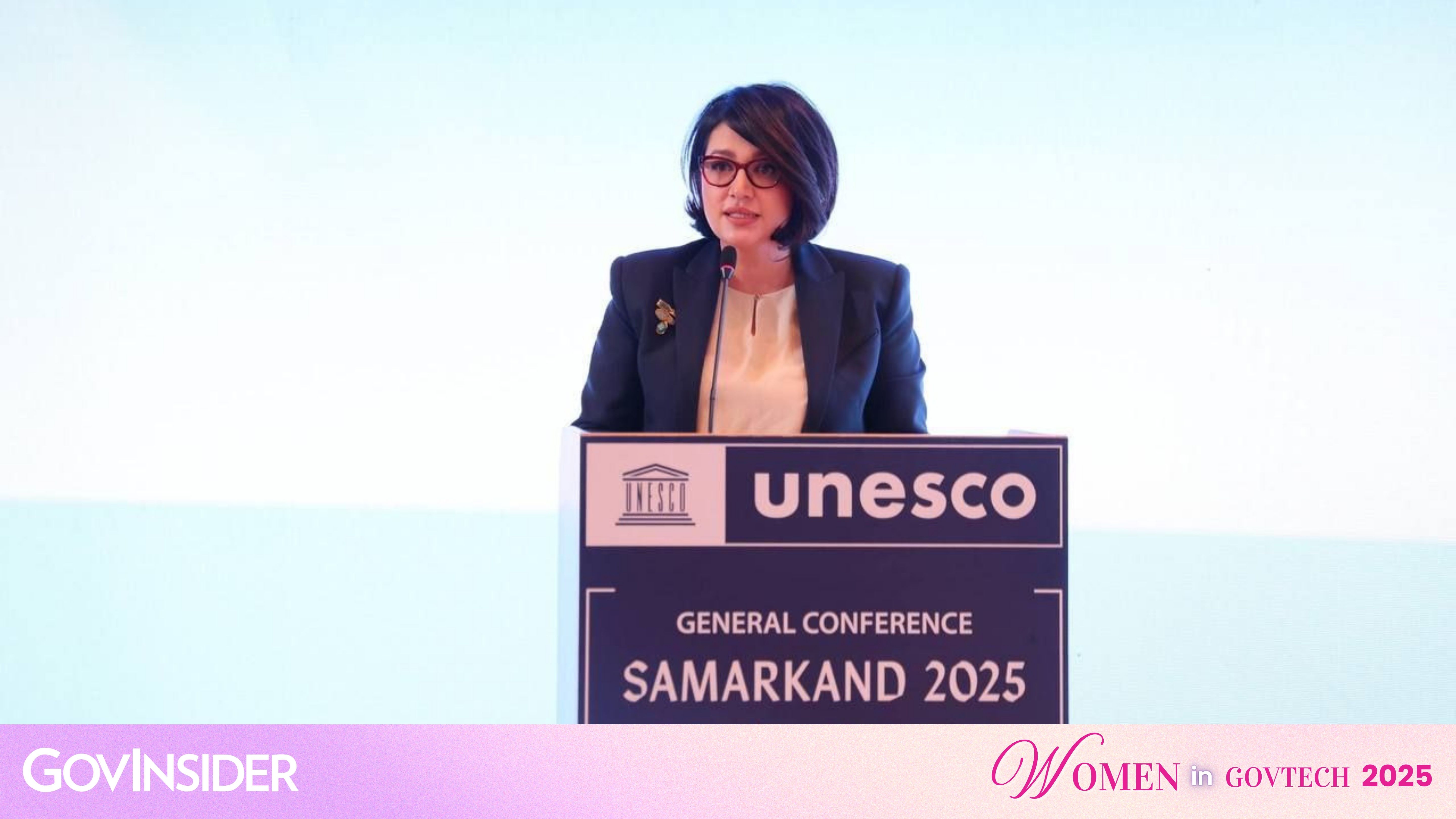
Aziza Umarova, Head of Delivery Unit, Agency for Strategic Development and Reforms under President of the Republic of Uzbekistan, shares about her journey. Image: Aziza Umarova
1) How do you use your role to ensure that technology and policy are truly inclusive?
For years, lack of reliable data was a major barrier - so we decided to turn the table. Instead of waiting for data, we collected it ourselves, validated it with citizens, and put it in front of policymakers.
We built an open-source, in-house geoportal platform that sparked a major shift across government toward data-driven decision-making.
This year, we gathered detailed, village-level information on schools, clinics, water access, and public services. Once every community is mapped and visible, silent inequalities can no longer be ignored. We made an entire Geoportal for Social Infrastructure with internally developed analytical tools.
My role is to ensure these insights turn into policy – so resources go to the most vulnerable, not just the most visible.
In the Delivery Unit, we design reforms with the principle “no data, no policy” at the core. For us, inclusivity starts with understanding reality on the ground.
2) What’s a moment in your career when you saw firsthand how technology or a new policy changed a citizen’s life for the better?
During the Mapathon in 2023, 150 students mapped all social facilities in 550 streets in two days.
A school principal later told us that for years their lack of water supply was invisible to decision-makers. Once the geoportal highlighted their situation, the situation became visible. That moment reaffirmed that when people are seen in data, their needs become actionable.
The second national mapathon in November 2025 - where 300 students helped construct a digital twin of an entire district - demonstrated the value of distributed knowledge production and citizen-supported data collection (Chandler Institute, 2025).
By promoting an open-data ethos, platform is visible to citizens through open access. This reorientation enabled the systematic collection of primary, ground-level data, together with built-in mechanisms for verification and validation from citizens, thereby strengthening the reliability of policy diagnostics.
This approach not only broadened analytical capacity but also demonstrated the practical value of making location-based tools widely accessible.
Its scenario-modelling functions allow policymakers to test alternative policy inputs and evaluate their projected implications for sectoral outcomes or territorial development trajectories.
In combining technical innovation, institutional integration, and participatory knowledge production, the Uzbekistan case offers a rare example of how location intelligence can be democratised and operationalised to strengthen strategic planning, accelerate implementation, and enhance the transparency of public action.
3) What was the most impactful project you worked on this year, and how did you measure its success in building trust and serving the needs of the public?
The geoportal for social infrastructure was our most transformative project. We measured success not by the technology itself but by how it changed state behaviour:
-
We began to use evidence instead of anecdotes.
-
Resource allocation for schools and clinics shifted toward areas with the biggest gaps.
-
Citizens and students contributed to data collection—creating trust through participation.
Success for us means when a policymaker stops saying “I think” and starts saying “The data shows…”
4) What was one unexpected lesson you learned this year about designing for real people? This can be about a specific project or a broader lesson about your work.
People don’t want “innovation.” They want problems solved.
In one district, citizens didn’t care about dashboards; they asked for clean toilets at schools.
It reminded me that technology should stay invisible - quietly enabling practical change - while the real focus stays on human dignity.
A) Water-sector diagnostics and public value creation
The Delivery Unit’s first major test was a water-access mapping pilot.
A maphathon with 120 students produced a full household-level dataset for an 8,000-household district, revealing major gaps compared to official statistics and confirming concerns raised by the World Bank and UNICEF/WHO WASH data.
The findings showed much lower access, poor water quality, and entire communities without infrastructure - exposing the limits of district-level reporting and proving the need for granular, verifiable data.
The water utility later endorsed the approach, enabling plans for national scale-up.
B) WASH in Schools: corrective program action
A nationwide assessment using a 55-item survey and geospatial mapping uncovered severe underreporting of school WASH conditions: only 12 per cent of schools were connected to sewage and 53 per cent to centralised drinking water - far below figures cited by local authorities and partners.
Using this evidence, the Delivery Unit and the Ministry of Economy and Finance co-designed targeted investment programmes, now backed by ~1 trillion soums in annual capital allocations and pilots of alternative technologies in rural areas.
This demonstrates how diagnostics were rapidly translated into policy adjustments and resource commitments.
5) We hear a lot about AI. What's a practical example of how AI can be used to make government services more inclusive and trustworthy?
AI can help governments shift from reactive to proactive care.
Imagine a system that automatically flags schools at risk of sanitation issues based on geoportal data, climate patterns, and past maintenance records. Instead of waiting for complaints, the state can act early.
AI is most inclusive when it helps the government anticipate people’s needs, especially in remote areas where voices are rarely heard.
We apply AI-driven methods in geospatial analytics, including GeoAI clustering - ML based spatial clustering to identify areas with high infrastructure pressure or gaps in service coverage; AI-powered assessment of infrastructure conditions automated recognition of defects in photos and videos, such as cracks, deformations, and leaks; Infrastructure Health Index (IHI+), a composite metric that integrates BIM attributes with GIS layers (location, environmental risks) to automatically rank maintenance and repair priorities; and predictive modeling of infrastructure dynamics - forecasting changes in population density, utility loads, and future infrastructure demand.
To subscribe to the GovInsider bulletin, click here.
6) How are you preparing for the next wave of change in the public sector? What new skill, approach, or technology are you most excited to explore in the coming year?
We are investing in capacities: data literacy, anticipatory governance, and rapid experiment cycles.
Personally, I am excited about participatory sensing - citizens collecting micro-data using simple tools and feeding it into national systems. It expands the state’s eyes and strengthens democratic accountability without political confrontation.
Our system incorporates multi-temporal satellite-derived indicators, including land-use classifications, land-cover change, urban expansion metrics, and vegetation indices (NDVI), alongside environmental and water-resource datasets such as wells, geological parameters, and digital elevation models.
The integration of population statistics, socio-economic indicators, and administrative registries further strengthens the analytical value of the ecosystem, allowing complex linkages between demographic dynamics, infrastructure provision, and spatial inequalities.
The platform supports three levels of control - interagency cross-checking, community-based data validation, and compliance assessments against quality standards, thus embedding evidence-based accountability into implementation processes.
7) What advice do you have for public sector innovators who want to build a career focused on serving all citizens?
Three principles:
-
Believe in open source and build your national capacities to innovate.
-
Prototype small, scale fast. Don’t wait for perfection.
-
Build coalitions, not presentations. Impact comes from alliances across ministries, youth, and local communities.
8) Who inspires you to build a more inclusive and trustworthy public sector?
I am inspired by the young people who join our mapathons and data challenges.
They don’t have titles or formal authority, yet their energy and honesty often move the system more than official meetings. They remind me why inclusion is not a slogan - it’s a source of national strength.
9) If you had an unlimited budget, what would your dream project be?
A real-time social infrastructure observatory for the entire country: Satellite, drone, and community-generated data with integrated with water, education, health, and transport systems and public-facing dashboards that anyone, from a minister to a mother, can access.
This would make inequality visible in real time, and ensure that policy is always anchored in truth.
10) Outside tech, what excites you the most?
Women’s empowerment.
GovTech is still a space largely dominated by men, but women bring a fundamentally different lens - one rooted in inclusion, social impact, and the lived realities of communities.
What excites me is how women can transform how governments design and deliver services: making systems more humane, more equitable, and more responsive to those who are often overlooked.
Empowering women in this field doesn’t just diversify the tech ecosystem; it changes the very outcomes of public policy.