-1783304403050.jpg)
Civic tech fills data gap, making Nigeria’s informal workers visible to the state
Oleh Si Ying Thian
The Waste Pickers Association of Nigeria (WAPAN) has built a digital registry for the country's informal waste pickers, and provided the government a live dashboard to support policy decisions for a long-overlooked workforce.
-1777447414283.jpg)
Governments cannot plan for a workforce they cannot count or verify. So, this non-profit organisation built up the numbers through a civic tech initiative. Image: Canva
What does it take for a government to see the communities it has long overlooked?
For Nigeria’s informal waste pickers, the answer isn’t in a protest or policy paper; its data.
The Waste Pickers Association of Nigeria (WAPAN) understands that governments cannot plan for a workforce that they cannot count or verify. So, they built up the numbers.
Last year, the non-profit organisation piloted the Waste Picker Digitalisation and Trust Initiative (WaPDiT), building a digital infrastructure around an ecosystem of waste pickers, local communities, waste banks, recyclers, government agencies and more.

Speaking to GovInsider, WAPAN’s Director of Communications and Strategic Partnerships, Aliyu Auwal, says: “Waste pickers were invisible both socially and within data systems”.
The initiative, which hopes to change that, provides waste pickers with QR-coded smart IDs that can be tracked through their collection routes, and connects them to digital payment systems.
This data is fed into a live dashboard shared directly with local government agencies and other stakeholders involved in the compensation for these workers.
According to Auwal, this is helping WAPAN gather “credible data” to seek compensation for waste pickers under Nigeria’s Extended Producer Responsibility (EPR) framework.
This framework mandates producers to take financial responsibility for the product lifecycles, including at the waste stage.
Although the framework has been in place since 2014, the workers for whom it has been designed to benefit still cannot access its incentives after more than a decade, he says.
Auwal notes that while the intent is there, the policy falls flat because the data tracking that is required for its implementation never existed.
While the tech is an enabler, trust and adoption have been built through co-creation with stakeholders.
Currently, the WaPDiT initiative has registered more than 600 waste pickers and six waste banks in Kano state, recovering about 67,000 kg of plastics monthly.
Both state and federal-level agencies are using the dashboard to inform their policy decisions, including the refuse management board (REMASAB) and environmental regulations agency (NESREA) - both of which report to the Federal Ministry of Environment.
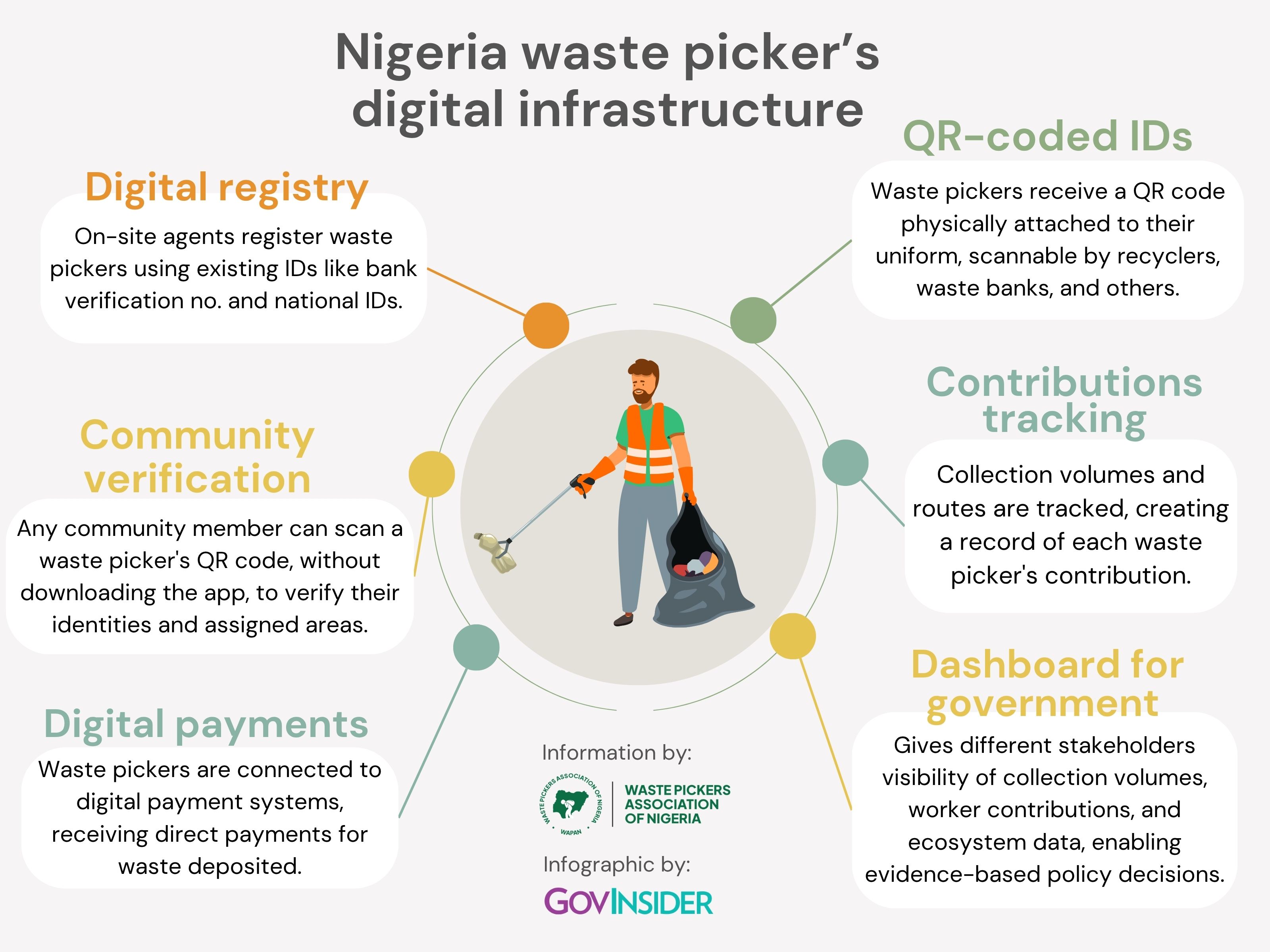
While government agencies use it for planning and decision making, recyclers use it to track monthly collection volumes while producer responsibility organisations (PROs) use it to verify the contributions of waste pickers, he says
More than just a digitalisation story, the initiative offers lessons on what bottom-up movements look like when they work alongside government rather than around it.
The initiative has also seen WAPAN clinch one of the three Jury Favourites Awards at the Creative Bureaucracy Festival (CBF)’s project showcase.
Tech building trust, and vice-versa
Local communities often view waste pickers with suspicion due to their informality, while waste pickers themselves feel excluded from formal society, says Auwal.
This mutual distrust presents a challenge to get both parties to actively engage with each other, he adds.
To bridge this gap, WAPAN is using its digital infrastructure, comprising a mobile app and a dashboard.
The mobile app allows any community member to instantly verify a waste picker’s identity and designated working area by simply scanning the unique QR-coded IDs on the waste picker’s uniform.
If a registered waste picker is found operating outside their designated area, community members can report this through the app as well.
To incentivise waste pickers to become formalised, “the system keeps a record of the data of what they’ve deposited [at waste banks] to facilitate the EPR benefit for the waste picker,” says Auwal.
For Auwal, tech is never the hardest part.
“Trust is what enables participation. Without it, digitalisation alone will fail,” he says, underlining the importance of rebuilding that trust between waste pickers, their communities and formal institutions to adopt the systems.
A shared problem needs a shared room
Auwal is candid about what has changed. The shift from simply presenting a diagnosis to troubleshooting together is what gives the WaPDiT initiative its best chance of being adopted and sustained, he notes.
He talks about WAPAN’s participation in the Red Innovación Local (RIL), which has given WAPAN the opportunity to exchange ideas with peers from abroad and develop creative approaches to engage governments.
RIL is a non-profit civil association based in Latin America which empowers local governments by strengthening their management skills.
“We learnt more on how to work with the government sector, which we were previously not aware of,” he says.
He candidly shares that before the interaction with RIL, WAPAN would essentially show up with a diagnosis and hope the government would act on it.

Over time, he realises that while everyone agrees on the problem, the real difficulty is implementing a solution acceptable to all and integrating it within government bureaucracy.
Calling it the “change network” model, Auwal explains that it is a structured approach to stakeholder engagement to involve all relevant parties to come together regularly to identify gaps, review progress and co-create solutions.
“It helps in bringing this solution to life, than just working on our own and pointing out the problem,” he notes.
About a month ago, WAPAN and REMASAB jointly presented the initiative’s progress in Kenya, highlighting the impact of civil society-government partnership to build inclusive waste management systems.
Meet users where they are at
Instead of expecting waste pickers to adapt to tech, WAPAN designed the whole system around the realities of their users, specifically their locations, skills, and constraints.
First, instead of getting waste pickers to go to an office, registration agents go where they actually work, which is at dump sites.
Cluster heads (who manage the designated working area) will approve new registrations, while orientation officers will deliver awareness training on-site.
Secondly, waste pickers don’t need a smart phone or possess digital skills to enrol in this initiative. The “interface” for waste pickers is physical, where the QR-coded IDs are attached to their uniforms once they are registered.
“The waste picker doesn’t need any tech knowledge to register himself. He only needs the awareness of the importance of what he is getting himself into,” Auwal explains.
Other stakeholders like the local communities, waste banks, and recyclers will scan the QR-coded IDs on the waste pickers.
Thirdly, the initiative uses existing IDs and structures that waste pickers are familiar with, instead of creating new paperwork.
Waste pickers register by using their bank verification number (BVN) and national identification number (NIN), which is pulled through an application programming interface (API). A photo is also taken during registration for verification.
WAPAN expects to scale from 600 to 10,000 waste pickers across Nigeria and expand into financial inclusion, he says.
Auwal underlines the importance of baking dignity in digital systems.
Be it policy or tech, a well-intended initiative is only as good as its user buy-in.
Instead of designing only for the most convenient users, the takeaway for governments to ensure an initiative lands well, is designing it around familiarities and needs of marginalised users.