-1783304403050.jpg)
Dr Nicholas Chew, Associate Consultant, Department of Cardiology, National University Heart Centre, Singapore (NUHCS)
Oleh Amit Roy Choudhury
Meet the young public sector officials in the inaugural Young & Official Report 2026.
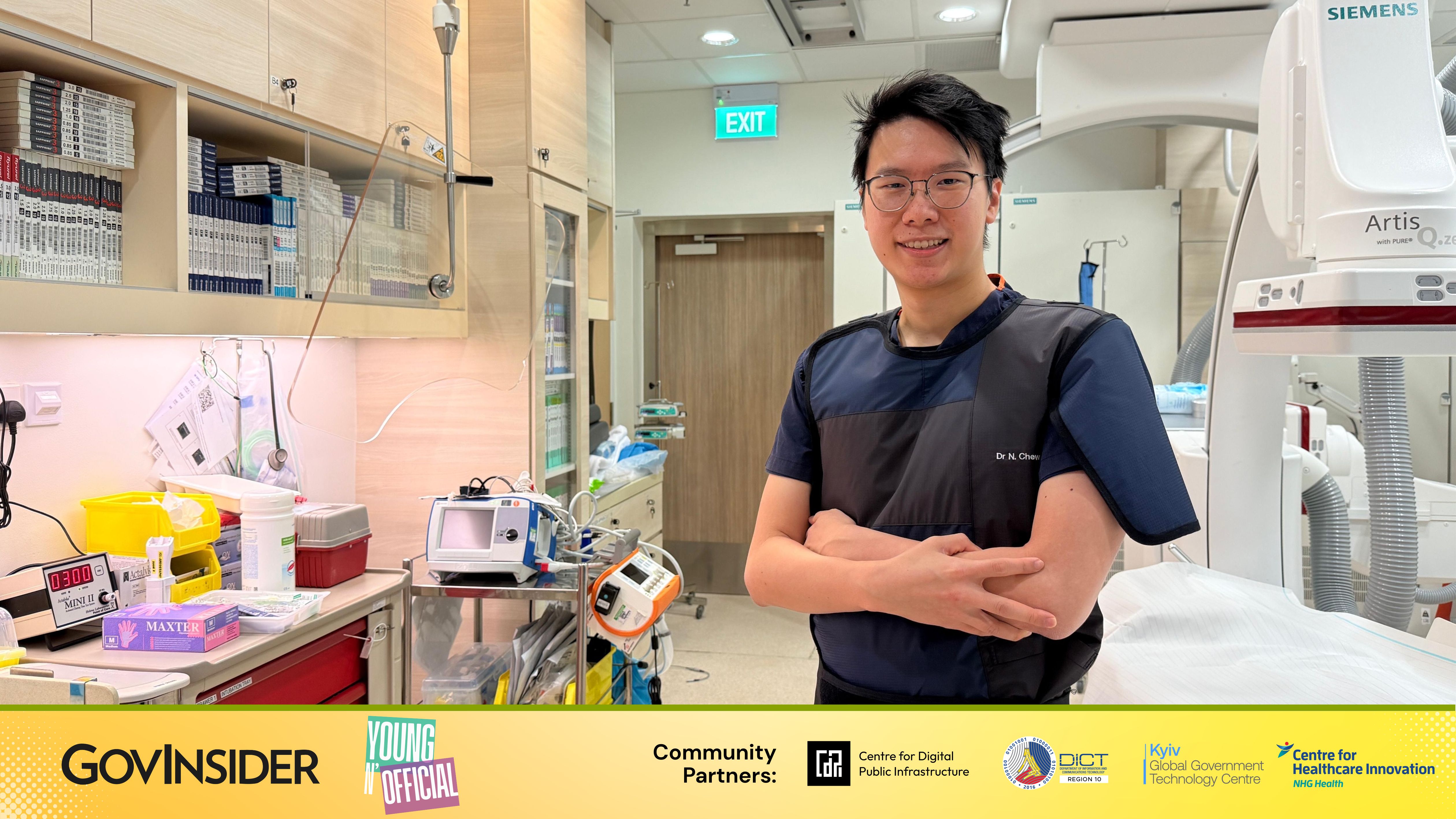
Dr Nicholas Chew, Associate Consultant, Department of Cardiology, National University Heart Centre, Singapore (NUHCS). Image: NUHS
1) What does public service mean to you? Can you share more about your role in the public sector?
Public service, to me, is the quiet privilege of being entrusted with someone's health at their most vulnerable. It also involves the wider responsibility of ensuring that the health systems we build today serve patients we may never meet.
As a cardiologist at the National University Heart Centre, my role spans from the catheterisation lab to the research lab. On any given day, I may be performing invasive percutaneous coronary intervention on a patient with a heart attack, managing patients in the ward, mentoring medical students at Yong Loo Lin School of Medicine, National University of Singapore, or working on research that seeks to understand why heart attacks are affecting our Singapore population at a younger age.
The public healthcare system provided me with my training, and continuing to serve within it is a future worth investing in. What keeps me grounded is the understanding that every clinical guideline we refine, every research finding we translate, and every student we inspire has the potential to ripple outward, far beyond the walls of any single hospital.
2) Tell us about a project you championed. What impact did it have on the community?
One project I am particularly passionate about is our work on heart attacks in seemingly healthy and young individuals.
We demonstrated that approximately one in 10 patients presenting with a heart attack in Singapore do not carry any traditional cardiovascular risk factors: they do not have high blood pressure, high cholesterol, or diabetes, and they are non-smokers.
This finding challenged the common assumption that heart attacks only happen to those with obvious risk profiles and brought public attention to a vulnerable group that often falls outside conventional screening pathways.
Building on this, we have expanded our research to examine early warning signs of cardiovascular disease that manifest across other organs - including the liver and the kidneys - before a heart attack occurs.
The goal is to equip clinicians with the tools to detect cardiovascular risk earlier, through signals that are already present but not yet routinely looked for, and to intervene with preventive treatment before the first cardiac event rather than after it.
3) As a young professional, how has your unique background or perspective allowed you to identify a solution that others in your organisation might have overlooked?
I would not describe my background as particularly unique. I came through the same training pathway as most of my peers, and I do not think the solutions I have pursued required a special vantage point.
Cardiology, by tradition, is organ-centric; we focus on the heart. But early in my career, opportunities arose to engage with research that sat at the intersection of cardiovascular disease, liver disease, and metabolic health, and I chose to follow that thread.
That decision led me to recognise something that was hiding in plain sight, that many of our cardiac patients carried a burden of early liver and/or kidney dysfunction that no one had routinely assessed, simply because it was not considered the cardiologist's domain.
The solution was to integrate what was already known across disciplines but had not yet been connected in routine clinical practice.
4) What is your personal strategy for maintaining your creative energy when faced with bureaucracy?
I remind myself that bureaucracy is not the enemy of progress; rather, it is the friction that ensures progress is durable.
However, this friction can be exhausting. Spending time away from work and prioritising my family replenishes me in ways that no professional achievement can. The most creative ideas are often conceived outside of the hospital!
Mentoring younger colleagues and students is also remarkably restorative. Their questions are unfiltered by institutional fatigue, and their enthusiasm is a reminder of why any of us entered medicine in the first place.
And then there are the patients. When we see someone walk out of the hospital door in better health, it renews a sense of calling that no amount of administrative burden can extinguish.
That moment is the clearest reminder that the work is not about us - it is about them. And it drives us to think more creatively, to work more efficiently within the system, and to keep pushing for better ways to serve.
Most importantly, I rely on my faith to provide meaning in what I do. It reframes bureaucracy not as an obstacle to endure, but as part of the discipline of serving faithfully in the place where I have been planted. That perspective does not eliminate the exhaustion, but it anchors it to something that will not shift despite the challenges.
5) If you had just one area to invest in to accelerate transformation in the public sector, which one would you choose and why?
I will choose to invest in talent. Technology can be procured, and regulations can be reformed, but the people who have the right mentality and drive – who ask the right questions, find solutions in impossible situations, and have the resilience to champion change within complex systems – are rare and irreplaceable.
In public healthcare and academic medicine, we risk losing our brightest young clinician-scientists not because they lack commitment to public service, but because we sometimes fail to give them the protected time, mentorship, and career pathways they need to thrive.
Too often, institutional academic goals can be short-sighted, prioritising metrics and key performance indicators over the development of the very people who generate them.
When success is defined narrowly by output rather than broadly by growth, we inadvertently cultivate a culture of survival rather than one of flourishing – and it is in such environments that the most promising talent is quietly lost.
I would urge academic institutions to take a longer view, to invest in clinician-scientist programmes, structured mentorship, and meaningful early-career autonomy, even when the return appears modest in the short-term.
A well-supported young doctor who is given the freedom to pursue a research question today, without the anxiety of whether their work will land in a top-tier journal, could reshape national clinical guidelines a decade from now. The transformation we seek should be of a human endeavour, not merely an exercise in paper achievements. Our future will only move as fast as the people we choose to invest in.
6) What is your greatest ambition as you grow in your public service career?
Early in one's career, it is natural to dream in terms of impact - reshaping guidelines, building programmes, advancing the field of medicine. But my ambition is simply to be faithful in the work that is in front of me.
I want to help build a healthcare system that treats the patient better, where cardiovascular, kidney, liver, and metabolic care are integrated rather than siloed. I want to see the evidence we have assembled for the cardiovascular-kidney-liver-metabolic framework translated into routine clinical practice across Singapore.
And I want to nurture a generation of younger clinician-scientists who will carry this work further than I can and do it better.
Beneath all of that, my deepest ambition is to finish well – to look back one day and know that the work was done with integrity, that the people I worked alongside were treated well, and that I did not sacrifice the things that matter most in the pursuit of fleeting gains.
7) What is a "universal value" that connects everyone in your department — from interns to directors — and how do you use that to drive collaboration?
The patient in front of us is someone's parent, someone's child, someone's reason to come home. That truth sounds simple, but I think it is the most powerful unifying force we have – if we let it be.
In the busyness of academic medicine, it can be easy for all of us to drift toward the pressures closest at hand — the next paper, the next grant, the next appraisal — and to lose sight, even momentarily, of the person at the centre of why we do what we do.
When the desire to serve our patients is what connects us, collaboration within the department becomes something that happens naturally — born out of shared purpose rather than obligation.
And that collaboration should be welcomed across all ranks, from medical students to senior consultants. I have found that the best ideas often come not from the most senior people in the room, but from our younger colleagues, whose thinking is unburdened by convention and whose proximity to the patient's experience can reveal what the rest of us have grown too familiar to see.
8) What is the best piece of advice you have got for the next generation of public servants?
In an era of instant gratification, building the fundamentals is essential. This often involves work that is unglamorous and seemingly unrewarded – for example, staying late to help a colleague on the ward, volunteering to clean up a dataset, or troubleshooting an analysis that is not your own.
These small acts of service build trust, sharpen your skills, and keep you connected to the reason you entered medicine in the first place. Importantly, these fundamentals cannot be replaced by cutting corners or by an overreliance on artificial intelligence (AI).
There is no substitute for having done the work yourself, and it is that firsthand understanding that will equip you to lead a team credibly in the future. The recognition will come, but only if the foundation has been built properly. And when it does come, hold it lightly.
9) What is a myth you wish to debunk about young public servants?
That we are a "strawberry generation". The narrative is familiar: life is not as hard as it used to be, we take things for granted, and we quit when the going gets tough. I think this misreads our generation entirely.
The young clinician-scientists I work alongside are not less resilient – they are differently resilient.
They navigate training environments that are more demanding and more scrutinised than ever before, contend with clinical documentation that has become more legalistic and laborious, and manage research demands that have intensified with the publish-or-perish culture. They do so while being more open about the mental and emotional cost of the work – this openness is not fragility; rather, it is honesty. This takes its own form of courage.
Yes, there has been a generational shift toward maintaining boundaries and spending time outside of the hospital. But I would argue that this is not a retreat from commitment – it is a more sustainable expression of it.
A doctor who protects time for family and rest is not less dedicated to their patients; they are more likely to still be serving those patients with compassion and clarity for the years to come. While the previous generation’s resilience was forged in endurance, the new generation’s is forged in the willingness to build something that lasts without losing oneself in the process. In my opinion, both deserve respect.
10) A letter to my future self in 2035
Dear Nicholas,
You’re forty-five now. I hope you still see public service as a privilege. I trust that you still enjoy treating patients and have not become distracted by accolades and legacy-building.
More importantly, I hope you are spending more time outside of the hospital.
Please, take more leave.
Nicholas