Estonia exercises sovereignty in its ministry-led AI movement for schools
Oleh Si Ying Thian
AI Leap Foundation’s CEO Ivo Visak shares how the country is moving beyond a market-led approach, collaborating with researchers and tech companies to define how AI is used for local education needs.
-1775641602664.jpg)
Teacher turned Principal and now CEO, Ivo Visak heads the AI Leap Foundation (TI-Hüpe), an Estonian educational innovation program to integrate AI into the national curriculum. Image: e-Estonia
“It’s like building a plane while it’s flying,” admits Ivo Visak, CEO, AI Leap Foundation (TI-Hüpe).
He is describing the ambitious, large-scale rollout of the AI Leap app, a specialised learning tool that has now reached nearly all the 154 upper secondary schools in Estonia, with plans to expand to other academic levels.
The app uses ChatGPT Edu as its underlying technology, and has been tailored for Estonian schools by a team comprising the country’s Ministry of Education and Research (MER), local university researchers, and OpenAI.
Instead of standalone pilots, AI Leap appears to be among the one of the world’s first Ministry-led initiatives to systemically integrate AI in the national curriculum.
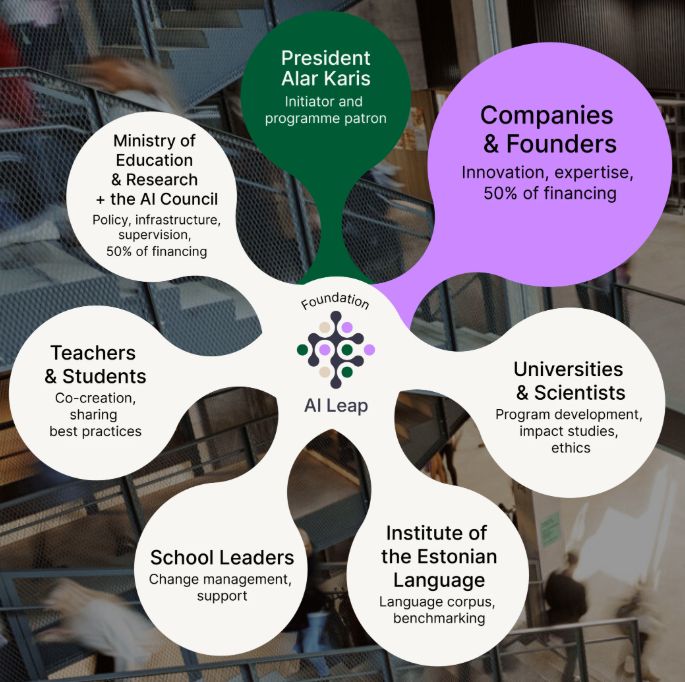
Based on a March 9 article published on AI Leap’s website, approximately 20,000 students studying in grades 10 and 11 and about 4,900 teachers are participating in the programme.
Visak shares with GovInsider that upper secondary schools have been chosen for the pilot year given the flexibility of their curriculum, which allows the AI Leap team to test and iterate on the programme much faster than they could in more rigid environments.
With few international role models to follow and existing studies to learn from, Estonia effectively serves as its own lab, simultaneously implementing the app while developing metrics and research to measure impact as it scales.
“We got to start steering [the artificial intelligence (AI) movement] ourselves. Or otherwise, it’s the market and the private companies that does it,” he explains.
This means taking a proactive approach to partnering with private tech partners, not only OpenAI but also Google among others, to define and align AI usage with the nation’s educational goals and safety requirements.
Visak shares more about the lessons learnt since last September’s rollout, and how it works with Big Tech to localise the learning tool for student’s needs.
Sovereignty cannot be an afterthought
With only one million Estonian speakers and a linguistic landscape vastly different from the rest of Europe, Estonia presents a unique challenge for localised AI support, Visak acknowledges.
To solve this, AI Leap leverages the power of global, frontier models like OpenAI’s ChatGPT and Google’s Gemini, while partnering with the Estonian Language Institute to refine their performance and cultural accuracy.
New York Times previously reported that researchers at the University of Tartu worked with OpenAI to modify the app to ensure that it acts as a Socratic tutor that prompts students with questions rather than simply providing answers.
Another observation that Visak makes is that students tend to use AI tools like “diaries”, mixing school work with personal topics.
This behavior makes localised safety guardrails essential. For example, rather than generic advice like "call 911," the AI needs to be calibrated to provide locally relevant resources, such as the 112 emergency line and local youth support services, he says.
“We want to make sure that these under 18 safety regulations have very clear, localised versions. This is something that we’re pushing our partners to really think about when we talk about some very hard topics,” he explains.
Rejecting the surveillance model of AI
On whether student’s chatlogs can be accessed and flagged to authorities, Visak likens AI chat data to genetic data, where both are treated with a high level of protection.
According to him, the government recently implemented a law that categorises a student’s interaction with AI as private correspondence.
This means that even if there are concerning statements raised by students, the chat history remains classified as private correspondence and cannot be viewed by teachers without the students’ explicit consent.
He also shares that all data movements are restricted to Europe, adhering to the region’s data privacy regulations and the AI Act.
The project remains under “more rigorous laws” and “kept a very close eye on” by Estonia’s national data protection agency and other regulators, he adds.
Noting a "bigger philosophical debate" that is emerging over whether this data can be ethically utilised for educational research, Visak emphasises that the government is moving carefully to ensure that pursuing innovation doesn’t come at the expense of the student's privacy.
Lessons learnt to land the ‘plane’
1. Continuous iteration based on user’s feedback
One of the key lessons goes back to Visak’s quote at the start of the story, which is adapting and iterating continuously as it implements.
Supported by an in-house R&D team, AI Leap maintains its technical agility to refine system instructions and platform behaviour based on user’s feedback.
This feedback loop also allows the initiative to develop more specialised training programmes for school leadership.
Visak highlights plans in to implement in May that will introduce “vibe coding” training to empower teachers to build tools for their specific classroom needs, and provide a platform to showcase these solutions to principals.
2. See the big picture while managing ideological tensions
Working on user’s feedback, especially around implementing AI in schools, is also about managing a minefield of ideological tensions.
Feedback is often split between two extremes: those who want to automate teaching entirely and those who ask for an outright ban.
Recognising the valid concerns on both sides, Visak notes that banning is simply not an option in a world where AI is easily accessible.
The pragmatic way forward is prioritising the safe and effective integration of the technology in the educational framework.
3. Cultural change matters more than one-off training
A successful rollout requires more than just providing free access to tools and hoping for organic interest.
To bridge this gap, AI Leap trained and embedded two lead teachers within every school to facilitate these professional learning communities (PLCs) where teachers master the tech and integrate it into the curriculum.
PLCs are localised support networks that allow other teachers to access help quickly and easily.
He also calls PLCs a “big equaliser”, by ensuring that a teacher's AI proficiency isn’t limited by their individual tech-savviness, but through collective knowledge shared horizontally.
“This peer-to-peer learning method is regarded as one of the best ways to bring about change in the culture, as well as making sure new ways of thinking find grounding in the school.
“Because if you do these top-down trainings, what happens is that the information stays in the teacher’s heads for some time and immediately goes away after the teacher is back in the classroom,” he explains.

AI as a ‘big mirror’ for the education system
For Visak, AI literacy is less about boosting tech adoption and more about redefining what human-centred education looks like in a digital society.
“Good AI literacy is more about navigating a society that’s now completely intertwined with AI and technology – and how to still be an educated and good person in this society,” he says.
Underlining a challenge that he sees more philosophical than technical, he moves the conversation away from using a tool to understanding its
limitations and recognising when a task requires it.
Visak also sees AI holding up a “big mirror”, forcing a fundamental rethink on the purpose of education. He asks: Why does homework still matter when two-thirds of the class can use AI to get the answers?
To push for reform at the very source, Visak says that AI Leap is working with the education ministry, as well as the teacher training institutes at the University of Tartu and University of Tallinn, to overhaul how future teachers are trained for an AI-integrated classroom.
He described the education curriculum as an “ongoing and never-ending update.” Researchers at the University of Tartu is currently embarking on a study to determine the impact of the AI Leap app on students’ development, with the results expected to publish later this year.
Returning to Visak’s quote at the start of the story, the plane is still very much in flight – in the sense that the project is far from finished – but lands on a clear goal for the journey.
Looking ahead, he sees AI Leap as a vital exercise for national adaptation, especially for a small but globally integrated nation like Estonia.
"For Estonia, it's a game of adoption and we have to really understand what we value the most. There are certain things that we can change, and there are certain things that we can't change.
“We shouldn't value tech for the sake of tech. We should only value tech when it's useful for our students,” he concludes.
Editor's note (April 9): The article earlier incorrectly stated that Anthropic was involved in the development of the AI Leap app. This is untrue and the article has been corrected to reflect that.