GovMesh Digest: The Netherlands’ Startup in Residence (SiR) Intergov transforms the government-startup relationship
By Luke Cavanaugh
Challenge-based funding has become the foundation for collaboration between governments and startups, enabling shared risk, faster learning cycles and a realistic path towards follow-up and scaling, says SiR Intergov’s Hessel van Oorschot.
-1770012924436.jpg)
Netherlands' story is one of those featured in the GovMesh Digest special report
Netherlands' story is one of those featured in the GovMesh Digest special report. You can find the other individual stories on the participating governments for GovMesh 3.0 here.
Hessel van Oorschot’s SiR Intergov originated from procurement practice and has evolved into an impact-driven programme focused on public value, learning and scalable implementation.
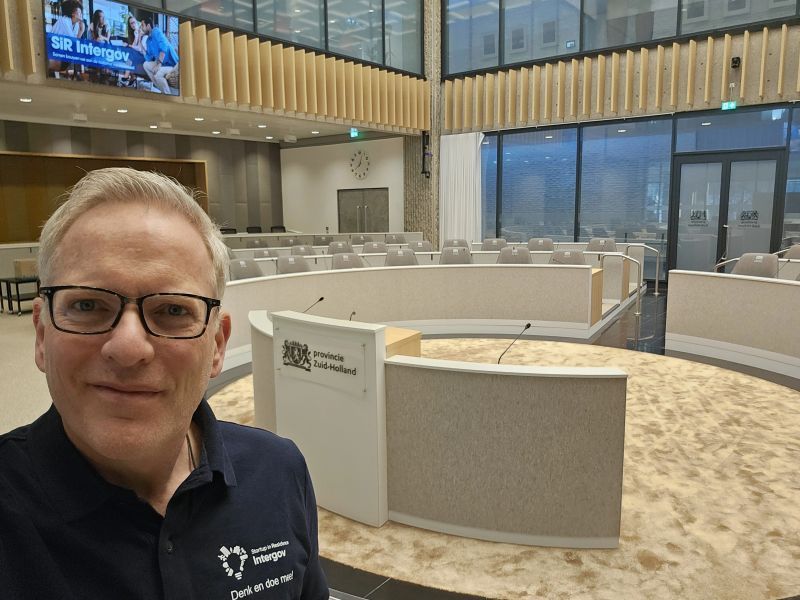
van Oorschot is the Program Manager at SiR Intergov, the Dutch government's pioneering initiative designed to tackle societal challenges through collaboration with startups, scale-ups, and innovative entrepreneurs.
When van Oorschot spoke at GovMesh, it is hot off the back of winning the “Improving Business Environment and Promoting Entrepreneurial spirit” Award at the European Enterprise Promotion Awards in Copenhagen.
The third edition of GovMesh, organised by interweave.gov, is a closed-door roundtable discussion that convenes a small group of governments to discuss selected topics around digital government.
The award recognises initiatives that “promote an entrepreneurial mindset […] and help to embed creativity, confidence and curiosity into communities”.
The recognition was the result of six years of working towards breathing life into the government-startup ecosystem of a country that has famously railed against Big Tech more than most, with the Dutch government moving earlier this year to reduce its dependence on US cloud technology.
SiR Intergov continues to shift the government-startup relationship from supplier-customer to collaborators – an October 2025 press release asks startups whether they “could be the innovation partner the government needs?”.
“Less procedural complexity, more partnership. Fewer assumptions upfront, more learning through practice” summarises the foreword of an innovation playbook recently produced by the Intergov team.
Working with startups and scaleups, said van Oorschot, allows governments to avoid vendor lock-in and develop solutions that are adaptable, testable and scalable within the public context.
“In some cases we deliberately formulate broader challenges to surface blind spots,” he explained, “allowing innovative entrepreneurs to explore systemic issues that are not yet fully articulated within policy or implementation.”
The programme, jointly run by eight local and national government bodies, uses challenge-based funding as a basis for public-private collaboration, with the aim of derisking the entrepreneur’s commitment.
Van Oorschot talked about “procurement with principles”: rather than asking for a predetermined solution, the priority is on ensuring “startups and scaleups can register easily” and “the contract is flexible, but clear about output, collaboration and agreements”.
The Intergov team continues to prove the model at a time of budget and R&D cuts across the Netherlands.
A new sectoral task force is set to cut 22 per cent of budgets at a ministry level, with innovation budgets one of the targets.
“There is a worrying tendency for public organisations to revert to familiar, risk-averse approaches,” said van Oorschot, “rather than investing in new ways of addressing urgent societal challenges.”
A five-step programme for public-private collaboration
The Intergov programme exists in five stages, all centred around “identifying and validating challenges worthwhile to fix”.
In identifying challenges and its participants, van Oorschot prioritises identifying whether they are worth pursuing. “Is this something that your family would think is a real problem?” he likes to ask partners.
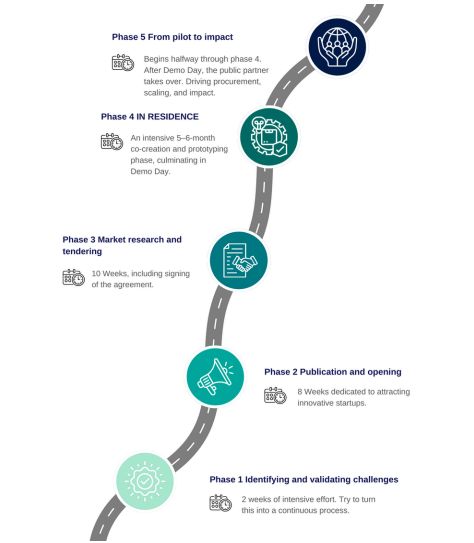
The recent playbook that the Intergov team have published – a “gift to Europe” that outlines the lessons from the SiR Intergov programme – indexes heavily on this part of the process, getting the question right.
This includes extensive market research.
“Sometimes challenges are formulated without sufficient market research,” van Oorschot said.
“In those cases, existing solutions are already available and a Startup in Residence trajectory is not the appropriate instrument.”
“A good challenge cannot be obtained ‘just like that’ through a form”, the Playbook says, giving guidance and criteria for how to develop challenges through existing signals, colleagues, and organisational innovators.
From there, the emphasis shifts to disburdening the innovators as much as possible versus a usual procurement process.
“We reach out to startups and scaleups and say, ‘what we will give you is our problem as clearly as possible so that you understand it”. This is easier said than done.
Intergov expects ministries to condense their problem statement down to just 2-3 pages, versus a norm of more than 20. “The only thing we ask for in return is a draft with startups’ ideas for direction”.
After tendering comes the actual residence programme, typically lasting between 4-6 months. As well as a €25,000 (S$37,476) innovation budget, the startup and government partner to “talk to legal and procurement experts together, run pilots with potential clients, and take part in training and mentoring activities”.
The Intergov programme has seen 170 examples of startups participating to date.
35 per cent of them receive follow-up assignments in government, with van Oorschot pointing out startups’ usual frustrations with innovation processes where pilots end without a success follow-up.
As the playbook puts it, “procurement is not the end point of the programme, but rather a means to scale up”. “We don’t think in terms of standard contracts but start with public value: what needs to be improved structurally and who will benefit from this?”.
These follow-ups can take the form of direct procurement through framework contracts, innovation partnerships, or a consortium formation for implementation in multiple regions.
Van Oorschot and the playbook are both keen to express that Startup in Residence is not just a niche programme, but hopefully the foundation for a new form of public-private collaboration.
“SiR Intergov is not a temporary experiment, but a structural way of working on public innovation”.
As governments across the world wrestle with their innovation budgets, programmes like SiR Intergov might just provide them with an opportunity to reap the rewards of innovation cheaper, and for longer.