Job creation should be a priority for all, says World Bank
At the ATxSummit on May 21, World Bank’s President Ajay Banga spoke on the importance of job creation even amidst the challenges of present developments.
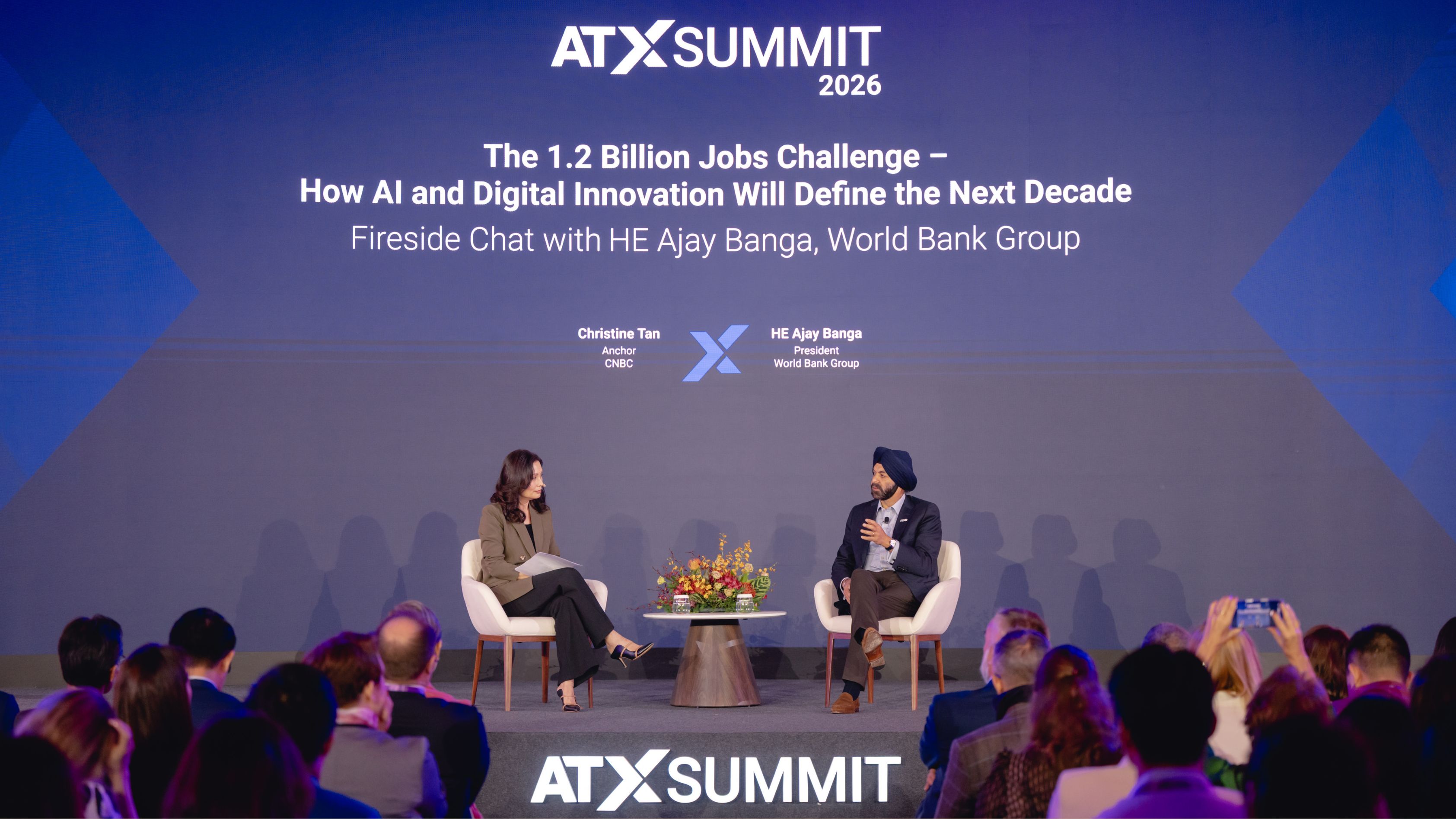
Photo of fireside chat with World Bank's President, Ajay Banga, taken at ATxSummit 2026. Photo: Infocomm Media Development Authority.
Over the next 15 years, an estimated 1.2 billion young people in emerging markets would reach working age.
But current economic projections anticipated the creation of only 400 to 600 million jobs (only 30 per cent).
This demographic surge would become a global opportunity if properly harnessed with adequate training and job creation, according to the World Bank’s President, Ajay Banga.
Conversely, a failure to secure opportunities for this generation risked creating a demographic "ticking time bomb," with widespread hopelessness threatening to trigger severe social unrest and unsustainable waves of illegal migration, he added.
Speaking at a fireside chat titled ‘The 1.2 Billion Jobs Challenge — How AI and Digital Innovation Will Define the Next Decade’ at the recent ATxSummit 2026 organised by the Singapore’s Infocomm Media and Development Authority (IMDA) on May 21, Banga said if this population could be integrated into the economy, Africa could emerge as the next major engine of global economic growth, mirroring Asia's rapid development over the past four decades.
To make this possible, there was a need for a fundamental shift in global development strategies.
Rather than fragmenting resources across isolated initiatives like climate, education, and healthcare, international efforts should focus on job creation as the central pillar of global development, prioritising human dignity and economic stability for the developing world.
Focus should be on basic education
Many leaders in developing countries “talk with great interest about the next university they want to put up but the real priority should be making sure that primary education and secondary education was of high quality” before thinking about elite institutions and advanced degrees, Banga noted.
Without this foundation, most young people would never be prepared for productive work.
The World Bank, said Banga, was working with countries to design “a compact… where we focus on what’s the right thing for your needs for the future of job creation in your country”.
That compact, he added, was anchored in five job‑rich sectors.
They were infrastructure, agriculture for small farmers, primary healthcare, tourism, and value‑added manufacturing and creative industries.
Education, vocational training and skilling systems should be rebuilt around these sectors, rather than around outdated outsourcing models that have created “a great deal of angst and challenges in politics,” he added.
Moving from big to small AI
Banga noted that the best way to use artificial intelligence (AI) in developing countries was to reframe the conversation away from what he calls “big AI” , that is large language models, generative AI and agentic AI to “small AI”, which he framed as applications what solved “daily problems for ordinary people”.
He shared an example of an illiterate woman farmer in Indian state of Uttar Pradesh using an old phone to photograph a diseased leaf; the AI identified the disease and arranged for the right input to be delivered via her cooperative.
She did not need to know the disease name or pronounce the pesticide – the system abstracted that complexity away.
“This is AI configured to meet users where they are, in their language, context and constraints,” he said.
Anchoring AI in basic infrastructure
To succeed in developing countries, AI had to be anchored in basic infrastructure and human development, Banga said.
Even “small AI” required electricity, connectivity, and basic digital infrastructure.
Pointing to the fact that nearly 600 million Africans go without power, he said: “When I hear people talking about how digitisation will change Africa, I start laughing… How do you plan to charge your phone, by connecting it to the sky with your finger? It doesn’t work.”
He added that basic things had to happen first and the best way to use AI would be to embed it in sectors like agriculture and primary healthcare, tie it to real‑world services for the poor, and build it on top of reliable power, water, and governance systems.
Done this way, AI would support dignity, productivity and opportunity, rather than becoming a distant, elite technology conversation disconnected from people’s lives, Banga said.
Banga noted that a crucial requirement was to “fundamentally reorient the educations system away from prestige towards practicality”.
Digital public infrastructure a must
Banga also stressed the importance of creating the full-stack digital public infrastructure (DPI), from digital IDs to online government and financial services along with the human skills required to use them.
Without affordable access and digital literacy, countries cannot build the entrepreneurial ecosystem that rides on this infrastructure, he said.
Education systems needed to embed digital skills and practical problem solving, not just traditional academic content, “so citizens could participate in and build on the digital economy”.
DPI was the rails of the modern state providing digital identity, digital government services and the ability to open a bank account and transact online, Banga said.
He cited Singapore and India as examples where such infrastructure has been built and normalised, in contrast to many developing countries in Africa that still lacked these basic facilities.
Without DPI, citizens cannot reliably identify themselves to the state, access services at scale, or participate fully in the formal financial system, Banga said.
He noted that it was not just about efficiency but also about giving people a fair chance at economic participation and ultimately, dignified work.
Banga added that DPI became an economic force multiplier when it enabled a private‑sector ecosystem to flourish on top of it.
Once governments have created robust digital IDs and platforms, entrepreneurs could build applications and businesses that ride on these rails; Banga noted that a company like Grab could not have succeeded without a strong DPI underneath it.
DPI is central to attracting private capital, scaling digital services, and turning technology into real productivity and employment gains.
It is the bridge between state capability and private innovation—without it, both are constrained; with it, they can jointly drive job-rich, inclusive growth.
Ultimately, the question on jobs and the livelihoods that would be affected by AI depended on how countries used technology to their advantage, he added.