Moving from being administrators to stewards of public outcomes
Oleh Amit Roy Choudhury
In an era of AI, public services must shift from process compliance to delivering tangible citizen-centric services, according to speakers at a Festival of Innovation panel discussion.
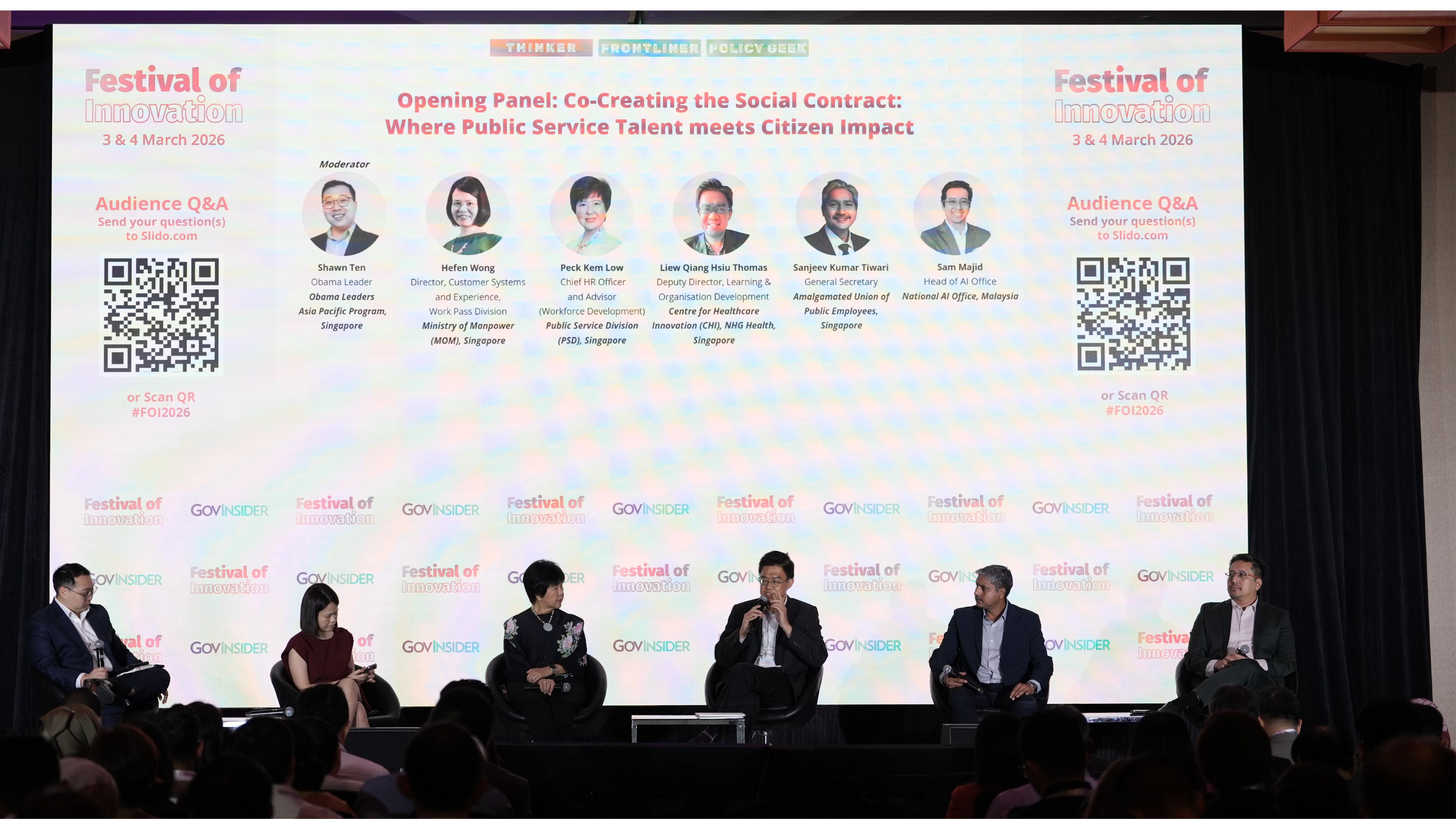
Panellist at the Co-creating the social Contract: Where Public Service Talent meets Citizen Impact discussion. From left to right: Obama Leaders Asia Pacific Programme Singapore’s Shawn Tan, Ministry of Manpower (MOM) Singapore’s Work Pass Division Director, Customer Systems and Experience, Hefen Wong, Public Service Division (PSD) Singapore’s Chief HR Officer and Advisor, Peck Kem Low, NHG Health Singapore Centre for Healthcare Innovation (CHI) Deputy Director, Learning & Organisation Development, Liew Qiang Hsiu Thomas, Amalgamated Union of Public Employees, Singapore’s General Secretary, Sanjeev Kumar Tiwari and Malaysia National AI Office's Head, Sam Majid. Image: GovInsider.
Public officers needed to move beyond their traditional role as process administrators and become stewards of public outcomes and citizen impact.
This transition required them to develop a deep understanding of citizens’ needs and expectations, as well as to be able to redesign systems, services, and policies around those needs, rather than simply enforcing existing rules.
While arriving at this broad consensus, speakers at a panel discussion, Co-creating the social Contract: Where Public Service Talent meets Citizen Impact, examined how public services must transform in an era of artificial intelligence (AI).
This was the opening panel on the second day during GovInsider’s recent Festival of Innovation (FOI) 2026.
Speaking in front of a packed auditorium, Singapore and Malaysian public sector leaders shared their own experiences, highlighting the urgent need for rapid prototyping that enables officers to navigate uncertainty, anticipate emerging challenges, and test new solutions quickly.
Obama Leaders Asia Pacific Programme’s Singapore representative, Shawn Tan, who moderated the session, started off the discussion around a core question: “Upskilling for what?”
He noted that future-ready officers and investments in AI would only matter if they translated into “better outcomes and trust for citizens”.
AI reshaping public sector jobs
Singapore’s Public Service Division (PSD)’s Chief HR Officer and Advisor, Low Peck Kem, noted that AI and job redesign were fundamentally reshaping public sector work.
Sharing a personal anecdote, Low noted that where she once needed her staff to spend weeks preparing a keynote speech, she now turned to AI tools like ChatGPT or Gemini, “effectively making some traditional support roles obsolete”.
Responding to this forced obsolescence, PSD has been moving beyond high-level job descriptions to “task-level analysis”.
This approach required breaking jobs down into specific activities, then assessing which tasks were high-risk for AI automation and which required human judgment and relational skills.
Beyond PSD, Low noted that AI was pushing Singapore’s public service to move from broad job descriptions.
40:60 work split between machines and people
Low envisioned a future where “40 per cent of work was done by machines and 60 per cent by people, with pay, competencies and career paths rebuilt around that human core”.
The goal, she stressed, was not to protect jobs but people.
This approach equipped officers with future-ready skills while keeping services both “high tech and high touch”, so that digital innovation could deepen public sector trust and connection with citizens.
Highlighting how this would look in practice, Ministry of Manpower (MOM) Singapore’s Work Pass Division Director, Customer Systems and Experience, Hefen Wong, noted that the modernisation of Singapore’s work pass systems led to simplified, user-centric digital services.
This has driven “more than 90 per cent customer satisfaction” while reducing frontliners’ workload.
Transforming citizens’ experience has inevitably transformed officers’ experience, she added, shifting staff from firefighting to higher‑value work.
She highlighted that today’s engineers and designers at Anthropic rely on Claude to write code and prototype interfaces and suggested a future where much of the codebase and design work for digital services could be “largely machine-generated”.
In that world, public service needed to double down on “governance, testing, and accountability”, she stressed, ensuring accuracy and transparency in decisions made by AI models.
“Future public officers would need multi‑disciplinary experience across policy, operations, enforcement, customer communications, and technology, so they could navigate trade‑offs and steward automated systems responsibly,” she added.
The person doing the job cannot be forgotten
Sharing from the workers’ point of view, Singapore’s Amalgamated Union of Public Employees (AUPE), General Secretary, Sanjeev Kumar Tiwari, reminded the audience that amidst all the talk of AI transformation, “the person doing the job cannot be forgotten”.
Change was a “long journey”, and that planning had to start early for the officers whose roles would evolve, disappear or be reborn, he added.
Doing so ensured that the public officers were “trained, empowered and supported” to meet rising citizen expectations.
Positioning AUPE as a critical feedback channel between frontline staff and management, Tiwari said a successful public service was an ecosystem where “technology, leadership, unions and officers move in step”.
This guaranteed that citizens receive better services, while public officers remain motivated, valued, and able to find meaning in their work.
Centre for Healthcare Innovation (CHI)’s Deputy Director, Learning & Organisation Development, Liew Qiang Hsiu Thomas, noted that transforming the healthcare workforce meant redesigning the “whole care systems” and not just tweaking individual jobs.
Application-first capability building
Liew added that through sprints and sandboxes, his team was shifting learning away from classroom theory towards “application-first capability building”, where staff use new tools on real projects that improve patient journeys and work processes.
Applied “learning-by-doing” would be the main engine of change, he said.
For him, the ideal “future-ready healthcare officer” was not just clinically competent, but capable of systems thinking, experimenting and collaborating, using AI to support rather than replace human judgment.
Malaysia National AI Office (NAIO)'s Head, Sam Majid, shared how the country was steering an “AI Nation 2030” agenda that treated AI as both an economic catalyst and a core public-sector capability.
With around “700,000 jobs potentially affected [in Malaysia]” and at least “400,000 new roles” expected to emerge, his team was focusing on raising civil servants’ AI competence to prevent a new digital divide.
The effort included hard‑wiring governance and ethics into public sector AI deployment, Majid added.
As AI shifts from merely answering questions to “doing things for us and even acting through humanoid systems”, he argued that public servants would need “greater knowledge to understand and direct AI”.
This would include more empathy to keep citizens at the centre of everything, so new AI-enabled services deepen rather than erode public trust, Majid added.
Summing up the discussion, Tan underscored that technology and capability-building had to ultimately “strengthen the social contract”, not just make the machinery more efficient.
You can watch the full panel discussion here.