
Philippines anchors new EU partnership to scale space tech across ASEAN
Oleh Yen Ocampo
The Philippine Space Agency (PhilSA) has been strengthening its space cooperation, leading to a new initiative that expanded the use of Copernicus Earth observation data across Southeast Asia.
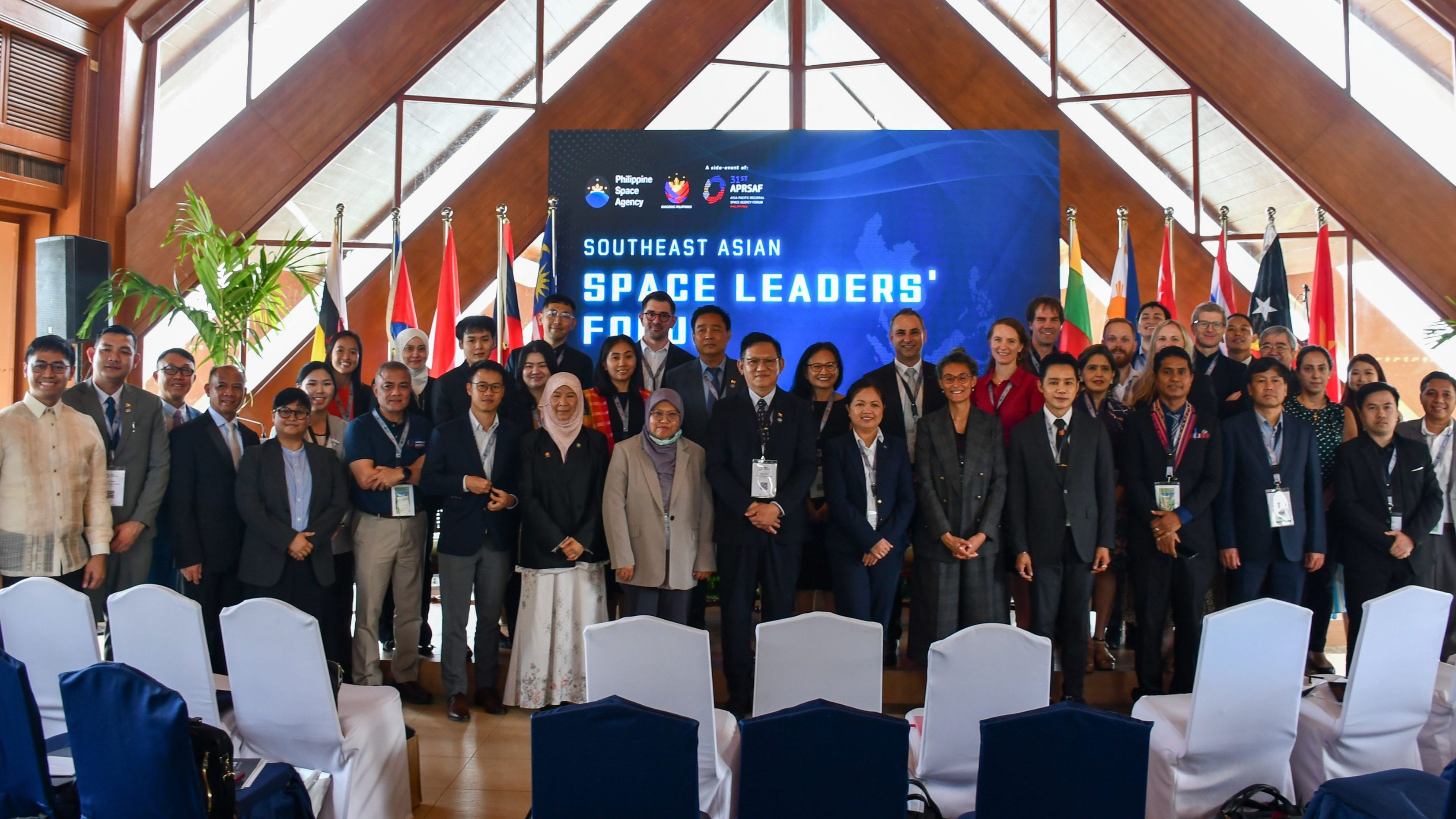
The Philippine Space Agency (PhilSA) successfully convened the Southeast Asian Space Leaders’ Forum late last year, held at Shangri-La Mactan, Cebu. The forum provided Southeast Asian space leaders a platform to discuss trends, challenges, and future directions in space science and technology, while sharing national initiatives and fostering regional and international cooperation. (Image: PhilSA)
The Philippines, Thailand, and Indonesia are collaborating with the European Space Agency (ESA) on a new project called SCOPE DIGITAL to broaden the reach of Copernicus’ satellite imagery and data throughout Southeast Asia.
Copernicus is the European Union (EU)'s earth observation initiative aimed at providing valuable information services to citizens and organisations across the EU.
The SCOPE DIGITAL programme builds on the existing Copernicus Philippines (CopPhil) initiative, which has increased the usefulness of Copernicus data in the Philippines, and supports the EU's Global Gateway goal.
According to the Philippine Space Agency’s (PhilSA) Officer-in-Charge, Gay Jane P. Perez, the country has recognised the importance of space in enhancing data-informed governance to build climate resilience, as well as bolster key sectors such as maritime security, agriculture, and environmental conservation.
However, Perez acknowledged that space data on its own was insufficient to solve all these issues.
PhilSA would need to provide the appropriate tools, services, and solutions to leverage the knowledge and experience of advanced space agencies.
This would then allow PhilSA to utilise this data in conjunction with terrestrial measurements and artificial intelligence (AI) models, she noted.
Globally shared expertise
For the Philippines, this collaborative approach reflects a core cultural value deeply embedded in national identity, known as Bayanihan, which is the spirit of shared effort and mutual support, said Perez.
In the space sector, this takes form as Space Bayanihan, where institutions and nations strengthen one another through shared expertise and resources.
“Space Bayanihan is an approach we hope to share across the Asia Pacific region, because complex missions thrive on cooperation,” Perez said during her opening remarks at the 31st Session of the Asia Pacific Regional Space Agency Forum held late last year.
This was reflected in the Asia-Pacific Regional Space Agency Forum (APRSAF), which has long served as an inclusive platform for collaboration on the peaceful and practical use of space, supporting working groups and initiatives in Satellite Applications, Space Capability Enhancement, Space Frontier, Space Education for All, Space Policy and Law, and the Space Industry.
SCOPE DIGITAL expands on the Copernicus programme in the Philippines, home to Southeast Asia’s first earth observation data centre, established in 2024. It was officially launched in November 2025 during the 31st APRSAF-31 in Cebu, Philippines.
Over the next three years, SCOPE DIGITAL will tap into European and Southeast Asian expertise to support pilot projects, training, and digital infrastructure development that enable data-driven policymaking and regional collaboration.
Focusing on disaster resilience, natural resource management, and sustainable development, its first phase will be implemented in Indonesia and Thailand, with technical support from the Philippines’ Copernicus data centre.
The project will be implemented by ESA in partnership with PhilSA; Department of Science and Technology (DOST), Indonesia’s National Research and Innovation Agency (BRIN), and Thailand’s space agency, the Geo-Informatics and Space Technology Development Agency (GISTDA).
PhilSA will serve as the regional anchor, providing technical leadership, coordinating activities, and driving capacity-building among ASEAN partners.
Space-based ocean protection
PhilSA has joined the global Space4Ocean Alliance to promote ocean preservation using space technology.
Signed in the last quarter of 2025 at the International Astronautical Congress, PhilSA will collaborate with over 30 international partners, including:
-
United Nations Office for Outer Space Affairs (UNOOSA)
-
French Space Agency (CNES)
-
Norwegian Space Agency (NOSA)
-
Monaco Space Office
-
Maldives Space Research Organisation (MSRO)
-
UNESCO
-
European Space Agency (ESA)
The multilateral partnership aims to enhance ocean monitoring, conservation, and sustainable management, while supporting capacity building for Small Island Developing States and Least Developed Countries.
Sharing the significance of the Philippines’ participation in the alliance as a maritime and archipelagic nation, Perez shared with GovInsider: “The Philippines is, in many ways, a natural laboratory for studying the ocean and coastal environment.
She stressed the significant value of the Space4Ocean Alliance’s objectives, especially in connecting space-based technologies with ocean science, bridging observational and operational gaps, and supporting data-driven, evidence-based policies for ocean health and resilience.
She further emphasised the advantages of leveraging space science and technology to address concerns of marine environments.
“By joining this alliance, we reaffirm our commitment to expanding our space capabilities and forging deeper synergies with national, regional, and international stakeholders,” Perez said.
She added that the Space4Ocean Alliance is a catalyst for transforming global cooperation into concrete, lasting solutions that safeguard oceans, empower communities, and secure a sustainable future for generations to come.
Artemis accords principles
PhilSA marked another key achievement by signing the Artemis Accords during the ASEAN Leaders’ Summit in Kuala Lumpur, Malaysia, late last year.
The Artemis Accords set principles for peaceful, transparent, and responsible space exploration, building on existing international law. By signing, the Philippines joins other nations committed to cooperative and sustainable space activities.
Perez told GovInsider that the Philippines underscores its commitment to being an active participant in space governance and the development of international law.
She emphasised the importance of reinforcing these principles amid emerging technologies and private sector activities that challenge the current legal framework.
Perez noted that the signing demonstrates the Philippines’ readiness to join like-minded nations in promoting transparency, sustainability, and shared benefits beyond national borders and into outer space.