-1783304403050.jpg)
Risza Damayanti, Policy Analyst, Ministry of Administrative and Bureaucratic Reform, Indonesia
Meet the young public sector officials in the inaugural Young & Official Report 2026.
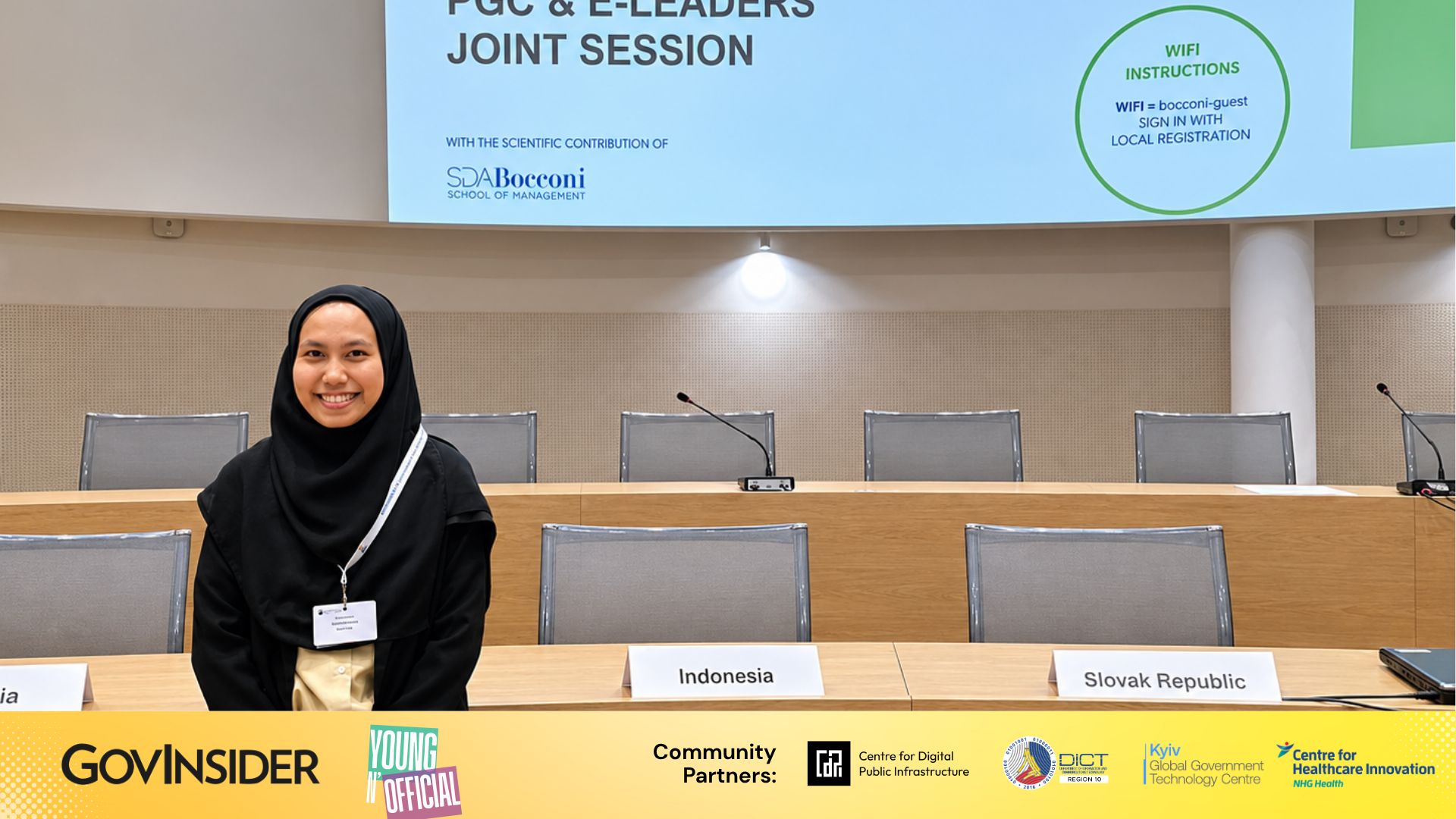
Risza Damayanti, Policy Analyst, Ministry of Administrative and Bureaucratic Reform, Indonesia
1) What does public service mean to you? Can you share more about your role in the public sector?
Whenever I reflect on the true meaning of public service, I always return to my initial motivation for joining government: to serve the Indonesian people. To me, public service is the clearest demonstration of how the state delivers for and stands with its citizens. Whilst the political landscape and technocratic development plans are dynamic and constantly shifting, our compass must remain steadfast: the public interest comes first.
This is why inclusivity, accessibility, security, and user-centric services form the core essence of everything we do. Whatever role I take on, the ultimate goal is to deliver what the people need, and to build that change together with them.
This core meaning of public service serves as my inspiration in my role as a digital government policy analyst.
In formulating digital government strategies and policies, my primary focus is ensuring that digital transformation delivers added value across all users: to citizens (G2C), businesses (G2B), government agencies (G2G), and the civil service (G2E).
Currently, the policy framework being designed by the Indonesian Government centres on a new paradigm: optimising user satisfaction through seamlessly integrated digital services under a human life-cycle approach. We aim to ensure that the state delivers a meaningful presence at every phase of a citizen's life.
This very transformation underpins my core responsibility today: serving on the core initiating team to draft the Presidential Regulation on Digital Government — a strategic milestone to revise the current presidential regulation on the Electronic-Based Government System (SPBE).
2) Tell us about an important project you pioneered. What impact did it have on the community?
One of the key projects I led was formulating a series of Administrative and Bureaucratic Reform Ministerial Decrees on national priority and shared government services. This covered sectors such as national development planning, state asset management, trade, and currently, the digital service ecosystem for civil service management.
The fundamental goal of designating these shared-use applications is to eliminate system fragmentation through standardisation, interoperability, and cross-agency infrastructure sharing.
The real impact is twofold. For the public, they will experience much simpler and more streamlined public services, as everything is integrated into a unified ecosystem rather than being scattered across various standalone applications.
For the government, it drives fiscal efficiency by preventing agencies from building redundant systems that serve the exact same function.
3) As a young professional, how has your unique background or perspective provided solutions that others in your organisation might not have considered?
The perspective I bring is one that I constantly advocate for — not because others in my organisation have not thought of it, but because it requires continuous emphasis. I always try to voice this core truth: the essence of digital transformation is that our policies must never get swept up in mere trends (FOMO) and lose sight of the actual problem statement.
We must treat the root causes, not merely address the symptoms. Given Indonesia's vast diversity in institutional maturity in conducting digital government, public readiness, and geography, a 'one-size-fits-all' formula is inherently flawed.
This is why regular policy evaluations and regulatory sandboxing are so vital. For me, government digital transformation must be viewed holistically: driven by tangible outcomes for users, guided by clear objectives, and backed by robust risk mitigation.
4) What is your strategy for maintaining your creative energy when faced with bureaucracy?
My strategy centres on maintaining a growth mindset. To prevent becoming stagnant in daily routines, I constantly cultivate curiosity and openness towards new perspectives. For me, the ultimate indicator of professional fulfilment is ensuring continuous personal capacity growth and a supportive environment for self-actualisation.
This aligns perfectly with my current field in government digital transformation. I see digitalisation not merely as adopting technology as a silver bullet for public service, but as a gateway to experimenting with innovative approaches that have never been tried before.
5) If you could choose one fundamental area of investment to accelerate transformation in the public sector, what would you choose and why?
I would choose to invest in an adaptive regulatory architecture. We are all aware that the core foundation of public sector transformation lies in competent and courageous talent — not solely in advanced technology. Regrettably, the agility of digital talent in the public sector is often bottlenecked by rules that are not yet fully aligned.
That is why harmonising regulations is the most urgent and foundational investment. Harmonised regulations deliver the legal certainty needed to encourage government talent to collaborate and execute innovative ideas safely, legally, and with massive impact.
6) What is your greatest ambition in your public service career?
To me, ambition is not about titles or positions achieved, but about the scale of the legacy and meaningful impact we leave behind. My ultimate vision is to see proactive public service implemented on a massive scale across Indonesia. The vision is of a state that anticipates the public's needs before they even request them, providing a seamless governmental presence.
As a concrete example, when a child is born in a hospital, the government's digital ecosystem would proactively issue a new national citizenship number, update the parents' family registry, and automatically activate health insurance coverage. Parents would no longer face the burden of navigating multiple government agencies.
This is exactly where my field of digital government plays a pivotal role: optimising cross-agency data exchange as the driving engine to deliver a truly proactive public service.
7) What is a "universal value" that connects everyone in your workplace — from interns to directors — and how do you use that to drive collaboration?
I view competence and integrity as the core foundation. Competence transforms ideas into concrete and meaningful execution, whilst integrity acts as the anchor that builds commitment and trust. For me, the impact of both values multiplies when driven by collaboration, because collaboration unifies our vision and actions whilst dismantling bureaucratic silos.
This collaborative spirit drives the ongoing digital transformation within government. After all, the essence of digital government goes beyond adopting new technologies. It is about delivering integrated and seamless public services through meaningful multi-stakeholder collaboration.
8) What is the best piece of advice you have received and would like to pass on to the next generation of civil servants?
Every era in public service comes with its own distinct characteristics and challenges. What the public needs today differs from the past, and it will continue to evolve in the future.
This is why lifelong learning is essential to ensuring public services remain adaptive and relevant to changing dynamics. Both as a reminder to myself and an invitation to my fellow civil servants, let us embrace the courage to unlearn and learn — to let go of outdated, ineffective patterns, remain open to new horizons, and consistently elevate our capacity.
Navigating a career in bureaucracy may not always be smooth, but for those who continuously strive and grow, the path to making a meaningful impact will always be open.
9) What is a myth you wish to debunk about young civil servants?
There is a myth that young civil servants, often stereotyped as 'rookies' or 'small fry', have limited room to contribute and innovate due to a lack of experience and rigid bureaucratic structures.
In my view, this perspective no longer holds true today. The ongoing merit-based system ensures that competent talent enters government. We are given a seat at the table not merely because of our age, but because the ideas and execution capabilities we bring are relevant to the demands of change.
10) Write a letter to your future self in 2035.
Hello, me in 2035,
As you read these words, I hope you are still nurturing the passion you hold today. Always remember that serving in government is not about chasing titles or comfort, but about purpose — about the legacy you wish to build, and the impact you leave behind. Also remember that your position, rank, and current platform are merely means, not the ultimate end.
My message to you is this: wherever you may be in the future, promise never to lose touch with your founding philosophy. Do not let routine extinguish your creativity. Are you still maintaining a growth mindset? I truly hope you are still that person with an insatiable curiosity and the courage to drive innovative ideas collaboratively, consistently bringing value through wholehearted public service.
Stay true to your course. Embrace your purpose.
From your 2026 self.