Tan Tock Seng Hospital champions age-inclusive practices for its workers
Oleh Sol Gonzalez
NTUC, the training grant provider, has urged employers to invest in older workers as Singapore’s ageing workforce grows at the same rate that technology changes the worker’s job scope.
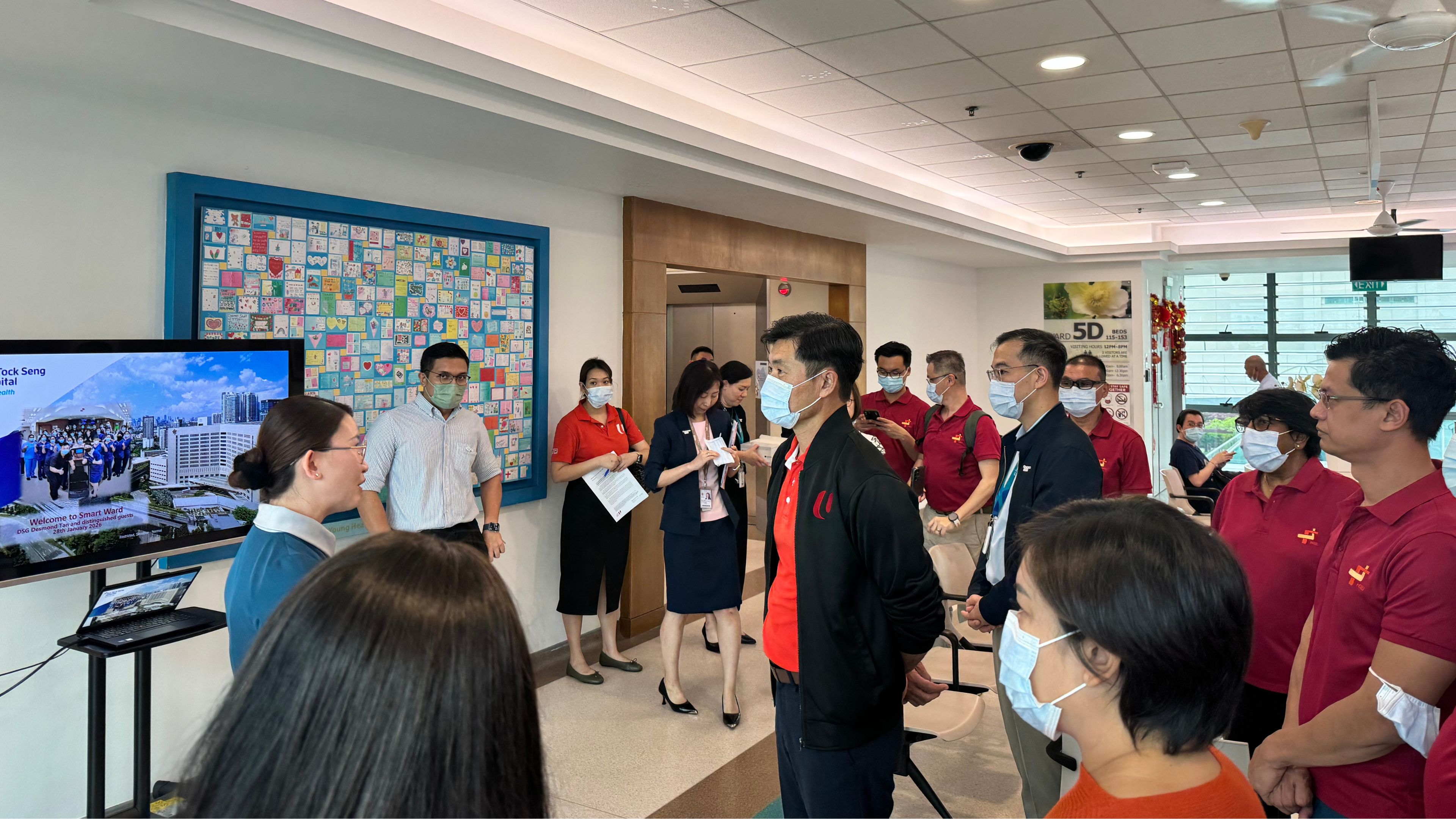
NTUC’s Deputy Secretary General (DSG), Desmond Tan, accompanied by TTSH Chief Executive Officer Adjunct Assistant Professor Tang Kong Choong, Chief Human Resource Officer Lillian Ho Lay Kuan, HSEU President K Thanaletchimi, and HSEU union leaders, at a visit to Tan Tock Seng Hospital's Smart Ward. Image: GovInsider.
At a visit to Tan Tock Seng Hospital (TTSH)’s Smart Ward on January 28, NTUC’s Deputy Secretary General (DSG), Desmond Tan, called for employers to adopt initiatives like job redesign and skills upgrading to support older workers’ needs.
He also urged the government to continue supporting employers to hire, train, and retain older workers so that they can work sustainably for as long as they choose.
In the same visit, TTSH showcased the age-inclusive practices that it has adopted to empower older healthcare workers, currently making up over 10 per cent of its workforce.
These were made possible in collaboration with the Healthcare Services Employees’ Union (HSEU) and supported by NTUC’s Company Training Committee (CTC) Grant.
The practices adopted by TTSH included more flexible work arrangements, job redesign, technology-enhanced processes, and upskilling.
Alongside these work arrangements, TTSH also implemented digital projects such as the PreSAGE Smart Predictive Patient Monitoring system, which alerts nurses when patients are at risk of falls; and the Smart Scheduler, a scheduling system that improved workload distribution and reduced administrative strain.
“Supporting our seniors doesn’t just increase our labour force participation, but it also ensures that we have a more resilient workforce that is able to cope with an AI-enabled future,” said Tan.
Supporting the workforce is a continuous effort
HSEU’s President K Thanaletchimi also called on healthcare employers to tap into the NTUC and HSEU ecosystem to support their workforce transformation.
“TTSH’s efforts show that when organisations plan ahead and redesign work with their employees in mind, the workforce can continue to contribute with confidence and purpose,” she said.
With the CTC Grant, TTSH improved existing systems with artificial intelligence (AI) and advanced technologies.
Under the CTC platform, companies and union leaders would map out solutions that benefit workers and organisations, with the grant helping to subsidise these initiatives.
-1769741920849.jpg)
At the event, the senior nurses highlighted PreSAGE as one of the innovations that made their role easier as it reduced physical strain and enhanced predictability.
“I no longer have to strain my back to set up the manual fall alarms for patients, and I can focus on more complex duties in the ward as I know that the system is watching over the patients, and will trigger us if needed,” said Senior Enrolled Nurse Lilian Teng, aged 69.
The nurses also noted that Smart Scheduler has freed up their time to focus on more complex tasks, as it reduced rostering time from 90 minutes to 15 minutes.
These two systems were key to TTSH’s wider goal of uplifting its workforce through age-inclusive practices and technological innovation.
“Our partnership with NTUC and HSEU has been instrumental in accelerating this transformation,” said TTSH Chief Human Resource Officer, Lillian Ho Lay Kuan.
“By redesigning roles, integrating AI and technology, and creating flexible work options, we continue to empower our workforce to thrive and deliver high quality care,” she added.
Supporting older workers’ aspirations
“I will continue to work as long as I’m physically fit and mentally healthy,” said Senior Nurse Teng who shared about their experience navigating job redesign at TTSH.
An NTUC survey found that over 46 per cent of respondents would like to work beyond the eventual re-employment age of 70.
Out of that number, 66.7 per cent of them aged 64 and above said that they want to continue working past 70.
TTSH was one of the early adopters of raising the retirement age to 64 and lowering re-employment age to 69, ahead of national legislation.
The hospital also reported strong re-employment outcomes with about 98 per cent of senior staff accepting re-employment beyond retirement age.
“We must create the right conditions for older workers to stay productive, engaged, and employable.
That means redesigning jobs thoughtfully, using technology to make workplace inclusive, and being intentional about offering flexible arrangements,” said DSG Tan.
-1769742012415.jpg)
Prior to her current role, Nurse Teng accessed NTUC-sponsored upskilling to become a Care Support Assistant and continued to learn and operate new technology with the support of younger colleagues.
Job redesign also helped 62-year-old Senior Patient Associate Executive, Mastan Nachival Mohd, who expressed having concerns about work progression and longevity in her previous administrative role.
The redesigned role enabled her to support nurses more meaningfully, through patient admission and discharge, taking vital signs, and assisting with feeding.
“The redesigned role gives me the confidence to stay in healthcare for many more years, and I intend to continue working at TTSH for as long as I can,” said Mastan.