-1783304403050.jpg)
Urban developers should support citizens in building their city
Oleh Hanna Kum
At the World Cities Summit 2026, representatives from cities around the world gathered to discuss the crucial role of community-driven planning in urban centres.
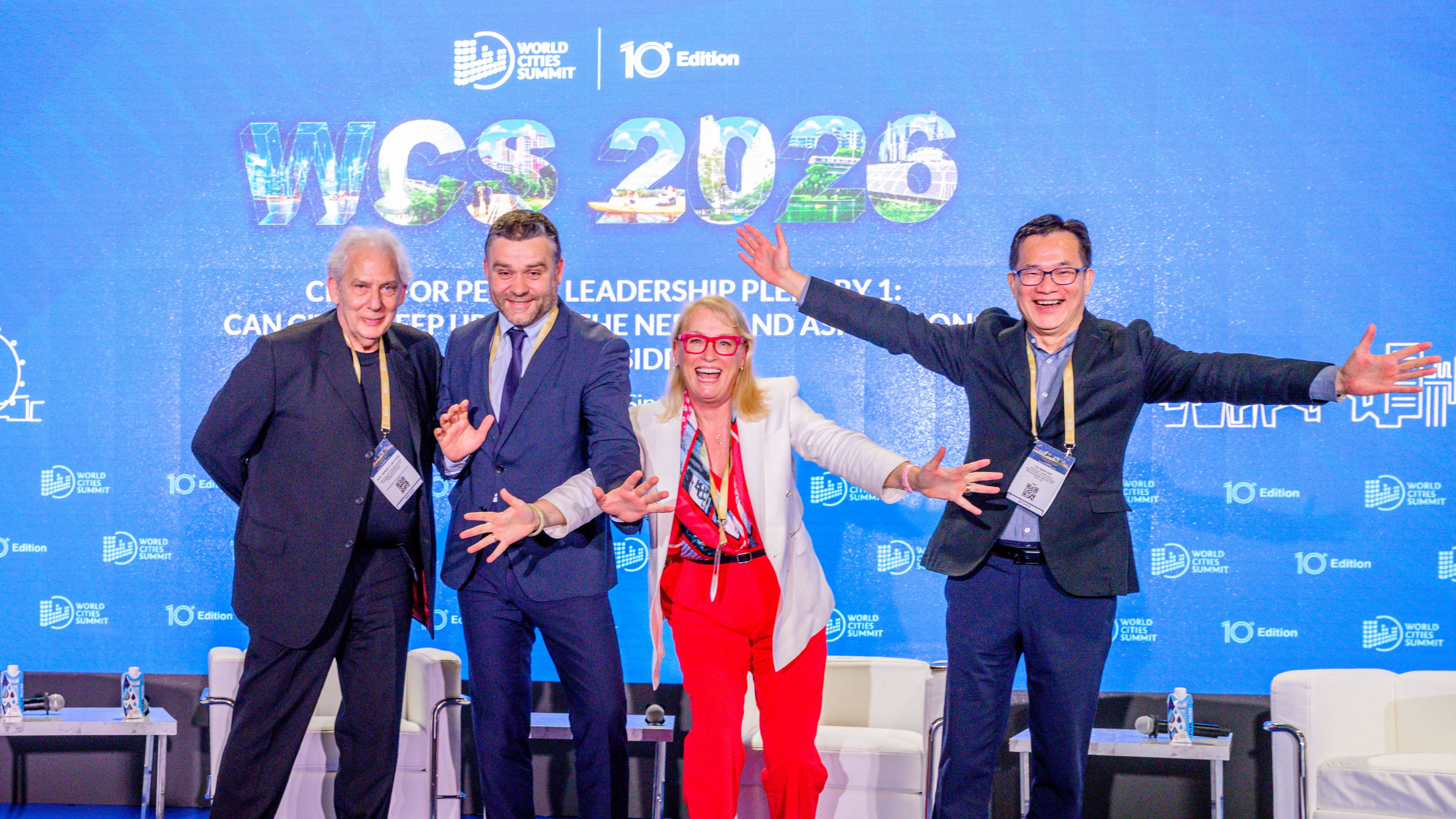
Picture taken at the World Cities Summit 2026, after the panel session titled "Can Cities Keep Up with the Needs and Aspirations of their Residents?" Image: World Cities Summit 2026
When asked if cities could ever keep up with the residents’ expectations, Melbourne’s former Lord Mayor Sally Capp AO gave an unexpected answer: “I hope that we never catch up to the aspirations and expectations of our citizens.”
For her, the conversation between city planners and the people they serve should be continuous and sustained.
"We want people to be demanding and have high expectations; as city leaders, responding to that is the best of challenges,” she noted.
Capp was speaking at the 10th edition of the World Cities Summit (WCS) held in Singapore from June 14 to 16, 2026, in the panel discussion titled Can Cities Keep Up with the Needs and Aspirations of their Residents?
With her in the discussion were city leaders from New South Wales in Australia, Bilbao in Spain, Bucharest in Romania, Singapore, alongside academics from Singapore, the United States, Australia, and London.
“It might require a fundamentally changing approach — from the city saying, ‘we were hoping you would support our plans’, to ‘we're going to help you shape your own future, and our job is to support your vision,’” said the Massachusetts Institute of Technology (MIT)’s Professor of Urban Design and Public Policy, Brent Ryan.
Planning the city that citizens use
“The biggest barrier to people coming together into the community is the attraction of the couch — the ‘at-home economy’,” said New South Wales’s 24-Hour Economy Commissioner, Michael Rodrigues.
He was referring to the prevalence of the Internet, streaming devices, and flexible working arrangements which reduced the likelihood of people leaving their houses and actually using the city.
“And I believe this threat is existential,” he said. “Cities don’t run on infrastructure, but participation.”
This meant that the ultimate heart and purpose of the city lay in how people use it, rather than how well it was planned.
Ryan gave the example of The Heidelberg Project in Detroit, US, where one man led a community art project and created a space in which the citizens could come together to interact.
Although this was not intentional, given that the urban control in 1986 Detroit was relatively loose, it proved the impact that citizens could have if they were given the opportunity to actually create something in the urban space.
To make this possible, city leaders and planners needed to first accept that professional frameworks and planning principles might not always be the best way to go.
“Cities might have to let go of their ‘business as usual’ approach,” Ryan said, referring to the typically adverse sentiments of city planners to trying new, unconventional things.
Only when actual citizen needs and wants were taken into consideration and used in urban planning, would it stand a chance against the “at-home economy”.
Urban renewal and improvement about strengthening social fabric
Some of the panelists shared their experiences on how to respond to their citizens’ needs, including the representatives from Melbourne and Singapore.
Melbourne’s Capp shared that the city’s previous urban strategy, as with many cities in Australia, were based on 20th century (1900s) assumptions, most of which were “out of the window these days.”
The city’s planners thus launched a program of re-using, re-working, and re-energising existing physical infrastructure.
“So many of our discussions are about putting people right at the centre,” Capp shared.
Melbourne transformed the Green Line, an underused riverfront, to a green space that improved climate resilience, boosted tourism and recreation, and created spaces where people could come together to connect.
They also turned a disused city building into an accommodation for those experiencing homelessness.
“This reminds us that not all renewal is about economic activation, it can also be about dignity and inclusion and social recovery,” she reflected.
Also on the side of socio-cultural-led urban transformation, National University of Singapore (NUS)’s Professor of Architecture, Yeo Siew Haip, shared the city-state's challenge of housing a multi-generational population in the same neighbourhood.
Re-imagining community life is not for just one certain group, but multi-generational, Yeo said.
They did this by “remaking the heartland” — putting elements for various age groups into the same neighbourhood, making the neighbourhood enjoyable for any age group that might live there.
Singapore’s urban renewal strategy was thus about adapting rather than rebuilding, based on their updated population demographics.
Different strokes for different cities
Bucharest (Romanian city)’s proposed strategy included another missing piece, which was the renewal of historic spaces using private capital.
"Attract private capital to buy those buildings... turn them into libraries, cultural spaces, restaurants — because you have to bring life into the streets,” said Bucharest’s Mayor, Ciprian Ciucu.
Though people in Bucharest were “pretty conservative regarding what was built prior to the 1950s”, city leaders took this opportunity to engage with the community to find out what absolutely had to be preserved, and what the citizens were willing to compromise on.
Evidently, preservation and transformation were not opposites. In fact, the questions always circled back to who the city was preserved for, and who the city was transformed for.
Though the session discussed each city’s experiences and plans, ultimately, no two cities are the same, London School of Economics and Political Science’s Professor of Urban Studies, Ricky Burdette, observed.
Effectively, the role of the mayor is to act like a doctor. To analyse the city’s own circumstances, and then give a diagnosis, he said.