What GovInsider’s FOI 2026 event meant for you, by persona
Oleh Claude and fact-checked, edited by Si Ying Thian
Every public officer left the Festival of Innovation with something different, whether you’re a frontliner, policy architect, foresight practitioner or techie.
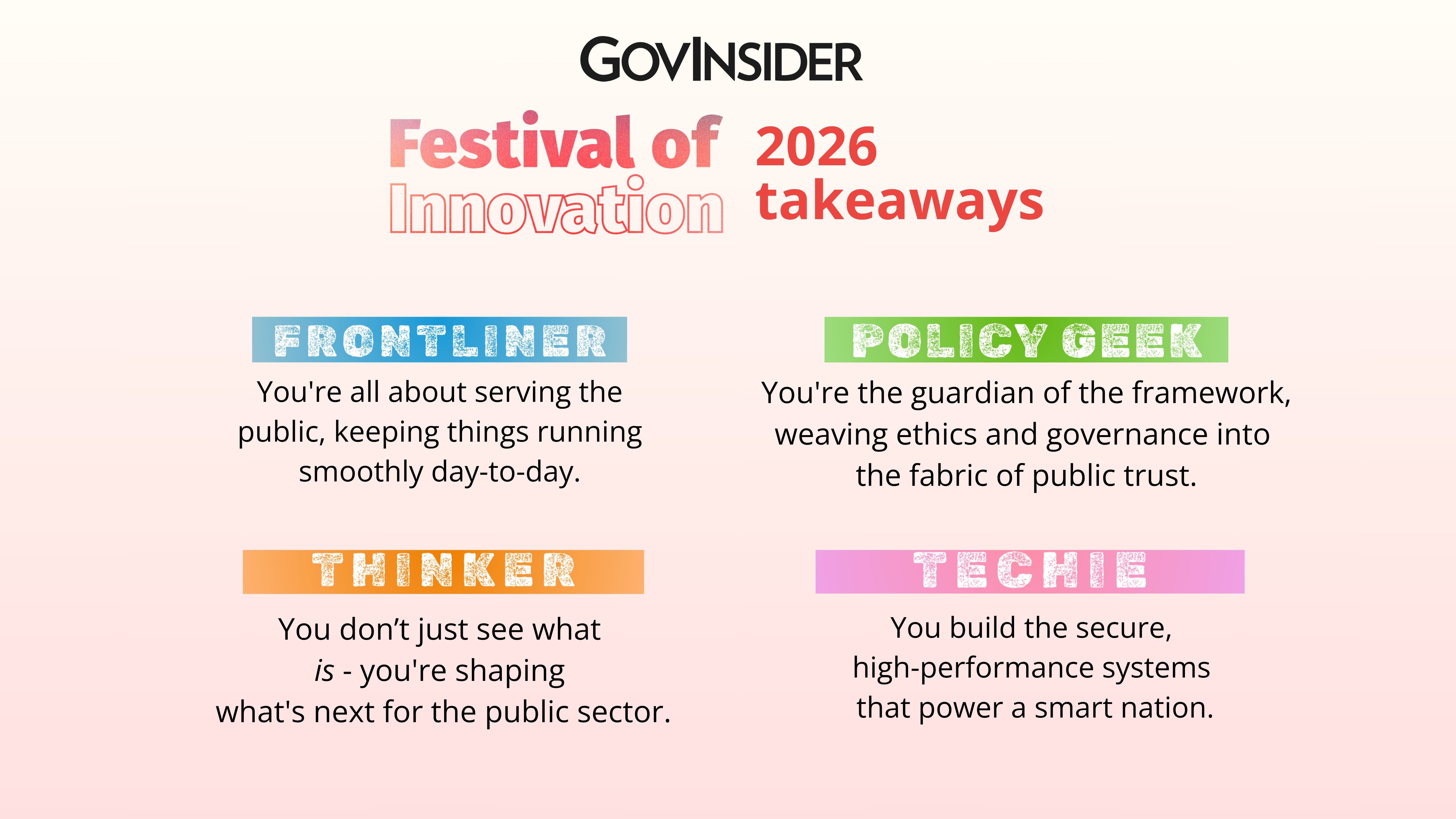
FOI 2026 reminded us once again that innovation in government isn’t a tech problem.
Every major event produces a flood of insights. The harder task is making sense of them in a way that speaks to the public officer who is reading this.
The Festival of Innovation (FOI) 2026 was no different. While it was rich and wide-ranging, it can pull in multiple directions at once.
Rather than simply handing you a list of things that were said, we got Claude, the artificial intelligence (AI) assistant built by Anthropic, to read across some of the sessions we picked to ask what it all means, depending on who you are and what you do.
FOI 2026 reminded us once again that innovation in government isn’t a tech problem.
It’s the frontliner who redesigns a form so that a stigmatised community finally feels safe enough to engage.
The policy architect who insists on getting the legal interoperability layer right before anyone touches the AI.
The foresight practitioner who feeds the right insight to the right person and watches it become policy.
The techie who kills a project because the problem it was solving no longer exists.
Frontliner: Moving from telling citizens to showing them
Citizens need information that means something to them. It’s less of a tech story, but one that centers around service design.
A medical report that hands a patient with some numbers on a page does almost nothing to change behaviour. The same data, reframed to show that person they are likely to be pre-diabetic in six years if current trends continue, changes everything.
The same principle applies to how governments visualise problems internally. Mapping data geospatially, rather than reading it in spreadsheets, reveals clusters of rural underinvestment that would otherwise be invisible.
The tools you use to understand problems shape the problems you are able to see.
Co-defining the problem, co-creating the solution, then co-owning the outcome is also what makes government initiatives sustainable rather than well-intentioned and short-lived.
Effective service delivery means listening first, and building programs that reflect what communities actually need.
This is especially relevant for agencies operating across diverse geographies, where solutions built for urban populations routinely underserve rural communities with entirely different needs and infrastructure realities.
Policy geek: Foundations (and underlying infrastructure) are more important than we think
While there is a growing ambition to integrate AI into government services, agencies are building foundations that may not be even there yet.
The interoperability problem covers technical, legal, organisational and semantic layers.
Most agencies focus on the technical part, but it means nothing if agencies have no legal authority to exchange data, or if the same data field means different things to different ministries.
Until those layers are in place, AI only accelerates fragmentation. The implication for policy architects is to build the conditions under which innovation can actually stick.
While there is a widespread digitalisation push, the reality is that not everyone can participate in it.
The “0.5 version of digital infrastructure” refers to a hybrid approach designed to bridge the gap between digital systems and the needs of citizens who are not yet digital literate.
While printing QR code vouchers for elderly residents who cannot navigate a mobile app is less glamorous, it recognises that the goal is access, rather than tech for tech’s sake.
Sometimes, the most sophisticated thing a government can do is meet people where they are.
When it comes to AI governance, speakers called for a shift in language from “sovereignty” to “autonomy” to enable for a more actionable standard.
Autonomy is defined as the ability to control AI deployment for specific use cases, to audit decisions, to know when not to deploy AI at all.
Thinker: Knowing what’s coming means nothing if nobody listens
Futures thinkers are often the first to identify what is coming and the last to be invited into the room where decisions are made.
The most useful reframe was that foresight work fails not because the analysis is wrong, but because the analysis never reaches the right people in the right way.
The practitioners who have shaped policies are those who have learned to work through influence rather than authority. This includes identifying champions who can carry ideas into rooms and tailoring narratives to resonate with what each stakeholder actually cares about.
Navigating the gap between good ideas and implementation isn't about producing better analyses, but finding the right people to carry the message.
It also requires resilience, which is the capacity to stay committed to long-term work during periods when short-term pressures push public officers out of the conversation.
Techie: Accountability gap is opening faster than you’re closing it
Getting five people from different ministries to collaborate on a shared goal was described as harder than implementing sophisticated tech.
Agencies rarely struggle because their tech is wrong, rather because the people, processes and incentive structures around the tech have not kept pace.
The speakers also made a case for discipline to “kill” tech when it’s clearly not solving the problem it was built to solve, or when circumstances change and the problem evolves.
Equally, not every working solution should be scaled. Some are inherently local, and scaling a localised solution to enterprise level may cost more than it returns.
Innovations that depend on a single champion to survive are more fragile than they look, so it’s important to build shared ownership into the project from the start, not as an afterthought when that person moves on.