
How this Singapore hospital scales speech-to-text to transform nursing workflows
By Cindy Peh
National University Hospital (NUH)’s Chief Nurse Karen Koh shares how NUH is using AI-enabled transcription tools to ease documentation burden and support nurses in spending more time on direct patient care.
-1785989990533.jpg)
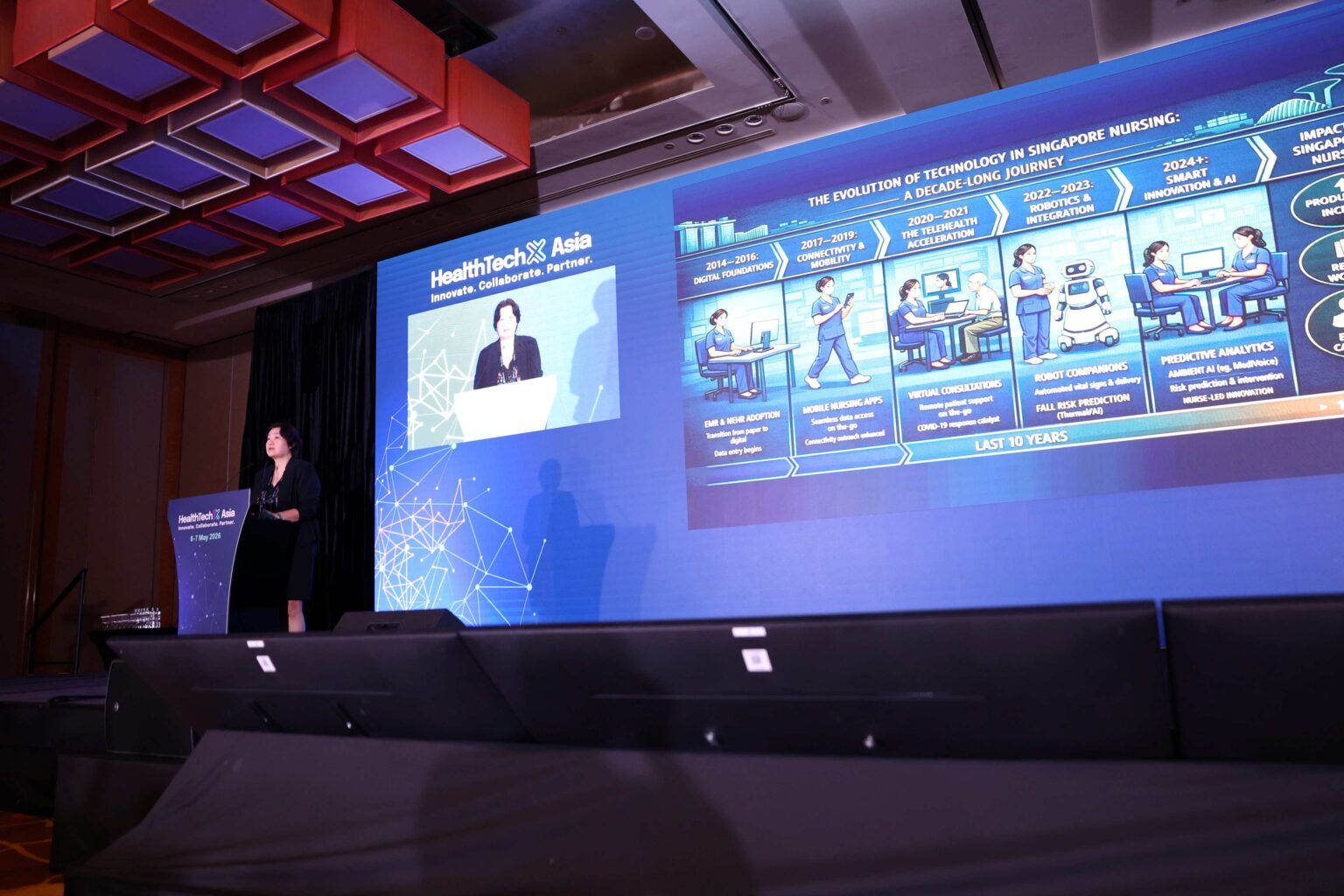
Chief Nurse of Singapore’s National University Hospital (NUH), Karen Koh, presenting at HealthTechX Asia 2026. Image: HealthTechX Asia
Across Asia, healthcare systems are grappling with rising patient demand, increasing bed capacity, and building a sustainable talent pipeline.
Nurses continue to face sustained work pressures as every additional patient requires not just additional care, but also additional documentation, coordination, conversation, handover updates, and follow ups.
Speaking at HealthTechX Asia 2026, Chief Nurse of Singapore’s National University Hospital (NUH), Karen Koh, highlighted the need to redesign nursing workflows so they can better meet fast-evolving care demands.
She shared how NUH has moved speech-to-text technology beyond pilot use into selected nursing workflows, with early impact observed on efficiency.
Reducing nursing documentation burden
Nursing documentation has steadily increased over the years, often extending well beyond the end of a shift and adding to the cognitive load of an already-demanding profession.
To address this challenge, NUH piloted two speech-to-text solutions: MediVoice, an in-house artificial intelligence (AI) transcription tool, and Scribe, a transcription tool developed by Open Government Products (OGP).
The technology supports transcription across multiple languages and dialects before generating structured documentation using customised templates, as well as governed by institutional safeguards and data protection requirements.
This helps reduce the need for nurses to spend time recalling conversations, retyping notes, and reconstructing documentation after patient encounters.
Early implementation data suggests time savings of up to 16 minutes per encounter in selected use cases.
These time savings can accumulate across shifts, enabling nurses to spend more time on direct patient care, mentoring junior colleagues, and reducing unnecessary overtime.
As one nurse reflected, burnout is not simply about working long hours, but about whether the work feels meaningful.
Building trust through co-creation
Koh emphasised that safe adoption depends on iterative improvement, rather than expecting technology to be perfect from the outset.
Rather than seeking perfection, NUH focused on continuous improvement through close collaboration between frontline nurses and developers.
The hospital actively gathered user feedback and refined the solutions to better fit clinical workflows instead of forcing staff to adapt to the technology.
This approach also shaped deployment. NUH differentiated the use of the two solutions according to clinical and non-clinical needs, with access provided through approved hospital platforms and devices.
Using institutionally-approved devices for patient interactions helped strengthen patient confidence when transcription tools were used.
Equally important were the nurse champions who drove adoption across departments.
These champions took on the roles of cultural ambassadors, helping colleagues understand the technology, troubleshoot challenges and build confidence through peer support.
Governance enables safe adoption
Strong governance underpins the adoption and implementation of such technologies, Koh noted.
The hospital evaluates risks before deployment, introduces safeguards throughout implementation, and continuously reviews the technology as it evolves.
Nurses are actively involved in testing new capabilities and working alongside developers to refine functionality, with human review remaining central to clinical documentation and decision-making.
For Koh, governance is not simply about compliance—it is about ensuring technology remains aligned with nursing values, rather than redefining them.
“The key is that we automate the routine and elevate the human,” she said.
AI is embedded into existing workflows rather than added as a separate process, allowing nurses to focus on judgement, communication, and compassionate care instead of repetitive administrative tasks.
A broader nursing transformation
Speech-to-text is only one component of NUH’s wider nursing transformation strategy.
In recent years, the hospital has introduced numerous technologies that streamline routine work while improving patient safety.
These include electronic medical records for handovers, mobile applications for patient identification and task management, automated vital signs capture, smart infusion pumps, medication management systems, real-time equipment tracking, robotic process automation for inventory checks and digital patient education platforms.
Together, these tools help to reduce manual processes and support safer, more efficient workflows, returning valuable time to frontline clinicians for direct patient care.
NUH is also equipping nurses with other AI tools to support evidence retrieval, research, education and workforce rostering.
For example, early use of AI-assisted scheduling could potentially reduce the time nurse managers spend preparing monthly rosters, allowing them to focus more on leadership and staff development.
Keeping human connection at the heart of nursing
The next phase of NUH’s transformation will continue to be purposeful and carefully governed, shared Koh.
NUH is exploring opportunities to expand the use of ambient AI, intelligent patient interfaces and smarter monitoring technologies where these can add value safely and responsibly.
Importantly, successful adoption will continue to depend on nurses playing an active role in testing, governing and shaping these tools.
She concluded with three takeaways for AI-enabled nursing transformation: automate routine work wherever possible to elevate human care; embrace continuous co-creation rather than expecting perfect technology; and ensure technology strengthens the human connection at the heart of nursing.
“The future of nursing will not be written by technology alone,” Koh concluded. “It will be written by how we choose to use it together.”
Editor's note (August 13): The article has been corrected to clarify that Scribe's use is not just limited to non-clinical documentation.
The article was originally published in Hospital Management Asia here, and edited.
-------------------------------------------
Cindy Peh is the Content and Community Manager at Hospital Management Asia, which showcases trends and best practices in healthcare management via in-person and digital events, as well as an online publication.