
Indonesia modernises logistics by introducing e-seals for containers
By Yuniar A.
The customs authority has officially launched the e-seal as part of its digital transformation agenda to strengthen the national logistics ecosystem.
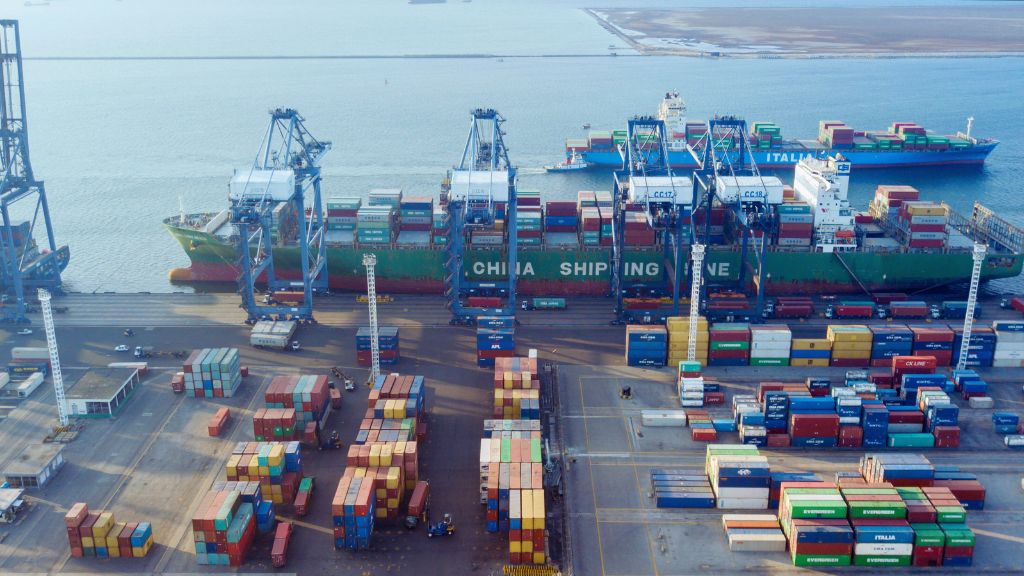
Loading and unloading process at Tanjung Priok Port, Indonesia. The implementation of Customs e-seals enables automatic and transparent container tracking, while promoting efficiency and accountability. Image: Canva
Imagine every container moving across Indonesia, a country with 6.4 million square kilometers of sea and 1.9 million square kilometers of land, tracked in real time and with full transparency.
This is the vision that the Directorate General of Customs and Excise (DGCE) at the Ministry of Finance is working on by implementing the e-seal, a digital seal for logistics.
This marks a new milestone in Indonesia customs’ digital transformation journey.
DGCE’s Director of Customs Technical Affairs, Susila Brata, said: “Our goal is to deliver services that are more efficient, accountable, and transparent”.
Brata was speaking at DGCE’s public dissemination event on the implementation of e-seals in Jakarta, June 26.

According to Brata, the e-seal is a significant step forward in the organisation’s efforts to strengthen the national logistics ecosystem.
The launch of e-seal is based on a DGCE Decree, which emphasises the critical role of technology in enabling real-time monitoring of goods and in building trust between the government and industry stakeholders.
In June this year, the digital seal was piloted at two DGCE offices: the Tanjung Priok Customs Office in Jakarta and the Cikarang customs area in West Java.
Its implementation will be expanded to all customs offices across Indonesia starting from September 2025.
The e-seal forms part of the Ministry of Finance’s wider customs digitalisation initiatives.
Previously, the Ministry launched the Indonesia National Single Window (INSW), a one-stop platform to integrate customs licensing processes across various ministries and agencies.
Additionally, the Ministry of Finance has initiated the National Logistics Ecosystem, which encompasses the end-to-end export-import process, including licensing and inbound and outbound logistics, across government-to-government, government-to-business, and business-to-business channels.
To subscribe to the GovInsider bulletin, click here.
Driving transparency, cutting costs
The e-seal uses GPS tracking which enables the tracking of containers right from their point of departure, anywhere along their journey and right to the destination where the e-seal is removed.
Transparency is the key value of this system, Brata emphasised.
With open data on the movement of goods, any irregularities can be identified more easily, encouraging compliance among businesses and strengthening the integrity of the national logistics ecosystem, he added.
“Both the authorities and e-seal users can monitor goods together ... Reducing concerns over misuse or deviations in the movement of goods from one location to another,” he explained.
Before e-seals were implemented, the DGCE faced various challenges, including frequent abuse of authority by certain individuals in the process of supervising and handling goods, as well as the falsification of documents to deceive officers and even smuggling.
The adoption of a digital seal was not merely an internal transformation but also elevated Indonesia’s logistics ecosystem, making it more prepared to compete globally, Brata added.
Two target groups of e-seal
DGCE’s Inspector, Pudji Seswanto, explained that there are two target groups using the e-seal.
The first group consists of customs service users, including importers, exporters, carriers, Temporary Storage Area (TPS) operators, Bonded Warehouse (TPB) operators, and other customs service users involved in customs business processes.
Customs service users are required to provide certified e-seals or those that meet the requirements for customs and excise processes. They must also integrate their e-seal systems with the Service Computer System (SKP) managed by the DGCE.
The second group comprises e-seal providers appointed by customs service users under business agreements or business-to-business schemes.
“These e-seal providers must hold business licences in logistics, equipment, digital equipment, security, digital security, or other related sectors,” he explained.
While the full implementation of the e-seal will be enforced, the government will continue to provide some flexibility around the use of conventional seals.
This flexibility will be granted under two conditions: first, if there is a disruption to the electronic network rendering the e-seal unusable; and second, if there is a limitation in e-seal capacity, which must be proven through a written statement from either the customs service user or the provider, within a maximum period of two months.
To date, there are eight e-seal providers covering logistics services across Sumatra (Medan, Padang, Palembang, Tanjung Enim, Lampung), Java (Greater Jakarta, East Java), Kalimantan (Balikpapan, Banjarmasin), Sulawesi (Makassar, Morowali), Maluku (Halmahera), and Bali (Denpasar).