
Indonesia unveils national AI roadmap
The White Paper on the National Artificial Intelligence (AI) Roadmap sets out policy directions, development priorities and financing models for the country’s AI landscape till 2045.
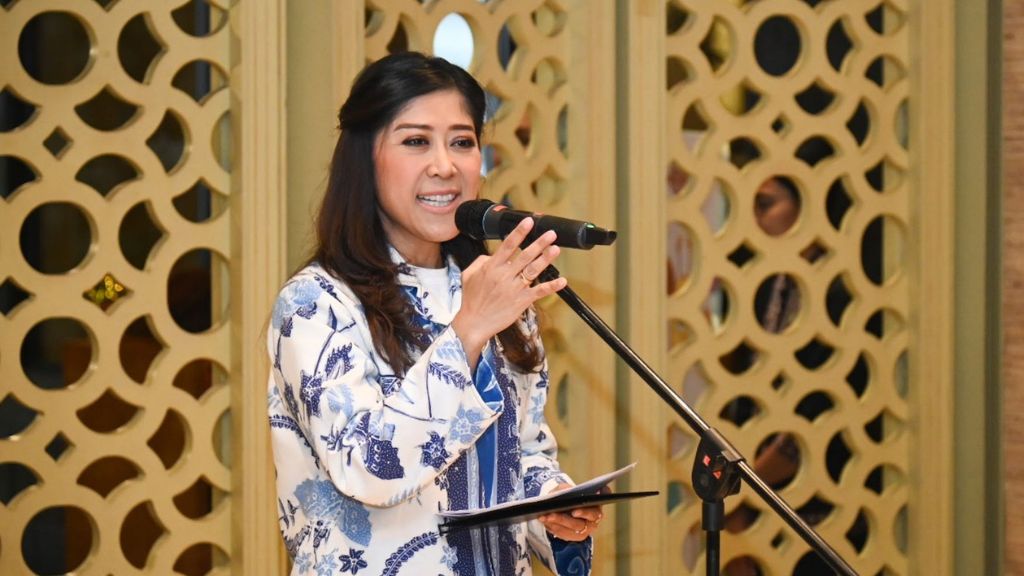
The Ministry of Communication and Digital Affairs launched a white paper on the national AI roadmap as a guide for targeted, inclusive and ethical AI policies. Image: Ministry of Communication and Digital Affairs
Artificial Intelligence (AI) could help Indonesia achieve its vision of Golden Indonesia 2045 with the right strategy and governance, according to Minister of Communication and Digital Affairs, Meutya Hafid.
Stating this in her forward to Indonesia’s National AI Roadmap White Paper, she said the AI roadmap would provide policy direction to accelerate AI ecosystem development to ensure the country was not to be left behind in a field increasingly dominated by advanced countries and global tech giants.
The White Paper, drafted by the AI Roadmap Task Force, a 443-member body representing government, academia, industry, civil society, and the media, was launched by the Ministry of Communication and Digital in early August.
It has been envisaged as a strategic document that would serve as the country’s reference for adopting and developing AI technology in a more focused, inclusive, and ethical manner. The document has been circulated for public consultation to gather wider input from stakeholders.
This initiative builds on the National AI Strategy 2020-2045, which was an initial framework developed by the Collaborative Research and Industrial Innovation in AI (KORIKA), an organisation formed by scientists, technocrats and industry leaders to accelerate the AI ecosystem in Indonesia.
However, that strategy has struggled to keep up with the rapid breakthroughs in generative AI (GenAI) since late 2022.
Three major action plans
The national AI roadmap outlines three main action plans: AI ecosystems, AI development priorities, and AI financing – all anchored in ethical guidance and regulation.
This roadmap also breaks down the action plan into three-time horizons: short term (2025-2027), medium term (2028-2035) and long term (2035-2045).
To subscribe to the GovInsider bulletin, click here.
-1756728192656.jpg)
Indonesia’s AI ecosystem development would focus on three main pillars.
The first pillar was talent development.
Indonesia aimed to nurture a large pool of skilled professionals who could both use and create AI innovation.
The roadmap sets an ambitious target of producing 100,000 AI talents annually. Around 30 per cent would be developers, divided further into AI specialists (30 per cent) and practitioners (70 per cent), and the remaining 70 per cent would be AI end-users.
The government also aimed to ensure 20 million citizens are AI-literate by 2029.
The next pillar was research and industrial innovation.
The roadmap emphasised advanced, relevant, and sustainable AI research that delivered real benefits to society.
To achieve this, the government would encourage agencies, universities, and industries to strengthen AI programmes in priority sectors.
A cross-sectoral open sandbox platform would also be developed to support experimentation and collaboration.
The last pillar in Indonesia’s AI ecosystem was infrastructure and data.
To foster domestic AI innovation, the government planned to expand digital infrastructure, including high-performance computing, GPUs/TPUs, and a national cloud hosted in sovereign data centres to ensure secure and regulated data management.
The white paper also outlined plans to promote the development of green data centres through public–private partnerships.
Strategic priorities in AI development
The roadmap focuses on developing AI for strategic use cases, ensuring that AI adoption delivers meaningful and sustainable impact.
These priorities closely align with the country’s national development agenda and President Prabowo’s Asta Cita vision.
The priority sectors for AI include food security, healthcare, education, economy and finance, bureaucratic reform, politics and security, energy, environment, housing, transport and logistics, as well as arts, culture, and the creative economy.
Public services were also identified as an immediate priority for the 2025–2027 term. In healthcare, AI would be applied for early disease detection, remote patient monitoring, and optimising the distribution of medicines and vaccines.
In education, the focus would be on adaptive learning and digital platforms for personalised teaching materials. The government also plans to develop automated evaluation systems to ease assessment processes in schools.
In governance, AI applications would centre on intelligent chatbots for public services and data-driven policy analytics.
For transport and mobility, development would be directed towards smart traffic systems, public transport management, and the optimisation of national logistics.
Financing the national AI agenda
The roadmap outlined a phased financing strategy, combining state budget allocations, private sector contributions, and external partnerships through bilateral and multilateral collaborations.
Over the next two decades, the government aimed to establish a sustainable financing ecosystem driven by industry participation and international investment. To achieve this, Indonesia will expand fiscal incentives to encourage AI-related investments.
A notable feature of the roadmap was the role of Danantara, Indonesia’s newly established sovereign wealth fund, which has been tasked with spearheading AI financing.
Danantara would design innovative financial instruments, establish a Sovereign AI Fund, and develop blended financing models for the country’s strategic AI projects.
In the initial phase, financing would target fundamental research, pilot projects in the public sector, and the development of data and computing infrastructure.
Subsequent stages would extend funding to industries, research institutions, universities, and domestic AI start-ups, with the goal of strengthening Indonesia’s AI ecosystem and boosting its global competitiveness.