
Indonesian government taps on bankable IP to protect creators in the AI era
By Yuniar A.
The Indonesia's Ministry of Law is preparing new rules that could transform intellectual property (IP) from a mere legal right into a financial asset.
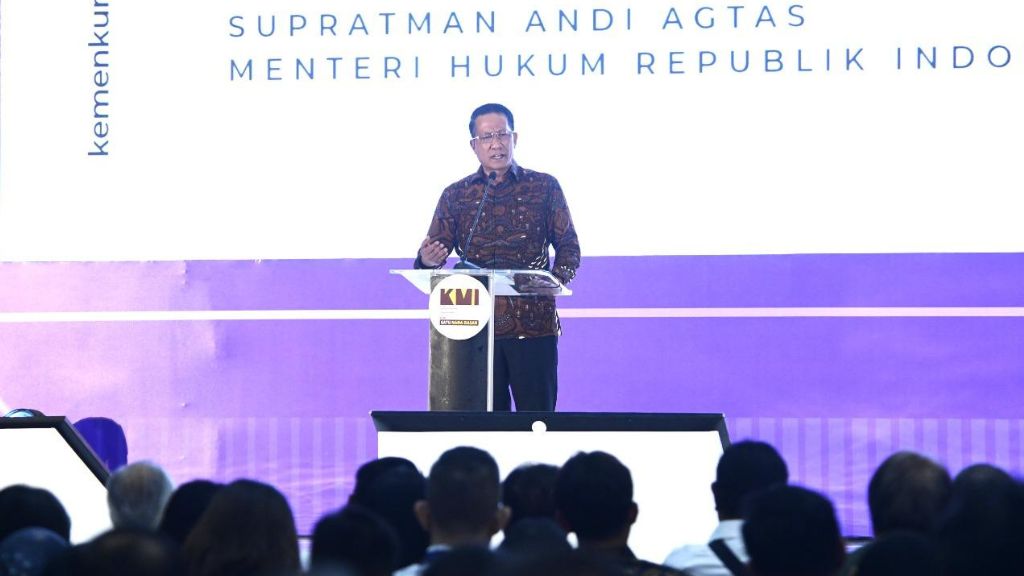
Indonesia’s Ministry of Law is set to issue regulations to protect copyright holders in the era of artificial intelligence (AI) disruption. Image: Ministry of Law of the Republic of Indonesia
As artificial intelligence (AI) reshapes how content is produced, shared and valued, Indonesia is taking a decisive step to protect its creators.
Indonesia’s Ministry of Law is currently developing a policy that would allow intellectual property (IP) certificates to be used as collateral for bank loans.
This move could unlock new sources of financing for artists, journalists, and other creative professionals who have long struggled to monetise their work in an increasingly digital world.
In his opening remarks at the Indonesia Digital Conference (IDC) 2025 on October 22 in Jakarta, Minister of Law Supratman Andi Agtas said the initiative would transform how creators, artists, and journalists leverage their works as intangible assets.
“This policy aims to expand access to financing for creators, help them grow their businesses, and strengthen the foundation of Indonesia’s creative economy.”
Under the new framework, creative works such as music, films, writing, and design would be recognised as intangible assets with measurable economic value.
This would mark a major shift in how creative output is treated and not merely as cultural expression but as legitimate capital, he added.
If implemented, Indonesia would join countries such as the US, China, Japan, Singapore, and Malaysia, which have already recognised IP as a bankable asset within their financial systems.
To support this policy, the Ministry of Law’s Directorate General of Intellectual Property (DJKI) will digitalise the end-to-end process for copyright registration, making it faster, easier, and more transparent.
“With the digitalisation of copyright registration through the DJKI website, certificates can now be issued in less than two minutes,” Agtas added.
Protecting creators from the AI disruption
According to Agtas, the new policy also seeks to ensure fair compensation for creators within Indonesia’s digital ecosystem, which is currently being increasingly dominated by AI.
With AI having the potential to disrupt entire creative industries, he said that “the government’s role in the royalty ecosystem is to make sure creators continue to benefit economically from their own works”.
One of the most affected sectors is journalism. As AI models learn from millions of online texts, news outlets have seen their content used without consent or compensation.
He argued that journalism – as a cornerstone of democracy – must be safeguarded through publisher rights, giving media organisations control and remuneration when their content is reused by others, including AI platforms.
“By ensuring media can optimise the value of their journalistic work, we preserve the vitality of democracy itself,” he added.
To subscribe to the GovInsider bulletin, click here.
Also speaking in IDC 2025 keynote, Indonesian Cyber Media Association’s (AMSI) Chairperson, Wahyu Dhyatmika, echoed the sentiment.
He cited AMSI internal research showing that nearly 30 per cent of all media website visits now come from AI crawler bots that scrape content to train models without offering any form of compensation.
“They use our content to create new material, but they don’t pay us – while media outlets must still pay their editorial staff and server costs. This is becoming a crisis of existence for journalism,” said Dhyatmika.
Without fair compensation, he added, news organisations risk losing their value in the eyes of advertisers.
The Jakarta Protocol as the ministry IP diplomacy
During IDC 2025, Minister Agtas introduced the “Jakarta Protocol”, a multi-sector initiative focused on protecting and utilising digital works particularly in music, audiovisual, and journalism, within the global online ecosystem.
The idea, he explained, was born from the urgent need for developing countries to achieve fairness in the global digital ecosystem – a concern frequently raised in international forums held by the World Intellectual Property Organisation (WIPO).
He noted that creators from developing countries have long faced unequal royalty distribution, even when their works are widely used.
“This is not about rates, it’s about fairness. Why do global digital platforms receive the largest share while [local] creators get only 15 per cent? This is what we must fight for,” he emphasised.
Agtas has planned to bring the Jakarta Protocol to Geneva for discussion at the upcoming WIPO meeting. The goal is to make the Jakarta Protocol not only a national framework but also a global reference for fairer royalty distribution in the digital age.
“The Jakarta Protocol is Indonesia’s concrete contribution to ensuring that IP becomes a catalyst for a more equitable, transparent, inclusive, and sustainable global economy,” he concluded.