
Papua New Guinea’s journey toward universal ID: How SevisPass and SevisWallet are building a more inclusive future
The launch of SevisPass — PNG’s national digital ID — and the companion SevisWallet app in late 2025 bring public services closer to remote communities in the country.
-1775439762705.jpg)
Jessy Sereke is the DPI Program Lead at Department of Information and Communications Technology (DICT), Papua New Guinea, while Fithya Findie is Country Operations Advisor (Asia) at Centre for Digital Public Infrastructure (CDPI). Image: Sekere; Findie
In 2018, Mina, a 55-year-old woman from Buka in the Autonomous Region of Bougainville (AROB), Papua New Guinea (PNG), needed to apply for a passport.
Like many Papua New Guineans, she first needed a birth certificate and a Papua New Guinea National Identification (PNG NID) card — and had neither.
With no ID office in AROB, she made three return trips to Kokopo, East New Britain Province, a 50-minute-flight each way. After three return trips, Mina managed to get her birth certificate, but she still could not complete her ID registration due to additional financial requirements.
In the end, she abandoned the effort.
According to the World Bank, around 850 million people worldwide lack any form of official ID. The barriers are familiar: strict document requirements, distance to registration points, and high costs.
Without an ID, people are excluded from essential services, opportunities, and rights.
The scale of the challenge in PNG
Mina’s story is far from extraordinary. PNG’s geography makes universal registration especially difficult.
As of early 2026, only about 4.2 million of an estimated 10.1 million total population have been registered under the NID system since its inception in 2014.
And from those registered, only 5 per cent have received their physical NID card, the remainder remain in processing queues. Birth registration rates also remain the lowest globally.
UNICEF indicates that as of 2024, 87 per cent of children in PNG had no birth certificate, making it harder to obtain an ID later in life.
To address this, since 2024, the government with the support from UNICEF have deployed mobile registration kits to bring birth registration services closer to remote communities.
A new approach: SevisPass and SevisWallet
The launch of SevisPass — PNG’s national digital ID — and the companion SevisWallet app in late 2025 offers a genuine path forward.
For SevisPass, the individual registers once, verifies their identity and they can start using it on their phones whenever needed to prove who they are —while opening a bank account, registering for a SIM card, or for a government service.
What sets SevisPass apart is its tiered design.
Rather than requiring everyone to have the same documents from day one, the system meets people where they are.
The true value-add is that each tier unlocks meaningful services for citizens and residents, a key factor in driving adoption and utility.
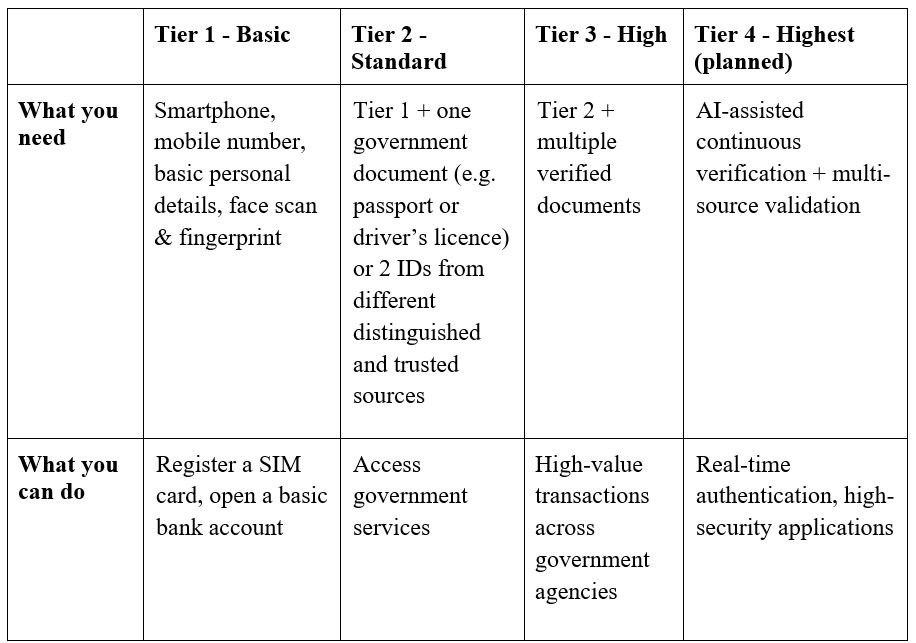
Everyone starts at Tier 1 and builds upward over time as they gather more documentation and their needs grow.
If Mina were to apply for her SevisPass today, she would be able to do it without going to a government office, all in 5 minutes.
SevisPass is currently available on the Google Play Store, with the iPhone (iOS) version to be released soon. Further information is available via the Department of ICT website at www.ict.gov.pg.
SevisWallet is the companion app that puts people in control of their digital identity.
It securely stores government-issued digital credentials, lets citizens share them with verified third parties with their consent, and allows them to manage and revoke access at any time.
Offline and printable credentials feature is available to ensure inclusion for those in low-connectivity areas or without smartphones.
Data Reportal 2026 found that as of 2025, only about 48.2 per cent of PNG’s total population have active cellular mobile connections, and the online penetration rate in the country currently stands at 24.1 per cent.
Both SevisPass and SevisWallet are accessible through PNG’s digital government service portal at www.sevis.gov.pg/about
Built as privacy-preserving digital public infrastructure
SevisPass and SevisWallet are designed as the foundational layers of PNG’s digital public infrastructure (DPI).
Its architecture complies with DPI principles - biometrics used for deduplication purposes; data stays federated, meaning it remains with authorised custodians rather than being stored centrally, allowing agencies to maintain control; only the minimal necessary fields are collected.
Most importantly, it is designed for re-use by both the public and the private sector, and setting up both applications comes at no additional cost to the individual.
From infrastructure to impact: Initial use cases and progress
They say that an ID system’s true value is when it is used by the citizens and adds value in daily life.
The government is preparing the following priority use cases in collaboration with public and private sectors to make sure that SevisPass will serve as a public infrastructure that delivers value and impact for Mina and the rest of the Papua New Guineans.
1. SIM card registration
In January 2026, the Government rolled out a campaign asking all SIM card holders to prepare to link their SIMs with SevisPass via SevisWallet as soon as the SIM regulation comes into effect making SevisPass mandatory for SIM registration.
2. Public services
Next in line are public services, with Government currently engaging multiple agencies to integrate SevisPass across key services.
These include passport integration (to elevate Tier 1 to Tier 2), tax identification number issuance, e-Police Clearance, voter registration and ID issuance, eTitles and landowner identification, Public Service employee IDs, and for integration with government e-recruitment systems—all to be accessible through SevisWallet.
3. Financial services
With over 4.5 million eligible Papua New Guineans remaining unbanked, easing access to banking and other financial services is also underway.
MiBank, a microfinance bank in PNG, is now letting customers open a bank account in under 15 minutes using SevisPass within SevisWallet — no paper forms, no branch visit required.
A growing number of major commercial banks and major superannuation funds are already integrating with the platform, signaling a broad industry shift toward digital financial inclusion.
How the whole of society help deliver success
Through the launch of SevisPass and SevisWallet, PNG has demonstrated a genuine commitment to the DPI approach.
To truly deliver societal transformation and ensure sustainable impact, coordinated action is required from the whole of society—all actors must pitch in.
- Government agencies: Prioritise integration with SevisPass and SevisWallet to eliminate the need for citizens to make in-person visits for services.
- Private sector: Leverage SevisPass for streamlined customer onboarding; and offering innovative products and services.
- Development partners: Provide sustained, multi-year support for the governance of SevisPass, including: strengthening the regulatory framework, improving the governance framework, enhancing data protection safeguards, building robust cybersecurity infrastructure, and investing in connectivity and last-mile digital access to ensure remote communities benefit from digital ID services.
- Civil society: Actively serve as the voice of the citizens, communicating concerns and unexpected service delivery issues to the government.
Finally, the SevisPass team must continue to remain proactive and operate with 'startup' mentality by continuously engaging with its customers (private sector, government agencies, and citizens) using bootcamps, improving the product (e.g., maximising uptimes and fixing bugs), coordinating across the government to resolve policy bottlenecks, and driving overall usage and adoption.
Looking ahead: Measuring what matters
Mina’s three trips to Kokopo, the cost, the frustration, the exclusion — that is what this system is designed to eliminate.
The infrastructure is now in place. Now the work is to make sure the infrastructure is being put to use and it is able to reach everyone.
The ultimate measure of success for SevisPass will not be technology deployed, but lives transformed.
By working collaboratively—government, private sector, development partners, technical experts, and civil society—we can ensure that future generations, including Mina's family and countless others in remote communities like Buka, no longer endure the frustration, cost, and exclusion she faced in 2018.
---------------------------------------------------
Jessy Sekere is SevisPNG & DPI Program Lead, Department of Information and Communications Technology (DICT), Papua New Guinea
Fithya Findie is Country Operations Advisor (Asia) at Centre for Digital Public Infrastructure (CDPI), a non-profit organisation dedicated to fostering the development, adoption, and implementation of DPI globally.