
Permission to fail: How Brazil is reimagining public innovation
By Sol Gonzalez
Brazil’s Ministry of Management and Innovation in Public Services’ Luana Faria hopes to create an environment where people feel safe to question, be curious, and experiment.
-1756377668195.jpg)
Brazil's Ministry of Management and Innovation in Public Services (MGI) is changing the narrative that innovation and technology are always attached. Faria shares how she is overseeing the creation of new policies to guide innovation for the public sector with people-centric approach. Image: Luana Faria.
Resistance to change is oftentimes identified as the main barrier of innovation in the public sector.
But this is a “lazy way to justify the lack of innovation”, says Brazil Ministry of Management and Innovation in Public Services (MGI)’s, Luana Faria.
According to Faria, who is MGI’s General Coordinator for Innovation and Governance, Secretariat for Management and Innovation (SEGES), when people frame innovation as a huge and daunting task, they don’t know where to begin.
“People want to do things differently, want to innovate. But innovation sounds too far away, the word itself is too evasive. So, I like to qualify it - tech innovation or people-centred innovation, for example,” she says.
“Qualifying innovation”, as she calls it, invites people to think about it in less abstract terms. This opens the door for sharing ideas and building networks of innovators.
That’s where Faria has been focussing on for the past six years - through LA-BORA! gov, Brazil's national innovation lab that aims to foster a conducive environment to exchange ideas, co-create solutions and network to innovate and improve public services.
In a conversation with GovInsider, Faria shares about her public service career, the imperative of creating a safe culture for innovation and interestingly, how detaching tech from innovation can drive change.
To subscribe to the GovInsider bulletin, click here.
Yes to innovation… but how?
“The turning point was that when I arrived at MGI, I learned that we have lots of public servants that were very willing to do things differently,” she says.
This is why she thinks that resistance to change is not a constraint to innovation in Brazil’s public sector.
“It’s important to say that public servants in Brazil are highly qualified. We don’t lack the ability or capacity to innovate. Then, why are we not innovating?”
A key insight emerged after conducting further research about public sector innovation:
“We have the ability and willingness to work with innovation approaches, but we don’t have the ambiance to do so. This means we have so many bureaucratic routines that we just don’t have time to put these innovation abilities into practice.
“That is where LA-BORA! gov comes in to build ‘psychologically safe spaces’ where people can be creative, where people are not afraid to question, where they’re not afraid to meet leaders,” she says.
This is what makes an environment safe for innovation, Faria adds.
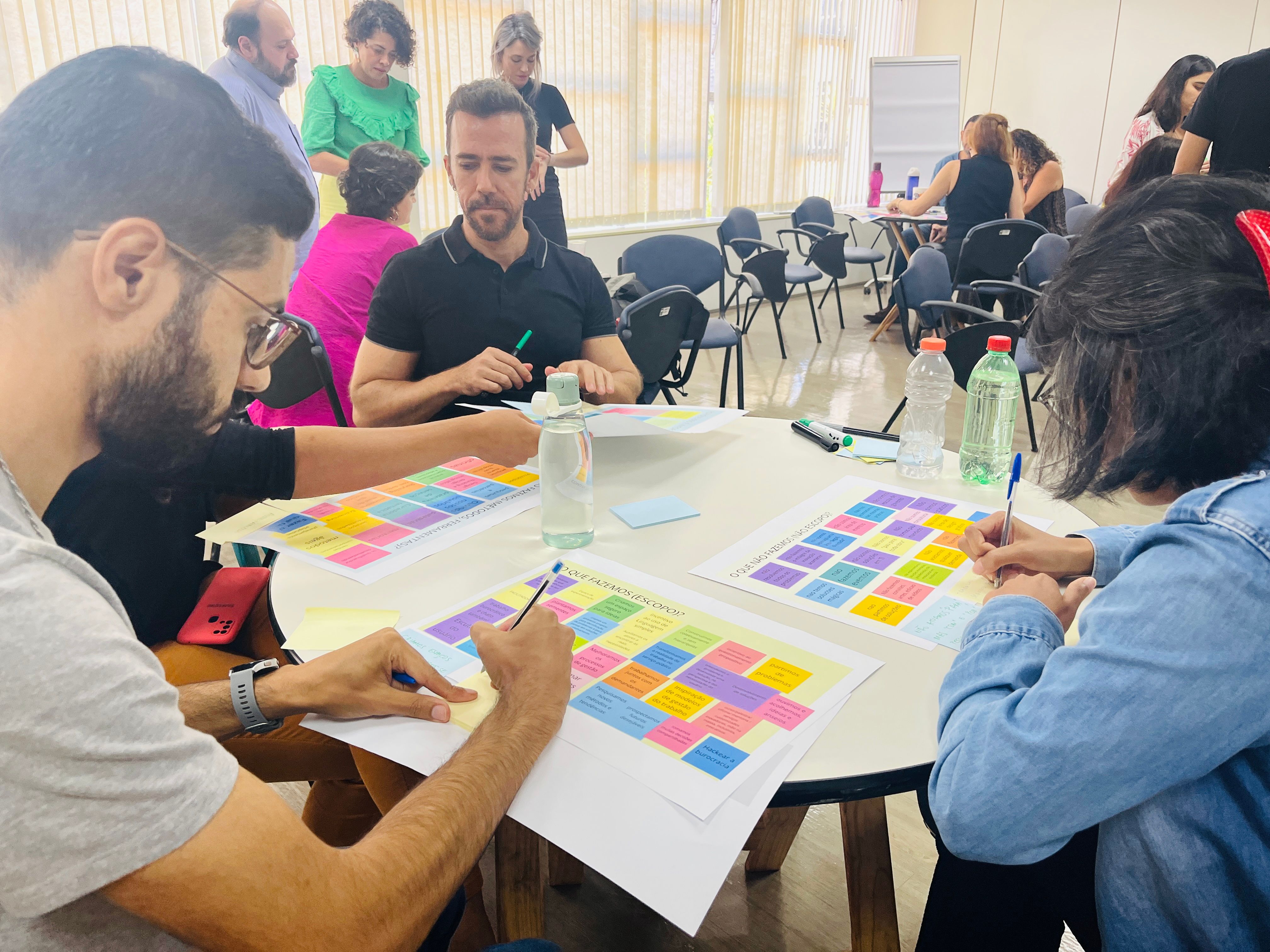
Since 2019, LA-BORA! gov has enabled more than 97,000 public servants across 290 public agencies to co-create and work together on common challenges, by providing them with trust and autonomy.
The lab encourages methodologies like simple language, inclusive and empathetic communication, design-thinking and behavioural science.
Since 2023, the lab includes a Scientific Committee that provides technical and scientific advice on public management.
Through initiatives, workshops, and lectures offered by the lab, Brazil’s public servants can gain the knowledge they need to improve public service delivery.
For instance, in 2020, the lab created two work models to overcome bureaucracy in the public sector and enhance team diversity across agencies.
These working models allow public servants to indicate their interest to work in the lab or a specific public sector challenge, while keeping their employment at their original agency.
According to Faria, employee experience, engagement, and performance are at the core of LA-BORA! gov, highlighting people as the key driver of innovation.
LA-BORA! gov is one of the innovation initiative winners of the Creative Bureaucracy Festival 2023 held in Berlin, Germany, and to this day it has won 11 innovation awards.
It starts with people
Perhaps surprisingly for someone who has been a public servant for close to a decade, it is not a dream career for Faria, she says.

While her family has a history of public service, Faria candidly shares that she didn’t initially pursue a similar path. She notes that working in the public sector only started after her original entrepreneurial goals didn’t pan out.
“I didn’t arrive in the public service with all my heart, at first. I like to say that I became a public servant after I started working as one”
She shares that the spark that ignited her love for public service was working closely with people.
“I started to work with indigenous populations in Brazil and had the privilege to work with the municipalities, working directly with the citizens, the indigenous people, and learning from them”.
This has been a unique opportunity, as it's often difficult for federal public servants to have direct contact with citizens due to Brazil's vast size and population.
With a background in psychology studies, Faria is inspired to connect the human experience to the innovation methodologies and practices she learns and practices.
Serving the public closely has revealed an uncomfortable reality to her: “It didn’t make any sense for us in the federal government to just write legislations, give orientations, and build public services without any contact with the users”.
This inspired her to start thinking about innovation from a people-centred perspective.
With a more holistic understanding of people’s perspectives on public service and what innovation could look like for the citizen, she founded LA-BORA! gov.
To subscribe to the GovInsider bulletin, click here.
Innovation is more than just tech
After six years as a Director of LA-BORA! gov, Faria has transitioned to a more policy-centred role to apply the lab’s learnings through regulation.
As the General Coordinator for Innovation and Governance, she is overseeing the creation of new policies that will orient innovation approaches in the public sector.
In Brazil’s public sector, developing policies for innovation as a standalone topic is a new concept. Faria explains that prior to the current government, the country didn't have a ministry dedicated solely to innovation – as it was always connected to technology.
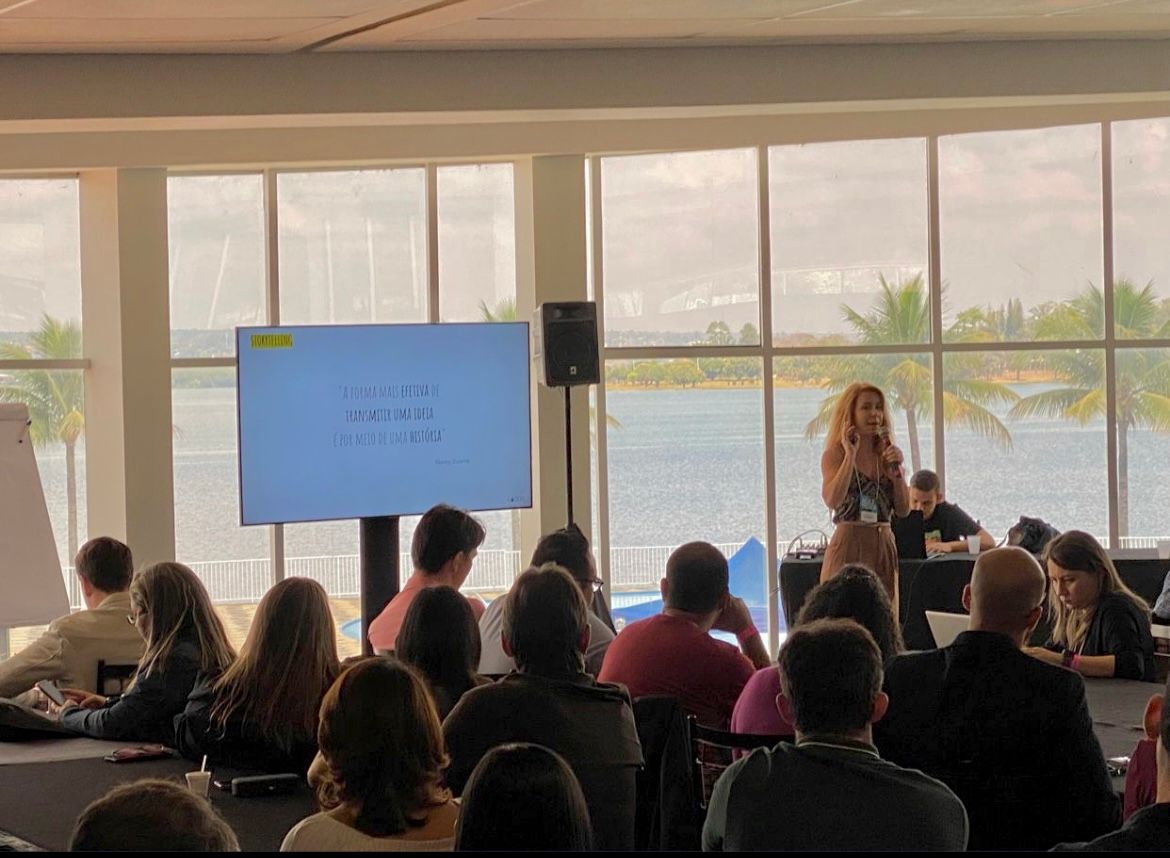
“Innovation and tech were always attached. Now, for the first time, we have a different narrative,” she says, alluding to the MGI.
That’s why the country needs regulation that addresses innovation more broadly, not just in tech, she adds.
“It’s something to give directions for all public servants to innovate and build more trust to innovate too, because without the regulation, people are afraid.
“We need to build the path through regulations to improve innovation in Brazil and to help people to innovate,” she says.
The next months will get busy for Faria and her team as the deadline to develop and publish the policy is from six months to a year.
She says that the “real work” will only intensify after this period as the next step is to create a tool to measure innovative capacity for public institutions.
“We have some measurements but always related to technology… we want to understand innovation in other ways, and many of these criteria are related to people,” she notes.
The aim would be to measure leadership models, innovation initiatives, the rate at which public servants adopt digital technologies, and the overall culture of innovation within the agencies, she explains.
Understanding from the ground
Faria shares that her team is inspired by the Chile government’s Public Innovation Index which measures the innovation capabilities of public services and helps them improve their service delivery.
“We want to measure the capacity for innovating in the public institutions in Brazil and maybe help the worst performing ones to develop capacity, and for the best ones, we want to use their knowledge to help these other institutions,” she adds, as this would also foster inter-agency collaboration.
Readapting the index from Chile was a conscious effort by the Brazilian government to contribute within Latin America, a region Faria believes is ripe for innovation because it has a "need" to innovate.
-1756437320417.jpg)
In Argentina, for example, public servants must adopt creativity and innovation to solve complex societal problems, said Buenos Aires’ Public Ministry’s Head of the 2050 Innovation Programme, Patricio Moyano Peña, to GovInsider last year.
For Faria, “where we can find scarcity, we can find innovation”.
She challenges the common belief that Brazil's most innovative states are the most developed, like São Paulo.
“Why is that not true? Because that is where the light is. In many other places, innovation is thriving, but people don’t even call it innovation—they don’t know they’re innovative. They don’t know because the light is not there.”
With the new policy and its measuring tools, the goal is to find and reach these places "where innovation is happening in the shadows." This, in turn, can help create environments that not only encourage but also reward innovation.
Dealing with today’s challenges first
Faria notes that while policymaking for innovation requires a bold attitude toward futures thinking, dealing with the problems of today is the first essential.
“We need to be really humble to admit we are not future ready, no matter how much we try…we need to understand that we are not present ready. If we are not present ready, we are not future ready,” she says.
As an example, she points out how conversations around artificial intelligence (AI) often focus on its potential to accelerate digitalisation, while rarely addressing its connection to mental health.
She notes that psychological safety is important to be both present- and future-ready.
Recently, some US states have launched regulations that limit AI use for therapy due to chatbots offering dangerous advice.
“People are using AI for therapy, for companionship. People are getting sick [because] of loneliness, and we don’t talk about it when we talk about innovation.”
According to her, innovation and mental health “are totally related”, as reflected in a problem that Brazil currently faces in its public service. In 2024, the greatest number of public servants were away due to mental health.
“This is huge, it’s a problem for the public service, and problem for citizens that expect public service to be delivered”.
This is why she calls for people to start thinking about attaching innovation and mental health and move beyond just technology as a tool or driver for innovation.
To subscribe to the GovInsider bulletin, click here.
What does the future look like?
On future plans, Faria says she would like to change her name – from Faria to Farian’t.
In Portuguese, the word “faria” means “one would do”.
“I play with it. In LinkedIn, for example, my name is ‘what would Luana do?’ So, in the future, if I can change my name, it’d be ‘one wouldn’t do’.”
She explains that this is because her passion for her work drove her to explore countless opportunities throughout her life, so in the future, she seeks to focus on herself.
“I focus on people a lot, and people get inspired by me… that is a huge responsibility, and I built it.
“If you asked me this question eight years ago, the answer would be: I want to inspire people. I want to be a reference. I managed to do it, and I’m so glad.”
Now, she sees her future focussing on what she cares about the most.
As a role model for public servants in Brazil, Faria continues to dedicate her current efforts toward policy and building connections to transform the public sector.