
Teaching the teachers about AI
Indonesian Education Ministry’s decision to introduce artificial intelligence as an elective subject in schools is a promising leap forward but it also raises a critical question: are the country’s teachers truly AI ready?

To prepare a future-ready generation, the Indonesian government is taking steps to integrate AI into its national education system. Image: Canva
Indonesia has taken the right decision to catch them early.
By introducing artificial intelligence (AI) as an elective subject in primary and secondary schools, the country hopes to develop a generation of AI ready citizens for the new age digital economy that was being shaped around us.
While this kind of planning for the future was truly commendable, execution was the key.
The question that needs to be asked was, does Indonesia have enough teachers well-versed in AI to teach youngster the fundamentals of this technology, which is changing the way we live, work and play?
Under the Minister of Primary and Secondary Education Regulation No 13/2025, AI and coding have been officially included in the national education curriculum as elective subjects.
This aimed to equip students to face future technological developments and also aligned with the strategy of catching them young as far as developing AI skills in the population was concerned, a strategy that has been followed by several countries including Singapore.
Indonesian Minister of Primary and Secondary Education Abdul Mu’ti said that the AI and coding subjects were intended for students from Grade 5 to senior high school, Tempo previously reported.
Schools that have both the infrastructure and resources could offer AI courses at earlier grades.
He also claimed that more than 50,000 schools were ready to implement AI classes.
However, readiness didn’t necessarily mean the teachers were ready.
Are teachers fully prepared?
AI education presents unique challenges in terms of teacher ability was concerned.
It's important to note that not all teachers in Indonesia have previously studied computer science or IT. Even for IT graduates, AI is relatively new.
As a result, not all teachers were familiar with the basics of the technology such as the difference between machine learning and AI or what natural language processing was and also understand the importance of ethics in AI.
This could lead to students taking the subject but in school not developing an adequate understanding of the concepts behind AI.
To further complicate matters, AI as a technology was evolving at a super-fast pace with generative AI (GenAI) and agentic AI taking the technology to a new direction over the past three years.
Guru Belajar Foundation’s Maman Basyaiban made the important that, often, teachers felt that their students were more proficient in using AI than they were.
This created a unique dynamic where teachers were no longer the sole source of knowledge in the classroom, and instead, became facilitators of an evolving learning process.
In this situation, apart from learning more about AI as a subject, teachers also had to move on from the one-way teaching methodology that they have been used to, that is of imparting knowledge to a new role of facilitating knowledge sharing within the cohort group.
In order to truly meet its ambition of imparting AI education during the students’ formative age at school the government has to prepare teachers by imparting the necessary skill sets to them to make them competent teachers of AI.
To subscribe to the GovInsider bulletin, click here.
Comprehensive training
The efforts to train teachers in AI have actually been implemented, although the government has not specified the number of teachers who have received AI training in the past year.
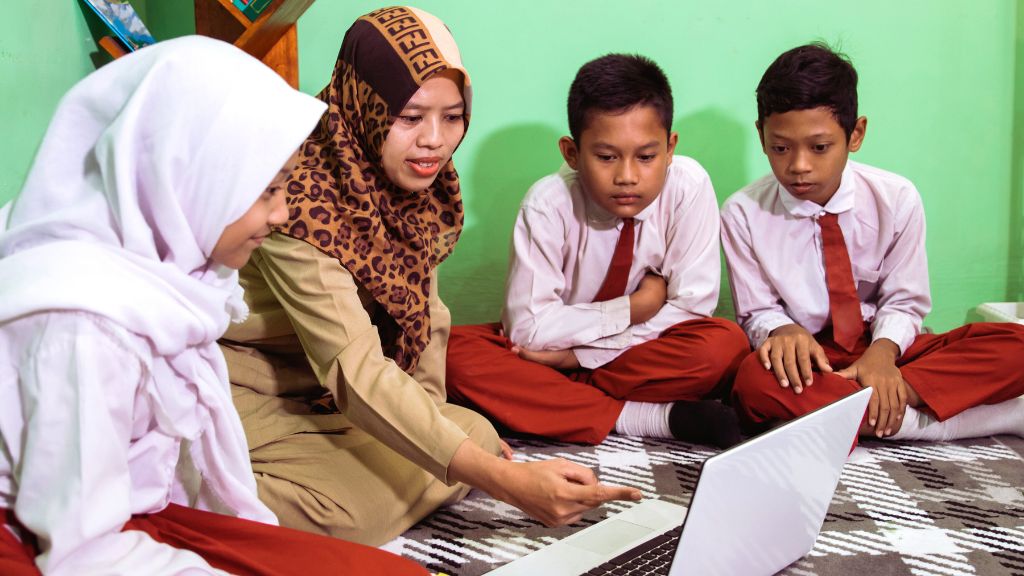
However, the teacher’s AI training was still a fragmented process.
Most of the training was organised by private tech companies and non-profit institutions, where most of them target schools in big cities and private schools that already have internet access and digital learning devices.
This may potentially deepen the inequality between teachers teaching in big cities and those in small cities or remote areas in terms of AI proficiency.
The government needs to prepare a national training programme that is comprehensive, structured, and continuous for teachers, accompanied by ongoing assistance or updated materials as AI technology evolves.
The training materials taught should not only be limited to basic knowledge but also include practical examples of AI use in education and the pedagogical skills needed to teach this subject.
Teachers bear the greatest responsibility
When teaching AI, teachers will bear extra responsibilities; they would have to explain AI and its benefits to students, while also equipping them with knowledge of the potential dangers posed by the technology.
Some education practitioners have warned that the use of GenAI without ethical and strong regulatory framework will negatively impact education: from permissive attitudes toward plagiarism to the decline of students' critical thinking skills.
Studies from top universities highlighted that extensive use of large language models (LLMs) for routine tasks can lower our native critical thinking ability, as GovInsider previously reported.
In this context, teachers will take on a greater role to ensure that students remain critical, creative, and not become too dependent on GenAI.
Adaptive and standardised learning modules
If Indonesia was serious about preparing a future-ready generation, the government must develop adaptive and standardised AI learning modules to provide guidance for teachers in preparing materials, developing teaching methods, and creating assessments system.
Currently, the Indonesian Agency for Standards, Curriculum, and Educational Assessment (BSKAP) has been drafting a national AI curriculum framework for primary and secondary education, referring to the global framework developed by UNESCO.
However, the work is still in progress.
In this regard, Indonesia can learn from other countries that have already developed clear and measurable AI learning modules.
For example, Singapore has launched the AI for Fun initiative this year for both primary and secondary students. These include modules designed to allow elementary school students to experiment with GenAI and smart robots.
As part of the country’s updated Smart Nation vision, AI for Fun builds under the previously introduced Code for Fun module.
Like Singapore, China has been gradually integrating AI into its primary school curriculum since 2018. With a centralised approach, the country now has a national AI textbook, enabling students to become familiar with AI from an early age, develop critical understanding, and engage in real-world problem-solving.
Teacher involvement from the earliest stages of AI curriculum design was also crucial, as they were the key to this programmes success.
Teachers must be given the opportunity to understand, adapt to, and integrate their knowledge of AI into cross-disciplinary learning.
Equally important, the government must address the digital infrastructure gap between regions to ensure that every school has an equal opportunity to implement AI as a subject.