
The most important thing governments should measure is what they don't know
By Igor Lys
Governments love to innovate, but novelty is not the same as progress. Innovation is simply the implementation of something new, while progress is achieving something better.
-1793838257330.jpg)
Government Tomorrow Summit in Berlin this October. Image: Lys' LinkedIn
If there is one thing I learned during my work as a government advisor and later as the President of Government Tomorrow Forum (GTF), it’s that governments love measuring things.
Budgets spent, applications processed, waiting times reduced, satisfaction rates improved.
Every public administration has its dashboards, performance indicators, and evaluation procedures.
In some countries, the sophistication of these instruments has become a source of national pride.
And yet, I would argue that we are still remarkably bad at answering one fundamental question: does the government actually work?
Not whether a particular department meets its targets, not whether a digital service has attracted enough users… Not even whether a policy has delivered its promised outputs.
But whether the government, as a complex system of institutions, decisions and interactions, is achieving what it exists to achieve.
While it might seem that this is some sort of abstract philosophical question (and after all, I am French), it is not. The question is as practical as it can be.
When success conceals failure
Imagine a government that proudly announces it has reduced the average processing time for a public service from fifteen days to three.
Excellent news, surely!

But what if the service is unnecessarily complicated in the first place? What if citizens are regularly submitting incorrect applications because the instructions are incomprehensible?
What if the department processing them has become remarkably efficient at transferring problems to another department?
The performance indicator would show success, and the government keynotes at various conferences will be spectacular.
But the citizen experiences something entirely different.
We have become so accustomed to measuring what is measurable that we sometimes forget to question what ought to be measured.
And there is another problem: public institutions rarely operate in isolation.
A citizen's experience of government does not necessarily follow the neat organisational boundaries of a ministry, a municipality or an agency.
A successful policy may depend on several institutions working together, sometimes without sharing the same definition of success.
Yet our evaluations often reproduce precisely those institutional boundaries.
I have seen in my work cases where different departments of the same ministry hired the same advisor to do more or less the same work.
The advisor did not complain, but they never gave the advice that made the most sense: de-silo both knowledge and action.
We assess departments rather than interactions, outputs rather than outcomes, and compliance rather than purpose.
Innovation is not progress
This distinction became central to our work at Government Tomorrow Forum, particularly during our Governance Lab in Geneva in March 2026.
When we met with the group of extraordinary people (from Kelly Ommundsen from WEF to Carlos Santiso from OECD, passing by the genius Leonardo Quattrucci and Marcelo Cabrol who advises the Vatican on artificial intelligence), we started from a simple observation.
Governments are enthusiastic about innovation, but we do not always ask whether that innovation produces actual progress.
I like to formulate the distinction this way: innovation is the implementation of something new. Progress is the achievement of something better.
A government can introduce artificial intelligence (AI), replace its legacy systems, launch a beautiful mobile application and win an innovation award, all without fundamentally improving the lives of the people it serves.
The challenge is to measure progress in a way that accounts for the complexity of government.
This is the idea behind GTF Pathways, the evaluation methodology we developed through the Forum's research work and presented at the Government Tomorrow Summit in Berlin this October.
Rather than treating government performance as a collection of disconnected indicators, Pathways examines public services and policies through three interconnected dimensions: Technology, Human-Centricity and Prosperity.
Each contains three indicators, making nine in total. And the important part is that they are designed to work together.
Three pathways to a better government
The first pathway, Technology, examines speed, availability and quality.
Is the service delivered quickly? Is it accessible when and where people need it? Does it function reliably and deliver the expected result?
These may seem like conventional performance questions, but technology is only one part of the equation.
The second pathway, Human-Centricity, examines adaptability, language and seamlessness.
Can the service accommodate different circumstances and legitimate individual needs? Can an ordinary person understand its instructions without requiring a degree in public administration? And most importantly, does the government manage administrative complexity internally, or does it force citizens to navigate that complexity themselves?
I consider seamlessness particularly important. A citizen should not need to understand the internal architecture of government to receive a service.
Finally, Prosperity examines equality, stability and opportunities.
Does the service work fairly for different groups of people? Can citizens rely on its continuity and consistency, including during crises? And does it merely complete an administrative transaction, or does it actually create opportunities and improve people's ability to live, work and prosper?
This third pathway pushes evaluation beyond the immediate interaction between an individual and a public institution.
A service may be fast, technically excellent and easy to use, yet still fail to contribute meaningfully to the public good.
A government’s ultimate product is not an application, but the conditions in which society can flourish.

From nine indicators to a Government Service Passport
Making the nine indicators useful to governments is much harder.
This is why, in the month following the Lab, we used the Lab research to develop the GTF Government Service Passport, an interactive evaluation tool.
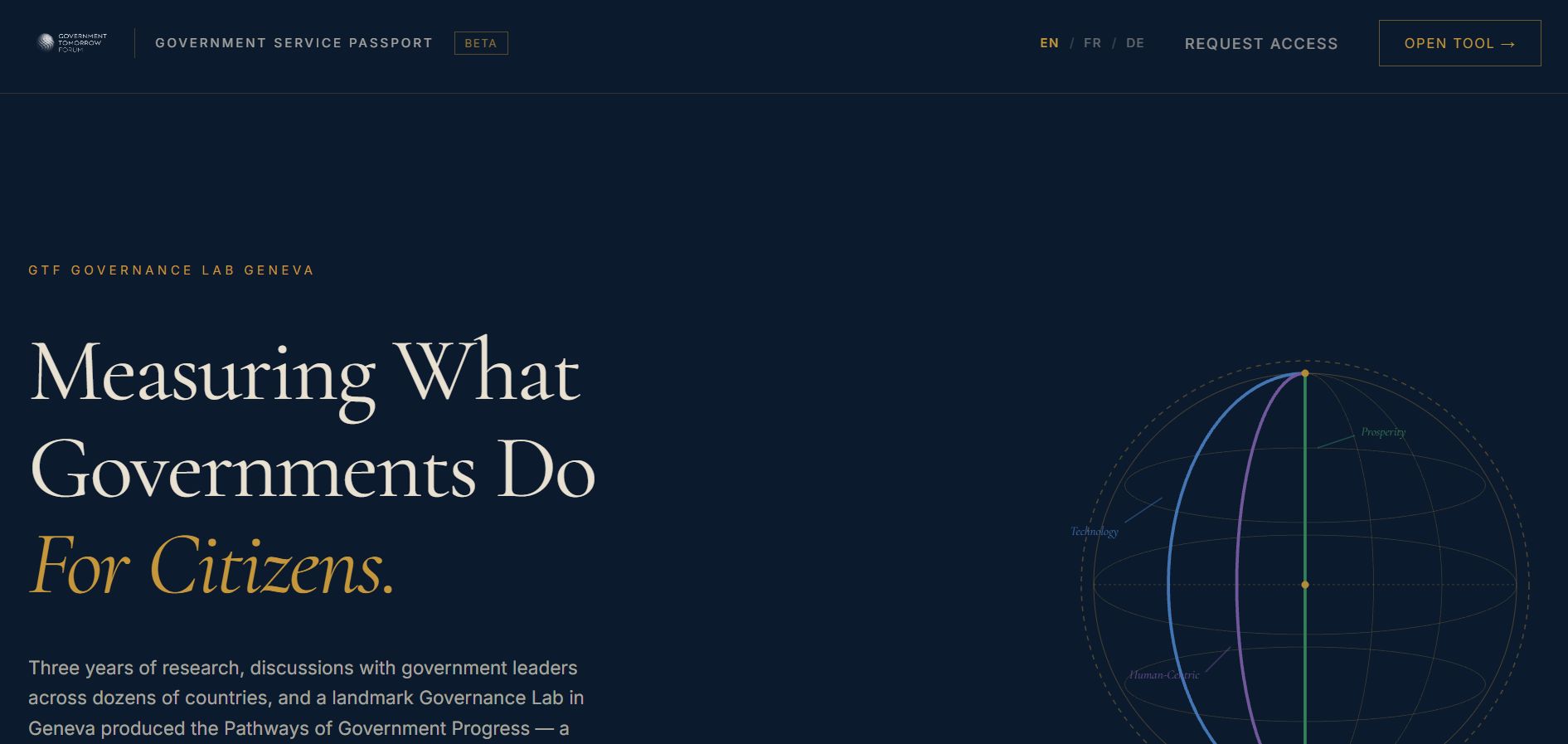
The tool is a questionnaire that examines the service from multiple perspectives: its objectives and design, how it operates, how people interact with it, the institutions involved, the evidence supporting its performance, and its broader effects.
The answers feed into the Pathways assessment, helping identify gaps across the nine indicators and translating them into a structured view of the service.
We presented it at our Government Tomorrow Summit in Berlin last October, and I am happy to see that the response has been very enthusiastic.
Imagine, for example, a digital service for business permits.
Its Technology indicators may look excellent: applications are processed quickly, the platform is available around the clock, and technical errors are rare.
But the Human-Centricity assessment might reveal that applicants struggle with administrative language, that unusual cases are poorly accommodated, or that businesses repeatedly provide the same information to different authorities.
And the Prosperity assessment might raise further questions: does the service work equally well for smaller businesses? Is it resilient to disruptions? Does it genuinely make entrepreneurship easier?
A holistic assessment reveals tensions, dependencies and weaknesses that isolated performance indicators can easily conceal.
By examining all nine indicators together, the Passport provides a basis for identifying what deserves attention, where evidence is missing, and which improvements may require cooperation across institutional boundaries.
The process itself oftentimes is valuable.
A sufficiently thorough questionnaire forces people to consider questions they might never have asked within their normal departmental responsibilities.
And sometimes the person completing it does not have the answer.
That is not necessarily a failure: it may be the first indication that another department needs to join the conversation.
A different way to think about government performance
GTF Pathways is not intended to replace every existing KPI, auditing mechanism or policy evaluation instrument.
The Pathways are a method of work, and our key idea is to force agencies to iterate on their thinking, as the system constantly underscores the gaps in the current understanding of a service or a reform.
Through these iterations, we can help set up a holistic framework that will help institutions understand public services more comprehensively and identify practical opportunities for improvement.
The methodology and its supporting tool are still developing, and their value will ultimately depend on how effectively governments and advisors put them to work.
But the underlying principle is one I believe should guide public sector reform more broadly: we cannot improve government by optimising its individual parts while ignoring how those parts work together.
The next time your institution celebrates an improvement in a performance indicator, I would suggest asking three additional questions:
Has the service become better for the people who use it? Has it become better at working across the institutions responsible for delivering it? And has it become better at producing the wider public value for which it exists?
If the answer is "yes” to all three, that is something worth celebrating.
And the conference keynote will probably be spectacular, too.
--------
The author is the Founder and President of Government Tomorrow Forum (GTF), an international platform dedicated to developing practical ideas and methodologies for the future of government. GTF Pathways and the Government Service Passport can be explored at gtfpathways.com.