
Trinidad and Tobago flips the DPI script by starting with credentials launch
IGovTT launches VerifyTT with ready-to-implement use cases, starting with academic certificates and job credentials, followed by civil records and police-issued documents.

The launch concluded with a panel discussion examining the role of digital credentialing in T&T, moderated by iGovTT, and featured representatives from the Ministry of Public Administration and Artificial Intelligence (MPAAI);
United Nations Development Programme (UNDP); Centre for Digital Public Infrastructure (CDPI); T&T's Cyber Security Incident Response Team; and Deloitte. Image: CDPI
For years, proving your qualifications in Trinidad and Tobago (T&T) has been about the paper chase.
Graduates in the Caribbean country would typically submit a request for the official transcript, wait weeks for the registrar’s office to process it, pay for certified copies, stuff them into a paper envelope and courier them to a prospective employer, hoping that nothing gets lost in transit.
The same process repeats again the next time someone asks.
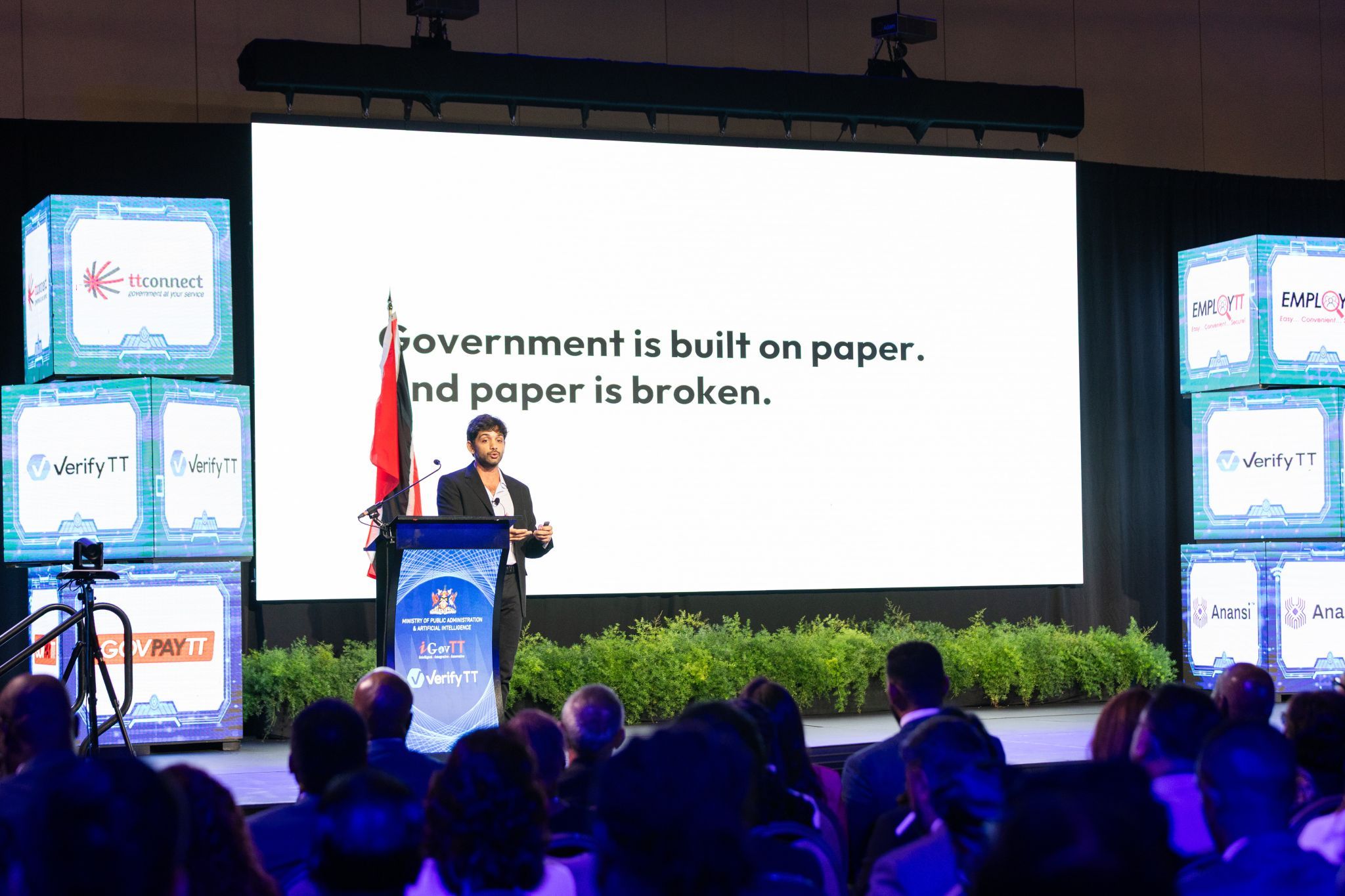
Fortunately, this would no longer be the case this week with the launch of VerifyTT by iGovTT, the govtech agency under the country’s Ministry of Public Administration and Artificial Intelligence (MPAAI).
VerifyTT is a national credentials platform that lets citizens store and share official documents from a mobile wallet instantly and securely, with no paperwork, no wait and no middlemen.
The platform was launched on April 22, where the government announced three use cases, including academic and employment credentials, civil records and police-issued documents, and its commitment to scale it to other sectors.
T&T flips the script
T&T was betting on a different approach to digital public infrastructure (DPI) order, one in which credentials could be built without solving the digital ID layer first.
Technewstt's reporting highlighted that the digital ID project in T&T has been attempted and stalled for the past 15 years, with the main challenges being inter-ministry infighting, lack of legislation and political will.

Most countries treat DPI as a sequential stack, starting with digital ID as a foundational layer to utilise for financial inclusion and government services, followed by payments and data exchange.
T&T has flipped the order of DPI, partially by design due to the immediate use cases available as well as the abovementioned circumstances.
At the VerifyTT’s launch event, iGovTT's CEO Charles Bobb-Semple emphasised the importance of trust enabled by VerifyTT.
“Our focus [with implementing VerifyTT] has been execution - ensuring that what is designed is not only innovative but works; not only ambitious, but sustainable; and not only global in concept, but practical for the people of Trinidad and Tobago.”
First live use case in education
The education sector was the first live use case of the VerifyTT platform.
VerifyTT was integrated with EmployTT, the national job portal, letting job seekers share verified credentials directly with prospective employers.
The Minister of Tertiary Education and Skills Training, Professor Prakash Persad, noted that prior to the launch, some groundwork with the tertiary institutions was done to ensure that the institutions could start issuing digital, verifiable degree, diploma and certificate credentials.
So when VerifyTT went live, it launched with eight institutions.
Aside from issuance, the institutions could cryptographically sign and secure the qualifications.
These credentials are then stored in the job seeker's mobile wallet, and shareable with an employer or another institution.
This also applies for continuing education and adult learning courses. LearnTT, the national online learning platform specialising in digital tech courses, will be able to issue digital, verifiable certificates.
Notably, T&T’s digital credentials can be recognised across borders as VerifyTT adopts open international standards.
Civil records and police-issued documents next
The launch also saw two memoranda of understanding (MoUs) signed with other government agencies that will extend VerifyTT into documents citizens need for everyday transactions.
The first is Registrar General’s Department (RGD) using VerifyTT to issue civil records, including birth, marriages, and death certificates, in the first phase.
This allowed citizens at home or abroad to securely store and share government-issued credentials.
The Minister of Land and Legal Affairs and Mister of Agriculture and Fisheries shared at that civil records, including land records, were previously QR-coded and could now be integrated into VerifyTT.
“That allows for faster authentication, reduces the risk of fraud, and gives citizens and institutions greater confidence in the validity of official records,” he explained.
The second is T&T’s Police Service (TTPS) using VerifyTT to issue Certificates of Character, which are documents stating whether an individual has a criminal record and are commonly required for job applications, visa processing and other transactions.
DPI as a packaged service
The Centre for Digital Public Infrastructure (CDPI) previously reported that the VerifyTT project marked the “first-ever implementation of DPI-as-a-Packaged Solution (DaaS)”.
CDPI’s Chief Strategy Officer, Kamya Chandra, previously told GovInsider that the DaaS approach allows governments to develop their DPIs within six months.
The Minister of MPAAI, Dominic Smith, at the event underlined the importance of DPI as a “foundational layer” that facilitates the government’s broader transformation agenda.
“We are not going to be mere purchasers of technology. We are going to be active participants in the new wave of digital transformation,” he said.
According to iGovTT's Bob-Semple as cited by Technewstt and TV broadcasting news tv6tnt, VerifyTT project was enabled by a government-to-government partnership between T&T and India.
More than a year ago when the project was initiated, Biometric Update revealed that it was implemented with Deloitte as the service provider, Inji mobile wallet providing the digital public good, Co-Develop as the funder, and CDPI as the orchestrator.
You can find more stories about iGovTT on our global digital government directory here.