Indonesia must focus on the problems AI is meant to solve, says Vice Minister
Oleh Yuniar A.
Instead of focusing solely on accelerating tech adoption, Vice Minister of Higher Education, Science and Technology, Stella Christie, urged stakeholders to think about how the country could build meaningful AI capabilities while preserving uniquely human abilities.
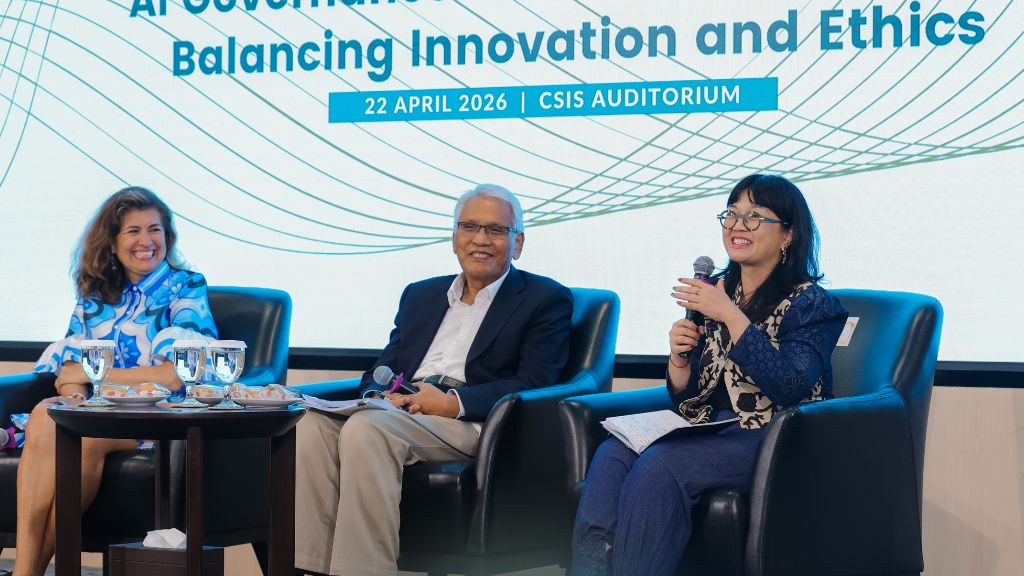
Vice Minister of Higher Education, Science, and Technology, Stella Christie (right), emphasised the importance of cognitive learning as a core human capability that cannot be replaced by machines. Image: CSIS
Indonesia needs to stop seeing artificial intelligence (AI) merely as a technology trend and start asking a more fundamental question: What national problems does the country want to solve?
“Without that question, we will only become users, not creators,” said Indonesia’s Vice Minister of Higher Education, Science and Technology, Stella Christie.
Christie delivered the keynote address at the AI Governance for the Greater Good: Balancing Innovation and Ethics event organised by the Centre for Strategic and International Studies (CSIS) in Jakarta on April 22.
According to Christie, having a clear sense of purpose would shape the direction of Indonesia’s future investments in AI, be it in talent development or R&D around open-source ecosystems to align with national priorities.
She warned that without a clear strategy, Indonesia risked becoming more like a data supplier for global AI companies without gaining added value in return.
“I hope we could have more discussions about how to make AI useful for Indonesia, rather than the other way around,” she said.
Rather than focusing solely on accelerating tech adoption or debating about the threat of automation, Christie urged the government, universities, and industry to think more deeply about how Indonesia could build meaningful AI capabilities while preserving uniquely human abilities that machines cannot replicate.
Thinking processes mattered more than results
During her presentation, Christie highlighted the growing hype around generative AI (GenAI), particularly in the education sector.
In her view, AI literacy was often misunderstood as simply knowing how to use AI applications.
What mattered more was the ability to think critically and assess whether AI outputs were accurate and relevant, or potentially misleading.
She cited research from the Massachusetts Institute of Technology comparing three groups of students: ChatGPT users, search engine users, and brain-only users.
The study found that students who relied on their own thinking abilities produced the best essays, while the ChatGPT group performed the worst.
For Christie, the findings were a reminder that education in the AI era should not focus only on tech adoption, but also on helping students understand the thinking processes behind adoption.
Ultimately, AI still did not learn like humans
Drawing on her cognitive scientist’s background when she used to study how intelligence is built, Christie highlighted the difference between how AI and the human brain learn.
“One of the biggest differences between the human brain and AI is that humans can learn from very small amounts of data,” she said.
Today’s AI systems remain heavily dependent on vast datasets. In general, the larger the dataset, the better the model performs.
Human intelligence, however, works differently.
A three-year-old child could master their native language without formal instruction.
Young children also rarely confuse everyday objects such as cups or bicycles, despite encountering only a limited number of examples throughout their lives.
AI systems, by contrast, can still make mistakes even after being trained on millions of data points.
“The human ability to understand concepts, form abstractions, and draw conclusions from limited information is an advantage we must preserve,” Christie added.
This was why the country’s largest investments should be directed towards talent and human capital development, she emphasised, particularly in strategic areas relevant to Indonesia’s needs.
Ethics and innovation could not be separated
Christie also rejected the idea that ethics and innovation were inherently in conflict.
She referred to the founding of Anthropic, the AI company established by former OpenAI researchers over concerns about the direction of AI development.
According to Christie, the decision demonstrated that scientists were still guided by integrity and moral responsibility.
She said the message was particularly relevant for Indonesia, where research and academia were still often seen as lacking direct societal impact.
She stressed that scientific curiosity, not commercial demand, often drives some of the most transformation technologies that deliver real-world value rather than quick returns.
Indonesia between two global AI powers
During the Q&A session, Christie addressed concerns about the dominance of large AI models from the United States (US) and China over countries in the Global South.
Responding to a question from a European Union delegate about bias and dependence on large language models (LLMs), she said Indonesia needed to understand its strategic position within the global AI value chain.
According to Christie, AI was fundamentally built on three main components: algorithms, data, and computing power.
“When it comes to algorithms, we have to be realistic. It is extremely difficult for Indonesia to catch up with the US or China,” she said.
The same applies to computing infrastructure, which required investments of hundreds of millions of dollars just to train a single large-scale AI model.
However, Christie believed Indonesia possessed another important asset, which is data.
As the world’s fourth most populous country, Indonesia had a vast amount of data that had yet to be strategically utilised.
“If we control the data, we can buy algorithms and computing power,” she said.
For that reason, she argued that countries in the Global South needed to start treating data as a strategic asset rather than merely a by-product of digital activity.