GovTech Singapore stresses need for shared platforms as AI agents move into citizen services
At its STACK conference, GovTech’s CE Goh Wei Boon said AI agents are only as capable as the platforms they run on, and warned that agencies building their own risk creating tomorrow’s legacy systems.
-1793860762378.jpg)
GovTech Singapore Chief Executive, Goh Wei Boon, delivering a keynote presentation at the STACK Conference on November 4. Image: GovTech Singapore
A resident asked an artificial intelligence (AI) voice assistant to book a badminton court near Bishan on Monday morning.
The agent finds the nearest available slot and with the resident's permission, it fills in the resident’s details from their profile, accepts the standard declarations and takes payment.
The demo was shown at GovTech Singapore's STACK conference on November 4, and is for a public facility booking system that the People's Association (PA) plans to trial in 2027.
In his keynote, GovTech's CE Goh Wei Boon, said that an AI agent is only as capable as the platforms it runs on – as showcased in the demo's seamless steps from verifying the resident's identity to processing payment.
"When AI agents can generate large amounts of code quickly, our engineering foundation becomes even more important," he said.
Harnessing potential from a decade's work of building foundations
"Over the past decade, we have engineered digital government at scale, making everyday life simpler for citizens and businesses," said Goh.
As GovTech turns ten this year, Senior Minister of State for Digital Development and Information, Jasmin Lau, used Singpass as an example to underline the importance of foundations.
Ten years ago, she recalled that it was mostly a password that people kept forgetting.
Today, it is how most people start a transaction with government.
"That is what good infrastructure does. After a while, you stop noticing it," she noted.
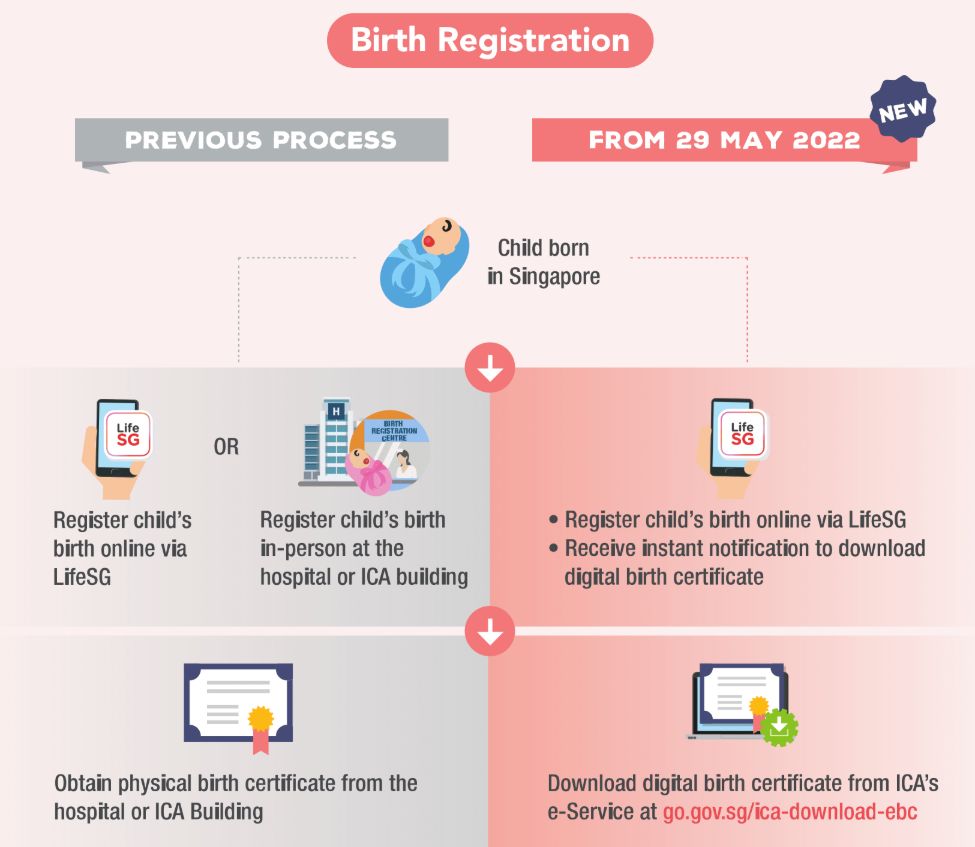
Goh also opened his keynote with an example of how parents register for a newborn today.
Parents once had to first get a certificate of live birth form from the hospital, then head down to the immigration office with their own IDs, marriage certificate and this form to register for their baby.
Today, a parent only needs to log into LifeSG, pays online, and downloads the child's digital birth certificate.
In the same app, parents can also apply for the Baby Bonus, which opens a Child Development Account (CDA), and sign up their child for library membership.
According to the LifeSG's page, the registration takes about 15 minutes, compared with 60 before.
The same infrastructure and foundations stand important even as AI start to transform citizen services.
AI can now produce a working code in minutes, which makes it tempting for any agency to spin up its own application for their own needs.
Goh warned that agencies that build their own siloed, disconnected applications would end up creating legacy systems of tomorrow.
Government can harness AI’s speed and potential if agents are built on strong, interoperable platforms.
What a good platform looks like to GovTech
Over the past ten years, Goh said that GovTech has built reusable platforms for areas such as identity, case management and workflows.
Agencies can combine them to build larger services faster, more cheaply and more resiliently.
According to him, these shared platforms need to be reusable, easily configurable by agencies, interoperable so they can be combined, and usable by AI agents to comb across different agency's platforms and services.
Minister Lau shared what EnterpriseSG gained from onboarding into the Standard Data Platform.
In just four months, the agency started using it for trade intelligence and forecasting.
The platform also allowed the officers to leverage AI tools to ask questions of enterprise-wide data in plain English.
"It means the EnterpriseSG team now spends its time on enterprise problems, not on rebuilding data pipelines. Building good and shared foundations allows us to work on harder things," she said.
Goh also demonstrated WebSG, which is an AI-assisted website builder that turns a brief, a document or a reference image, into a website that agencies can adjust and publish themselves, without developers.
Why agents raise the stakes
As agents begin to act and not just answer, the case for shared platforms grows stronger.
Shared platforms are also where guardrails can sit.
On November 5, Senior Minister of State for Digital Development and Information, Tan Kiat How, announced that GovTech is developing GovHarness as a shared infrastructure to build and operate AI agents across the Singapore government.
Besides being able to monitor the agents, the platform will also include common guardrails and evaluation to manage the agents' behaviour.
Goh said GovTech also wants to move security upstream, so that code is as secure as it can be before it is deployed.
Along the lines of centralising capabilities, Goh also mentioned a central security operations centre which was among the foundations GovTech built over the past decade.
GovTech also assumes some attacks will get through.
To catch them, it wants to use AI to sift through logs and connect related alerts, so that threats can be prioritised and handled quickly.
Closing his keynote, Goh described a future in which residents have personal agents that tell government what they need.
“When something goes wrong, someone has to be accountable.
“And that someone in government is us – in GovTech," Minister Lau noted.
With the first 10 years about building the digital foundations of government, Goh concluded that the next 10 years must be about reimagining what government itself can do.
You can read other articles covering GovTech Singapore here in our digital government directory.