A call for more ‘creative destruction’ in Singapore’s public sector
Oleh Si Ying Thian
At the GovTech Innovation Day 2025, Deputy Secretary, PMO – Strategy, Amelia Tang, shared about Singapore’s innovation journey, emphasising the need to have a system that was constantly critical and able to design itself to do better.
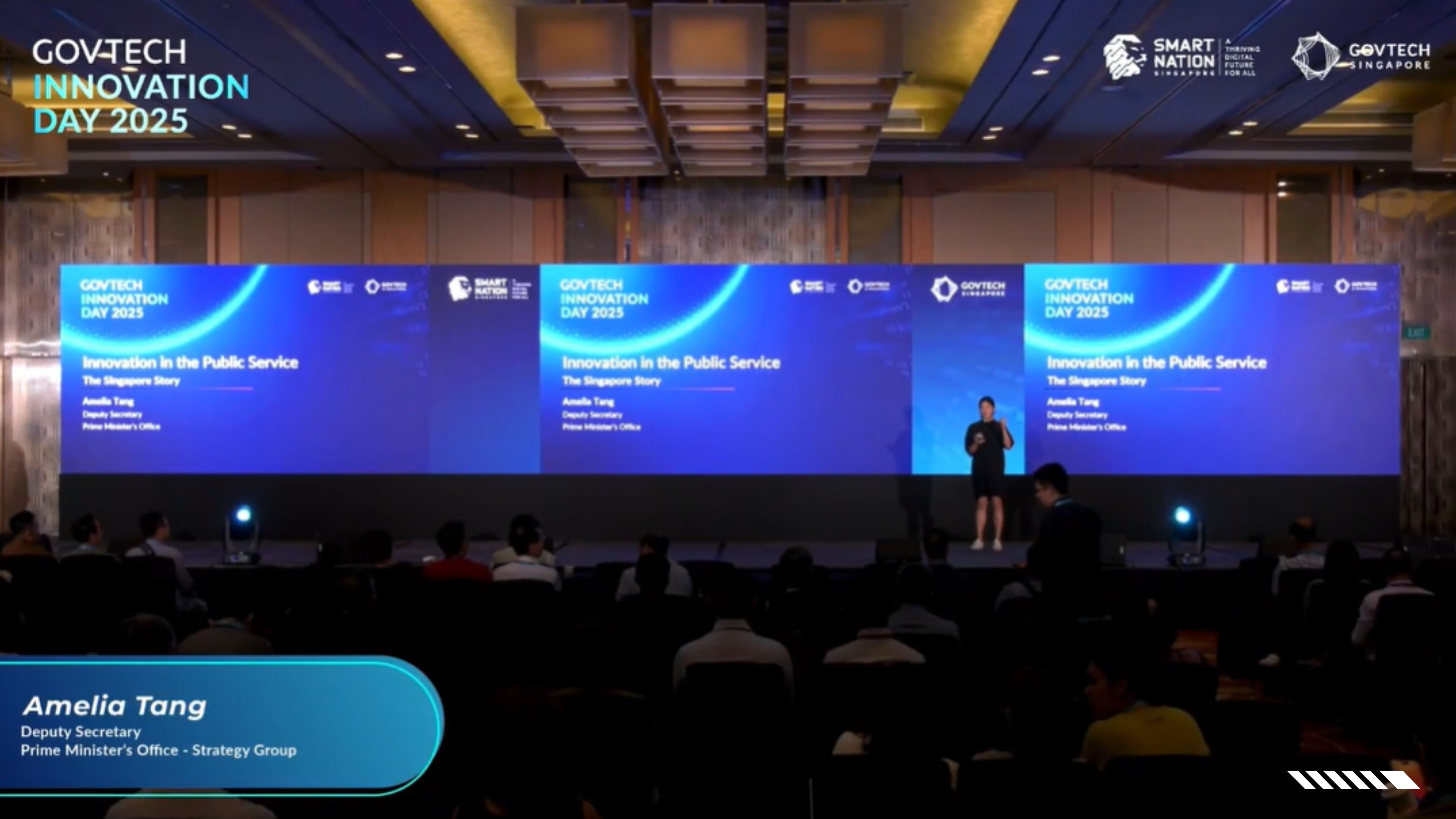
Singapore's Deputy Secretary, PMO – Strategy, Amelia Tang, spoke in the "Innovation in the Public Service" at GovTech Innovation Day 2025. Image: GovTech Singapore
Reflecting on Singapore’s journey as a nation built on design, Deputy Secretary, Prime Minister’s Office – Strategy, Amelia Tang, explained how design thinking is embedded in public policymaking.
“We didn’t call it design thinking back then. But under every major policy, our founding fathers had to understand and define the problems, come up with creative ideas, prototype them and constantly review these solutions,” she said.
Tang made her remarks during a presentation titled Innovation in the Public Service at the GovTech Innovation Day 2025 on November 13.
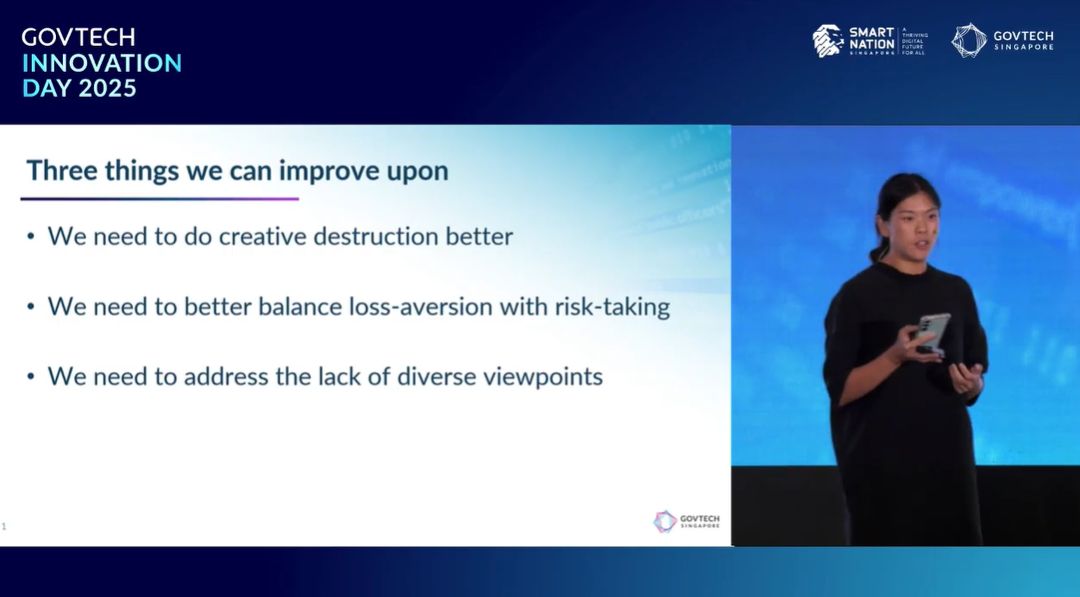
She reflected on three things the Singapore public sector has done well and three other things that could be improved upon.
Tang recognised the Singapore public sector’s efforts for designing services for people, not bureaucracy.
She noted that the focus needed to move beyond simple good customer service or being reactive when a citizen was physically present at the counter.
“It’s about moving away from providing services centered on agency lines to one that was around the actual lives of citizens,” she explained, citing LifeSG as an example.
This led to the consolidation of over 15 different government touchpoints into one smooth digital experience for citizens centred around the citizen’s life stages.
"It’s really the government’s way of saying that ‘we hear your pain points and how difficult it is. In some of these important milestones in life, we’re here to help you resolve them and make it better’,” she said.
More creative destruction needed
While the public sector exceled in incremental innovation, which Tang explained as “making existing systems 10 to 20 per cent better”, she highlighted that it’s insufficient to cope with the rapid speed of change.
Creative destruction required taking away old systems entirely to create something new and better.
She reflected how some of Singapore’s major early successes, such as the formation of the Housing Development Board (HDB), water policies and Electronic Road Pricing (ERP), were made possible when policymakers started with mapping.
“When there was nothing in place, you didn’t have to work with a status quo,” she explained.
She noted that public sector leadership could support creative destruction by putting in place teams with a very clear mandate to seek out new ideas and even to remove what doesn’t work today.
For these teams to succeed, leaders must protect their mandates, help them gain credibility, and be prepared to tolerate the risk and resistance that comes with change, she adds.
She highlighted the Centre for Strategic Futures (CSF) as an example of a team designed to operate outside the system, focusing on foresight methodologies and “blue sky ideas” research.
By doing this, CSF has the freedom to think about future possibilities, rather than just solving immediate operational problems.
To subscribe to the GovInsider bulletin, click here.
Design incentives that reward experimentation, not just success
“As civil servants, we are accountable for things like funding and KPIs, and we face very strong disincentives to experiment and deviate from the status quo,” said Tang.
She highlighted that the CSF was exploring ways to design incentives that reward all public officers, specifically recognising not just successful achievements, but also the value from “missed opportunities” that lay beyond the traditional scope.
The problem with standard appraisals was that they only measure execution but ignored the potential of innovative ideas.
“Nobody ever asked you: What are the things you could have done that you didn’t do this year?”, she said.
Tang also highlighted that the public service recruitment process, while ensuring competence, could unintendedly lead to a homogenous workforce that stifles innovation.
“Innovation happens when you get a diversity of people together in a small space, and you have all these ideas coming together and they collide,” she noted.
She highlighted the importance of traits like creativity, curiosity, comfort with ambiguity and experimentation, empathy, and user-centricity.
Notably, Tang shared her perspective that for innovation to thrive in the public sector, “we really need to widen the funnel of who we bring in and look at bringing people from very different backgrounds”, be it mid-career workers, from the private sector, or exchange programmes for public officers.
She cited the Presidential Innovation Fellows initiative as a good example, where the US government brings in top-tier private sector talent for a short period of time to work with public officers to co-develop solutions.
The role of GovTech in public policy innovation
Tang highlighted the critical role that the GovTech agency plays in public service as a bridge between complex policy goals and practical implementation.
While policy teams focus on designing intricate rules to ensure precision, target effectiveness, and minimise inefficiency, they often end up developing highly complex policies, she said.
This gap necessitates a significant commitment of engineering resources for GovTech engineers to turn the policy vision into a functional reality for citizens and public officers.
This was why it was so important to put in place a collaborative relationship between policy makers and GovTech, she elaborated.
In her closing remarks, Tang emphasised the importance for GovTech engineers to actively contribute to the policy conversation by specifying problem statements and highlighting trade-offs in very clear terms.
By framing costs in concrete terms, GovTech engineers could help policy makers make better-informed decisions, ultimately leading to improved policies and higher efficiency gains.
You can access the full on-demand recording here.