
Cyber resilience the foundation for Indonesia’s thriving digital economy
Oleh Ghita Permatasari
With the country’s digital economy expected to reach US$120 billion this year, the National Cyber Agency (BSSN)’s chief has urged all parties to strengthen their cybersecurity resilience.
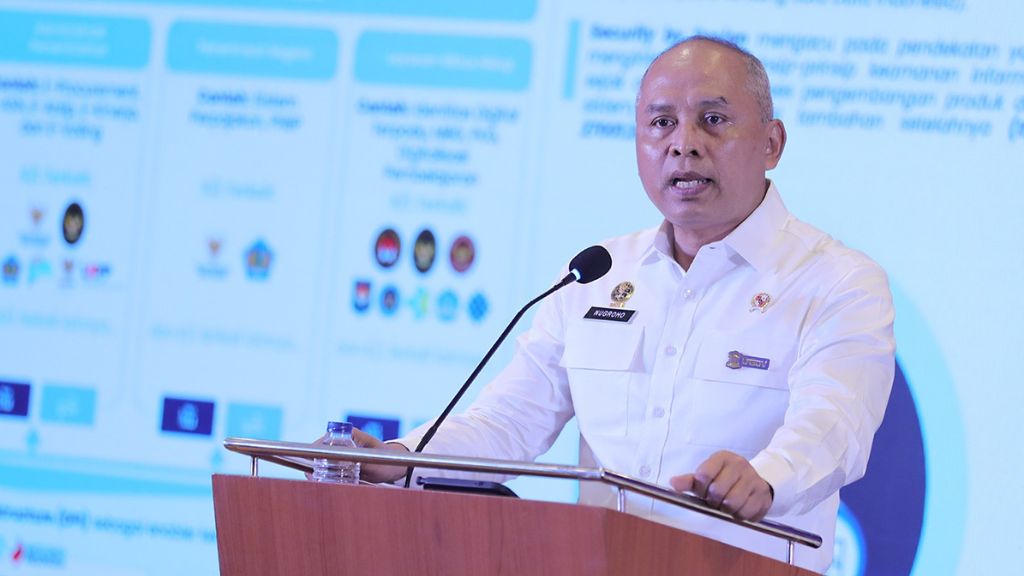
Indonesia’s National Cyber and Crypto Agency (BSSN)'s Chief, Nugroho Sulistyo Budi, emphasised the importance of raising awareness of cybersecurity. Image: BSSN
Indonesia National Cyber Agency’s (BSSN) Chief, Nugroho Sulistyo Budi, said that strong cyber resilience was the foundation of Indonesia’s digital economy.
Mentioning this during his opening remarks at the BSSN’s National Cybersecurity Connect 2025 in Jakarta, on October 29, Budi added that the country’s booming digital economy has made it one of the world’s emerging economic powers.
He cited a Google and Temasek report estimating that Indonesia’s digital economy this year will reach US$85-120 billion (S$110-156 billion), growing by up to 25 per cent compared to the previous year.
However, this digital progress also results in greater exposure to cyber threats, he added.
“In the digital economy, data and information have become new assets. The real issue is how seriously we anticipate and mitigate the risks so that they are not misused by unauthorised parties,” said Budi.
Many strategic industries in Indonesia still overlook the security aspects, he said, prioritising efficiency and technological convenience over safety.
“We need to ask whether the technologies we use are truly secure. Security components such as antivirus systems, firewalls, and others are integral parts of the technology itself. Moreover, governance must adopt ISO and SNI standards,” he explained.
Budi drew reference to the 2007 cyberattack on Estonia, which resulted in massive disruption of government websites, financial systems, and electricity services.
“The losses from that attack were extraordinary,” he said, expressing hope that such an incident would never occur in Indonesia.
To subscribe to the GovInsider bulletin, click here.
Three core aspects of cyber resilience
Budi highlighted three key aspects to cybersecurity: confidentiality, integrity, and availability.
Confidentiality was about ensuring that data and information were only accessed and managed by authorised parties. In this context, data must be protected through encryption systems.
Integrity, he continued, concerned the accuracy and validity of data. He added that availability ensured that data and services remained accessible to legitimate users whenever needed.
“If all three are well managed, we can protect data and information from theft, manipulation, hijacking, and destruction,” he said.
According to BSSN’s data, 90 per cent of cyberattacks in Indonesia stem from malware, a malicious software capable of damaging systems and stealing user identities.
Distributed Denial-of-Service (DDoS) attacks and social engineering techniques were also becoming common, with artificial intelligence (AI) being increasingly used to automate their propagation.
“AI-powered phishing attacks are becoming increasingly sophisticated in manipulating human behaviour. If people used to fall for the old ‘mom/dad needs phone credit’ scam, imagine when AI can perfectly imitate someone’s voice or face,” Budi said
He stressed that building a culture of cybersecurity awareness is just as essential as deploying advanced security technologies.
“Awareness must be part of governance. It’s not only about firewalls, encryption, or standardisation, but also about how people themselves understand and maintain security.”
From tech users to producers
Budi underscored the importance of maintaining Indonesia’s independence in strengthening its data and information security systems.
“We must not rely on licences or equipment that limit our ability to manage our own security. When those licences expire, they can become a major obstacle to developing our digital sovereignty,” he cautioned.
In his keynote session, Minister of Creative Economy, Teuku Riefky Harsya, encouraged Indonesia’s young digital talents to develop cybersecurity systems capable of protecting the nation’s data and information. He expressed confidence that local digital talents are on par with their global counterparts.
According to Harsya, the creative economy today extends far beyond its traditional subsectors such as fashion, culinary arts, design, music, film, and animation.
Digital creativity and technology now form the bulk of Indonesia’s creative economy.
His ministry, he added, plays a strategic role in supporting local technology startups in developing cybersecurity solutions.
“These innovations must continue to be directed so that Indonesia becomes a producer, not merely a consumer, of digital security technologies.
“The development of national cybersecurity talent must be at the forefront of nurturing a generation of young Indonesian innovators ready to bring home-grown technologies to the global stage,” he said.
He praised the achievements of Indonesian cybersecurity startup Peris.AI, one of the ventures supported by his ministry.
Peris.AI was selected among the top 100 global startups to reach the final of the Entrepreneurship World Cup in Dubai, which also won an award in the startup category at the ASEAN Business Awards 2025 that was held at the ASEAN Summit.
“They are not only bringing technology, but also the spirit that Indonesian startups can stand shoulder to shoulder with global innovators,” Harsya said, adding that Indonesia’s local talents can create truly global solutions with a collaborative ecosystem and the right support.