GovMesh Digest: Armenia adopts a ‘conducting without dominating’ life events approach to digital services
Oleh Luke Cavanaugh
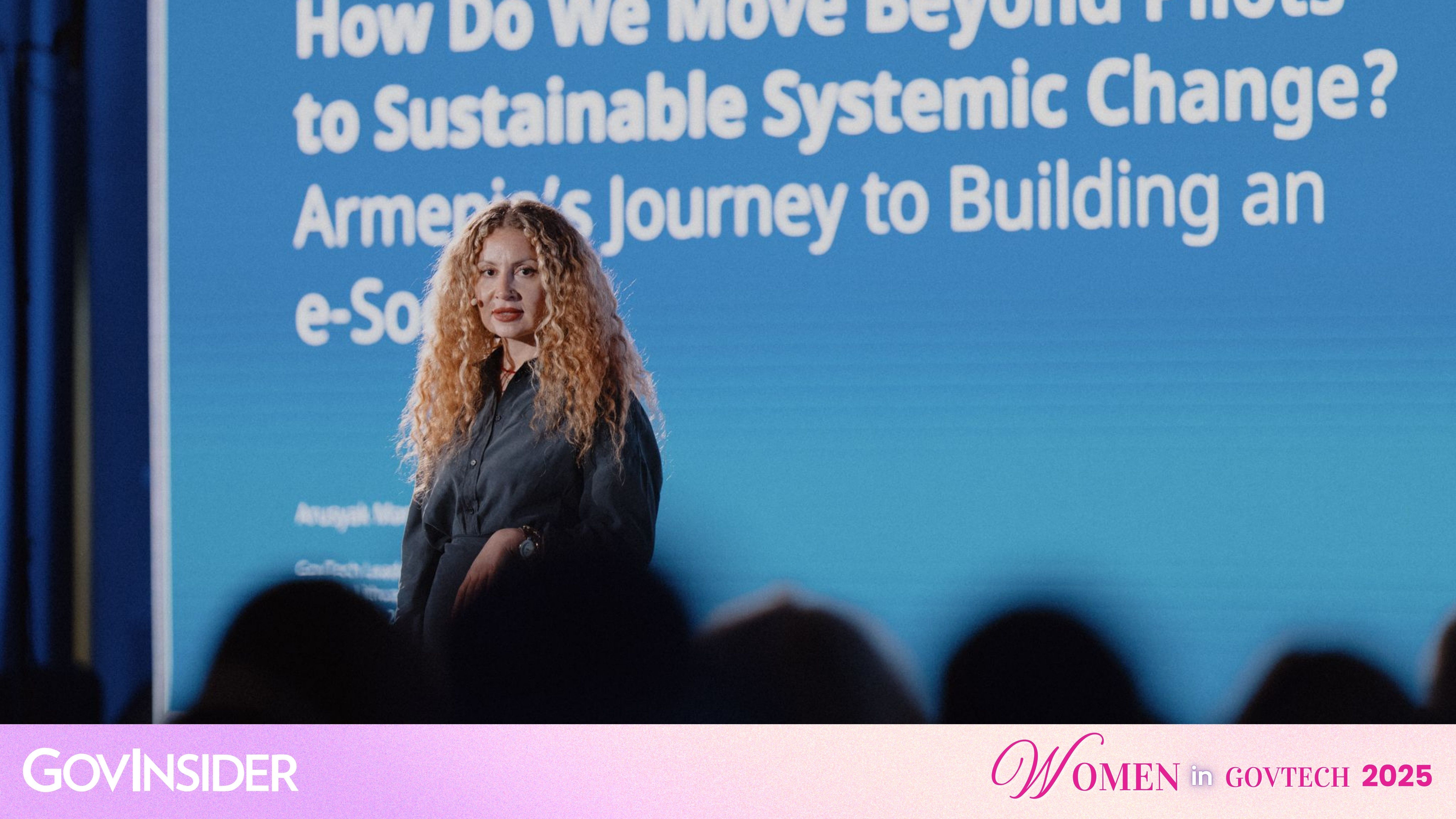
While Information Systems Agency (ISAA) is tasked with service design, its Head of UX and Service Delivery Arusyak Martirosyan is now prioritising building the capacities of other ministries and agencies to develop and maintain the services.

Armenia’s story is one of those featured in the GovMesh Digest special report
Armenia’s story is one of those featured in the GovMesh Digest special report. You can find the other individual stories on the participating governments for GovMesh 3.0 here.
Arusyak Martirosyan started her GovMesh presentation with the picture of the back of an apartment block, a metaphor for the challenges of digital government.
The third edition of GovMesh, organised by interweave.gov, was a closed-door roundtable discussion that convenes a small group of governments to discuss selected topics around digital government.

From the road the block might look uniform. But on the back end, it has been made completely heterogeneously by different actors with different styles, budgets, and temperaments.
It is functional throughout, but lacking in any uniformity.
Her Information Systems Agency (ISAA), set up three years ago, aimed to change that.
As Head of UX and Service Delivery, her role has been to deliver on a vision of an “e-Society” that brings seamless services to citizens, breaking silos and bringing ministries together.
The approach to doing so has been through Life Events, defined according to the 12 most common challenges of those in Armenia and its diaspora (Armenia has three times as many citizens living abroad than in the country).
Their sheer breadth is striking, and they are ambitious in their definitions.
When Martirosyan talked about the birth of a child, this included everything “from the 3rd trimester of a pregnancy to the child going to kindergarten”.
When it came to applying for citizenship, she described how they began by “thinking about the tourists”.
A tourist is also a potential would-be citizen, and relevant citizenship data begins to be collected as soon as someone first applies to enter the country.
This is a mature form of life events services, not conducted around a single moment in time - for example starting school - but a multi-year journey around key points of a person’s life.
ISAA’s role in navigating change
In developing these life events, Martirosyan is keen for ISAA to “play a conducting role without dominating”.
The actual approach for life event development has been split into four chunks – initiation with ministries; forming working groups and building capacity; design and then development.
Ministries are held jointly accountable on the progress of life events, meaning it is difficult for any single one to say, “I did my part, I’m doing no more”.
This coordination is by no means a simple process. A common challenge ISAA faces is in ensuring they are seen by ministries as “doing something” and not just “asking questions” or only holding others to account, while making sure that the proposals are watertight and actually useful.
“We get a lot of competing requests from government departments, she said. “We need to ask the right questions, so we don’t have thousands of apps and services existing completely separately”.
And so, every service development starts with a rigorous interrogation of the questions “Is this needed? Does it exist? Is it the number one priority for the people it is serving?”.
But this has to be done at speed, so that ISAA doesn’t get the reputation of “another agency who doesn’t want to do the work”.
Once service design begins, ISAA’s role is to slowly phase itself out of development, increasing the ministry’s capabilities and responsibilities in developing and maintaining services.
“For the MVP, ISAA is driving while others are learning; when the MVP expands we sit next to ministries but they’re driving; our aim is for them to be independent and us in the back seat”.
When the audience asked about the technical expertise that ISAA brings to service development, Martirosyan gave the example of mapping user personas during the life event service of having a child.
The team mapped 76 user personas – “each gets their own unique user journey”. Rather than starting with the most common journey, ISAA focused on the most complicated one first, with the thinking that if that one is possible, then the others ought to be to.
In an interview for GovInsider’s Women in GovTech, Martirosyan expanded on this: “no matter how carefully you map the most common scenarios, there will always be people whose circumstances, health, background, or life situations don’t fit the ‘standard’ flow”.
She continued, “identifying overlooked personas, edge cases, and specific barriers is what allows digital services to move from being efficient to being genuinely humane, adaptable, and fair”.
Results are already showing.
Several life events are already online, including selling a car and having a child. As she presented, Martirosyan engaged the room on four questions: capacity-building, removing analogue systems, balancing fear of transformation with speed and response, and maximising foreign investment funding.
Getting these elements right would create a vision of success “where citizens choose the digital service again and recommend it to others”, as Martirosyan told GovInsider.
It sounds like there’s a lot for her team to be getting on with, but it’s probably for the best if we want to keep people like Martirosyan around. “I’ll be successful at my job when I am redundant”, Martirosyan says, “and no longer needed”.