Indonesia focuses on digital literacy amidst new child safety rules
Oleh Mochamad Azhar
Following PP TUNAS enforcement, the digital ministry (Komdigi) plans to tailor education programmes and tap grassroots volunteers to ensure effective policy implementation to protect children in the digital environment.

The Indonesian government is placing a strong focus on educational programmes to help keep children safe in the digital space. Image: Canva
Since the Indonesian government’s rollout of a regulation that restricts children’s digital access, most discussions currently fixate on the technical aspects of enforcing age limits, platform compliance, and monitoring mechanisms.
The regulation,Government Regulation on the Governance of Children’s Access to Electronic Systems (PP TUNAS), sets restrictions on children’s access to digital platforms.
For the Ministry of Communication and Digital (Komdigi)’s Head of the Digital Literacy Development Centre, Rizky Ameliah, the success of this policy depends on how well it is understood by the public.
“Efforts to protect children in the digital environment are not sufficient if we only address the technical aspects. Education and digital literacy are absolutely essential,” says Ameliah to GovInsider.
The Centre operates under the ministry’s Human Resources Development Agency, and is tasked to develop national digital literacy guidelines, as well as to conduct public outreach and education initiatives.
In the context of this new regulation, the Centre has been developing modules, learning materials, and organising national campaigns to ensure that the regulation is well understood by the public.
“We are at the forefront of educating the public on the implementation of PP TUNAS, ensuring that these restrictions are fully understood and applied wisely,” she adds.
To effectively close the gap in digital capabilities, the Centre will customise the education programmes based on regional characteristics and target groups.
Schools as the primary entry point
The programmes will focus on schools as the main entry point. This allows for an integrated education system involving children, teachers, and parents.
Teachers and parents have been positioned as key actors in providing guidance. They will be equipped with practical skills to understand and filter digital content used by children.

“Programme for parents and teachers are focused on providing the guidance and skills needed for supervision, so that they can eventually apply restrictions independently,” she says.
Without adequate supervision, the digital environment risks becoming an unsafe setting for children, from exposure to harmful content to misinformation.
She cites the ministry’s internal report that 48 per cent of children under the age of 12 in Indonesia already have access to the Internet, with some of them using social media platforms.
UNICEF Indonesia reported that around two per cent of children aged 12–17 who use the Internet have experienced online sexual exploitation or abuse in the past year, which is equivalent to around half a million young people annually.
Around 17 per cent to more than half of the victims never report incidents because they do not know where to report, or feel afraid or ashamed to do so, the report adds.
“We want to ensure that the gap between access and readiness can be bridged through education,” Ameliah notes.
The programme will also cover other vulnerable groups, including women communities, the elderly, persons with disabilities, and local micro, small and medium enterprises (MSMEs).
Leveraging grassroots networks
To expand its reach, the programme also relies on the Digital Literacy Cadres network as trained agents of change at the local level.
These volunteers act as an extension of the Centre, delivering education directly to communities through various activities such as community meetings, outreach sessions, and online training.
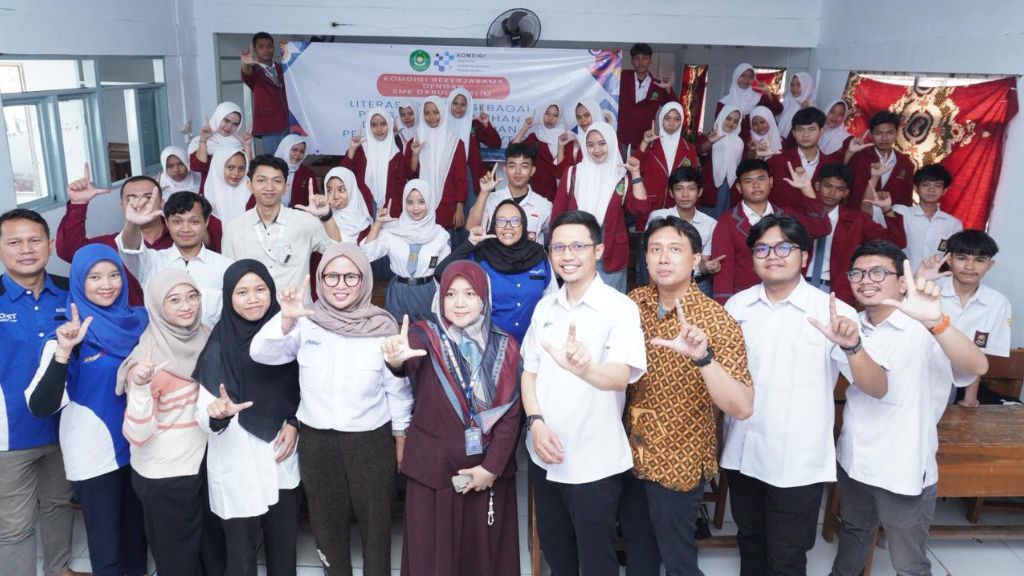
This approach enables digital literacy content to reach a wider audience, including remote areas.
“These activities are carried out continuously, not as one-off, hit-and-run initiatives,” Rizky says, adding that there are currently more than 733 volunteers across various regions reaching over 63,000 beneficiaries.
Before PP TUNAS was introduced, these cadres have been already actively educating the public using the government’s four pillars of digital literacy module: Digital Skills, Digital Safety, Digital Culture, and Digital Ethics (CABE).
Their main mission is to ensure that people use digital technology safely, productively, and responsibly.
In addition, the ministry collaborates with various non-government partners, including the private sector, professional communities, and student associations.
“The government cannot work alone. We aim to leverage as many networks as possible and collaborate,” she adds.
AI disruption and the future of digital literacy
With internet access now widespread, the real challenge lies in how social media affects young users, says Ameliah.
The situation is growing even more precarious with generative artificial intelligence (GenAI)-driven deepfakes and fake news, which will create complex new threats to online safety.
To address this, AI literacy is now being integrated into existing education programmes, focusing on foundational skills such as the ability to distinguish between authentic and AI-generated content.
“This approach places greater emphasis on responsibility rather than restricting adoption,” she says.
This aligns with the Ministry’s AI Roadmap, which aims to ensure that 20 million people are AI-literate by 2029.
The next step is to encourage the integration of digital and AI literacy into the formal education system through collaboration with the Ministry of Primary and Secondary Education.
This initiative aligns with ongoing efforts to implement AI learning as an elective subject in schools.
Ameliah emphasises that digital literacy should focus on strengthening human capacity to adapt to emerging technologies at an early stage, and is an effort requiring support from all stakeholders, particularly the users themselves.
“Technology will continue to evolve, and disruption will persist. The key question is whether people are willing to change,” she adds