-1783304403050.jpg)
Meet the Digital Health Champion transforming breast cancer care
Oleh Sol Gonzalez
Khoo Teck Puat Hospital (KTPH)’s Dr Clement Chia shares how the REBORN app taps into augmented reality to support breast cancer patients in their decision-making throughout their treatment journey.
-1770192742035.jpg)
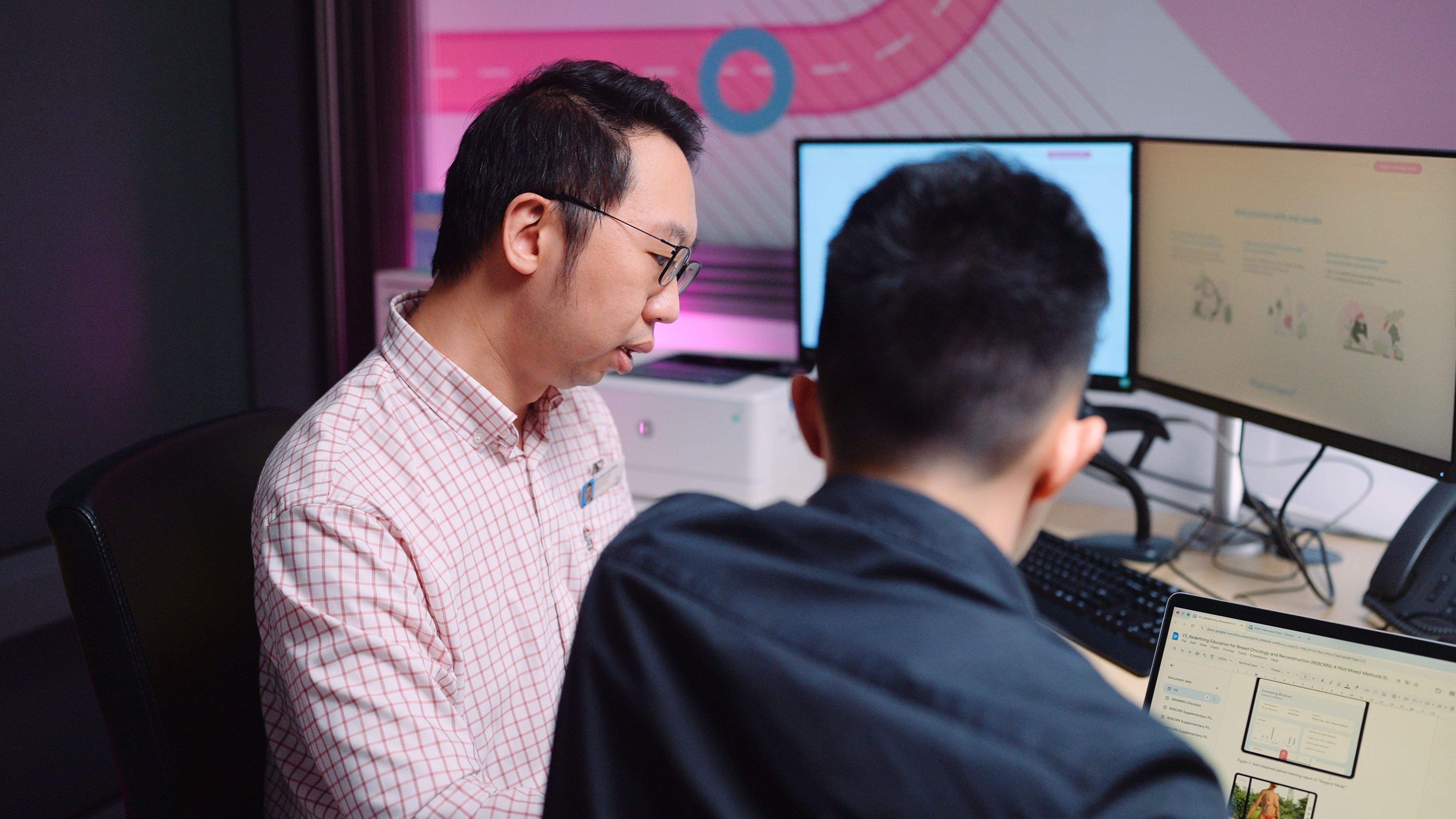
Dr Clement Chia shares how the REBORN app helps to support breast cancer patients in their decision-making throughout their treatment journey by providing information of the procedures in an easy-to-understand format even before the patient enters the room. Image: Corporate Communications, Faculty of Science, National University of Singapore.
From 2019 to 2023, women represented over 51 per cent of cancer cases reported in Singapore, with breast cancer being the most common diagnosis.
For these patients, this diagnosis requires them to navigate a maze of complex medical information and making high-stakes decisions about mastectomies and breast reconstruction surgeries.
"How can we better help our patients make life-changing decisions in a very delicate moment? How can we help them understand the options that they have, so that they can make better decisions about their breast reconstruction?"
These questions were the main drivers behind the REBORN application, says Khoo Teck Puat Hospital (KTPH)'s Head of Breast Surgery Service and REBORN's Project Lead, Dr Clement Chia, to GovInsider.
REBORN stands for Redefining Education for Breast Oncology Reconstruction, and was developed to allow for more informed decision-making during the patient's treatment journey.
The app helps patients to clarify the surgical options, procedures, and risks before making a decision.
It adopts a flipped classroom model by using augmented reality (AR) visuals and bite-sized information to reduce cognitive overload, without compromising the quality and depth of information.
Chia says that the collaborative team effort between industry partners, surgical professionals, and research experts was key to making this innovation work.
Dr Chia won the Digital Health Champion Award at GovInsider's Healthcare Day 2025 for his contributions in driving digital transformation in Singapore's healthcare sector.
Tapping on opportunities for innovations
“Traditionally, when patients wait to consult the doctor, they are sitting outside and waiting for a long time. So, we were thinking, why don’t we turn this into an opportunity?” says Chia.
The REBORN team found an opportunity to make the doctor-patient consultation more efficient for both parties.
A flipped classroom model fits this opportunity by providing the information of the procedures in an easy-to-understand format before the patient enters the room.
-1770192634801.jpg)
This ensures that they are not overwhelmed during the consultation and have space to process their options before their doctor consultations.
“While the patient is waiting to see the surgeon, the nurses will hand them an iPad with the REBORN app deployed. The app is designed such that it is very self-explanatory, and there’s also a digital mascot that will guide them through the options,” Chia explains.
A digital tool also allows for more opportunities to include digital animations and AR for visuals.
This replaces the previous way in which doctors delivered information, often through two-dimensional (2D) pamphlets that were limited in explaining complex anatomy processes and concepts, Chia adds.
“During the consult, the iPad is handed over to the plastic surgeon who then uses the functions of the app to further explain to the patient.
Then, the patients can download the content that was discussed during consultation and revisit at any time with their caregivers or family members,” he shares.
This helps clinicians extend a more supportive patient care, rather than a “one-touch, one-consult” process, notes Chia.
It’s about impact
The app has been implemented at KTPH and Tan Tock Seng Hospital (TTSH), and will be expanded to other healthcare institutions.
Usability was key to the success of its implementation, says Chia.
“You may have a very good idea, but if it’s cumbersome to use, or it’s not user friendly, then it doesn't serve its purpose, and it’s not going to work for implementation,” he notes.
The principles he learned during his experience in A*STAR’s Singapore Biodesign Innovation Fellowship came in handy.
At Singapore Biodesign, the talent development platform for health-tech innovations, Chia was trained in methodologies that fuelled his interest in the medtech ecosystem, he shares.
Considering the stakeholders in the entire product development process helps him to ensure usability and ultimately, implementation, Chia says.
As a surgeon, he understood the pressures of a high-volume clinical practice, which led him to develop user-friendly tool for both his patients and other clinicians.
The REBORN app has proved successful in terms of both patient experience and clinical workflows, reducing consultation time by over 40 per cent, easing clinicians’ workload while enhancing the quality of engagement as patients are better equipped with information.
The time saved, however, is a secondary benefit, notes Chia.
“Patient care is always at the centre of what we do. Making the process more time-efficient is just an additional benefit,” he says.
A positive outlook in health-tech
Chia shares that REBORN was made possible through a collaborative effort.
Chia and his co-lead Dr Jolie Hwee, who is also the KTPH’s Head of Service for Plastic, Reconstructive and Aesthetic Surgery, worked together with industry partners, plastic surgeons, and research experts.
They also received a grant from the Institute of Adult Learning (IAL).
He highlights the support from NHG Health’s Centre of Medtech Innovation Office and the clinical research unit to smooth out the innovation journey.
A good team is critical because the complexity involved in product development and innovation can be discouraging for individuals to continue alone in the innovation journey, he notes.
“That’s my message for readers: if you want to succeed in innovation, you need to put together a good team that helps each other, because the process of innovation can be quite tedious. Without a team, is not possible for one man to succeed”.
Following his experience with REBORN and a number of other innovative medtech projects, Chia has a positive view of the next wave of healthcare innovators.
He attributes this to having more opportunities to partner with the private sector, to explore commercialisation, obtain funding, and get additional expertise.
“We need to continue the momentum so that hopefully, among many tries, there will be some projects that eventually will succeed,” he concludes.