Shaza Khawaja, Federal Minister of IT & Telecommunication, Government of Pakistan
By James Yau
Meet the Women in GovTech 2025.
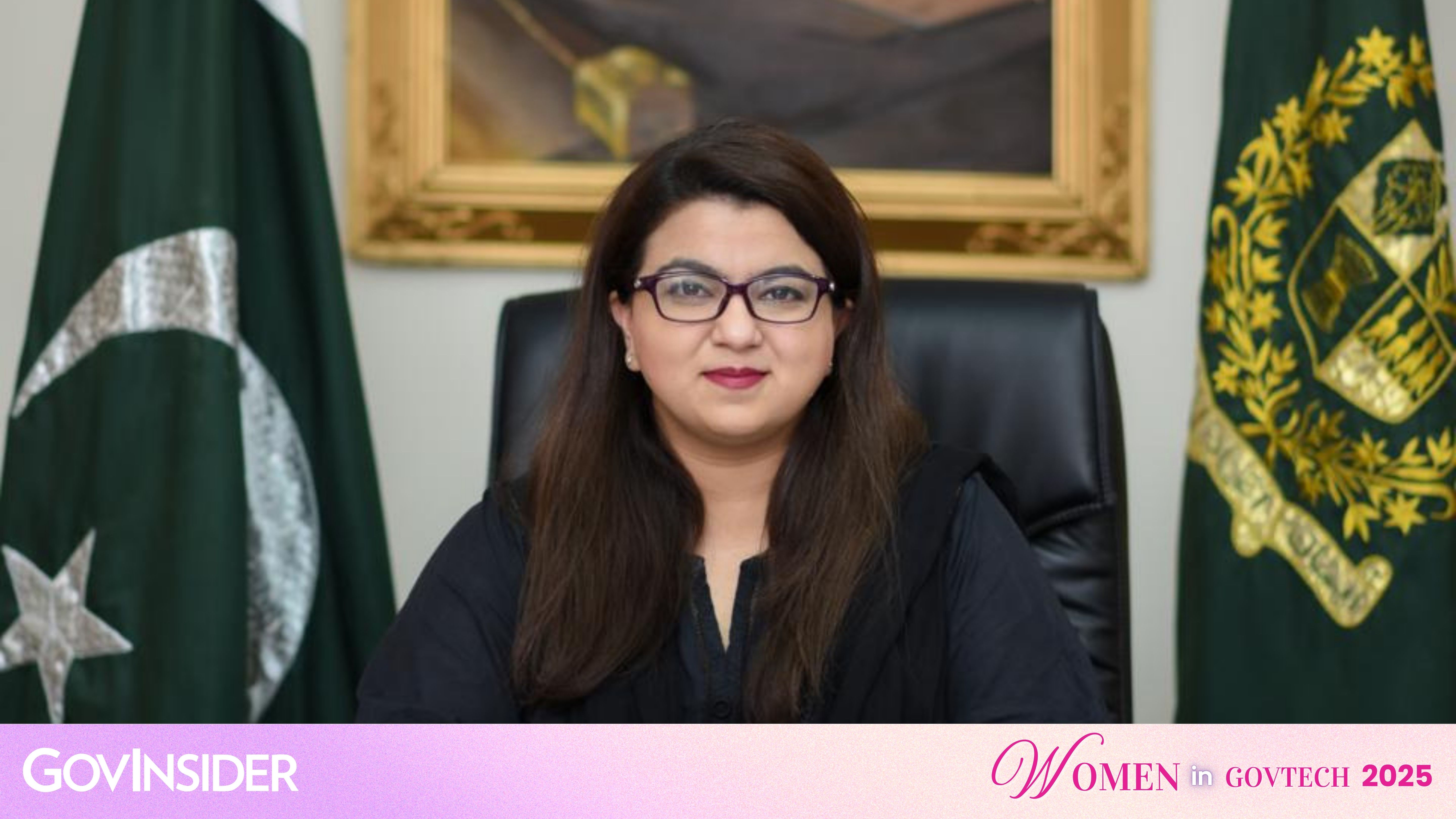
Shaza Khawaja, Federal Minister of IT & Telecommunication, Government of Pakistan, shares about her journey. Image: Shaza Khawaja
1) How do you use your role to ensure that technology and policy are truly inclusive?
So we always legislate with the least advantaged citizen in mind, but how do you walk in their shoes? How do we avoid the blinkered tyranny of the expert. The key is to come up with a systematic process with which you can digitize the right journeys.
Our approach is triangulated. We look at peer countries and their experiences. We listen to relevant experts but not just policy ones; sectoral ones who have direct exposure to citizens. We take input from provincial and federal stake holders.
However, the greatest data that we look to is qualitative from the ground. We build personas of all potential users. We map their journeys. We add capability, GDP contribution, scale, legal scenario, and expense filters.
We look at the maturity of related systems and then we come up with a prioritised list and go into execution mode which are constantly score-carded through inclusion metrics like reach (households connected), gender uptake, disability accommodation and affordability. We have developed an AI powered public private dialogue platform for direct input of citizens and experts as well.
2) What’s a moment in your career when you saw firsthand how technology or a new policy changed a citizen’s life for the better?
On a field visit I met a schoolteacher deep in a rural heartland, Gokina Village, who had been delivering lessons offline for years.
After fiber and 4G coverage arrived through one of our initiatives, she could livestream classes, access updated curricula and submit exam results online and her students gained immediate access to resources and university counselling previously only available in cities.
That teacher’s words “my classroom is now a window to the world” guide me to this day on the power of tech to scale progress.
On the other side of the table, the girls in the village did not have a science class teacher beyond grade six. After digital connectivity, they are not just your average science students, but some of them are in top engineering universities in the country.
3) What was the most impactful project you worked on this year, and how did you measure its success in building trust and serving the needs of the public?
DEEP (Digital Economy Enhancement Project) is easily the most transformational digital project in Pakistan’s history: it builds a national stack comprising of Data Exchange, Digital ID and a Universal Payment Interface.
Powered by a strong Digital Nation Pakistan Act, 2025 and our National AI policy approved this year, this will give every citizen access to affordable formal services, brings in efficiency and cost savings for government and unleash an innovation economy that will dramatically grow the size of digital in GDP.
One step more specific into it, deployment of E-Office in the Federal Government ministries and departments. Within a year our federal government is paperless, Prime Minister has visibility on every document and file in the system along with real time analytics on efficiency and quality of work being done.
It has not increased efficiency and transparency but has led to massive savings in the exchequer and helped us move towards our sustainability goals.
4) What was one unexpected lesson you learned this year about designing for real people? This can be about a specific project or a broader lesson about your work.
People adopt technology when it solves a clear daily problem reliably and not because it is “tech”.
We put the citizen experience at the center of every journey. A world-class micro-services backend is useless if a low-literacy citizen can’t access it with a feature phone. The public doesn’t experience government through policy papers, they experience it through forms, websites, queues in service centers, and helplines.
Experience design makes those moments dignified, accessible, effective and inclusive.
5) We hear a lot about AI. What's a practical example of how AI can be used to make government services more inclusive and trustworthy?
Look 24/7 multilingual, always-available chatbots built on LLM’s trained on clean government data sets are game changers if built right. Works in local languages, voice/IVR/video and WhatsApp/SMS/USSD for low-end phones and with “assisted mode” for agents at government service counters.
To subscribe to the GovInsider bulletin, click here.
6) How are you preparing for the next wave of change in the public sector? What new skill, approach, or technology are you most excited to explore in the coming year?
You will be surprised but it isn’t pure tech. What I am most excited about is the our Citizen Services Design Lab.
This will be a dedicated government innovation hub that uses human-centered design, rapid prototyping, and co-creation to reimagine public services. We are talking radical inclusivity.
You bring low-income, rural, disabled, elderly, non-literate citizens into the room and build services that work for the hardest-to-reach 20 per cent, instead of being optimised for the easiest 80 per cent.
7) What advice do you have for public sector innovators who want to build a career focused on serving all citizens?
Start with constant, empathetic user research and measure impact in lives changed and dreams realised. Experience design, the first thirty seconds are everything. Data is critical.
Spend the time and money needed to unify data, clean data and generate data where it is not available. Once you have access to data and you combine it with experience design you will be unstoppable.
8) Who inspires you to build a more inclusive and trustworthy public sector?
That brilliant and hardworking young Pakistani girl whose despite being denied opportunity, is not giving up.
Fighting every day to achieve her dreams which often are about contributing to the country in a positive way. I want to make her journey easy. Provide her with every modern tool, emerging tech, to leapfrog!
So every public servant who priorities service over spotlight, technologist who simplifies complexity for citizens, and leaders globally who combine empathy with decisiveness are my heroes.
9) If you had an unlimited budget, what would your dream project be?
This is an easy one. Free 1000 Mbps internet for every citizen using Satellite Mesh and broadband coupled with a smart device. Build digital roads and an entire new generation will travel on it to prosperity.
10) Outside tech, what excites you the most?
I love teaching! I used to teach at Lahore University of Management Sciences, one of Pakistan’s top universities. Debating with students (often losing to them!), learning from them and guiding them is great fun and a privilege. One day!