Singapore’s maritime authority (MPA) uses digital twin to unlock limited space for unlimited innovation
By Si Ying Thian
Maritime and Port Authority of Singapore’s David Foo shares how the digital twin served as a testbed for stakeholders to trial new operational concepts and response strategies before investing real money and risking safety.
-1776090486131.jpg)
Maritime and Port Authority of Singapore (MPA)'s David Foo presented the progress with Singapore’s first maritime digital twin at the Geo Autonomy Summit on March 31 in Singapore. Image: James Tan's YouTube video
While space in Singapore is scarce, its goals for the port are limitless.
For the Maritime and Port Authority of Singapore (MPA), which manages one of the world’s busiest ports, this creates a major challenge. How do you try new ideas where there is no physical room to fail?
To avoid costly mistakes, MPA has been leveraging a maritime digital twin for the last one year to solve the paradox of having “limited space but unlimited opportunities,” said MPA’s Deputy Chief Executive (Operations and Technology), David Foo.
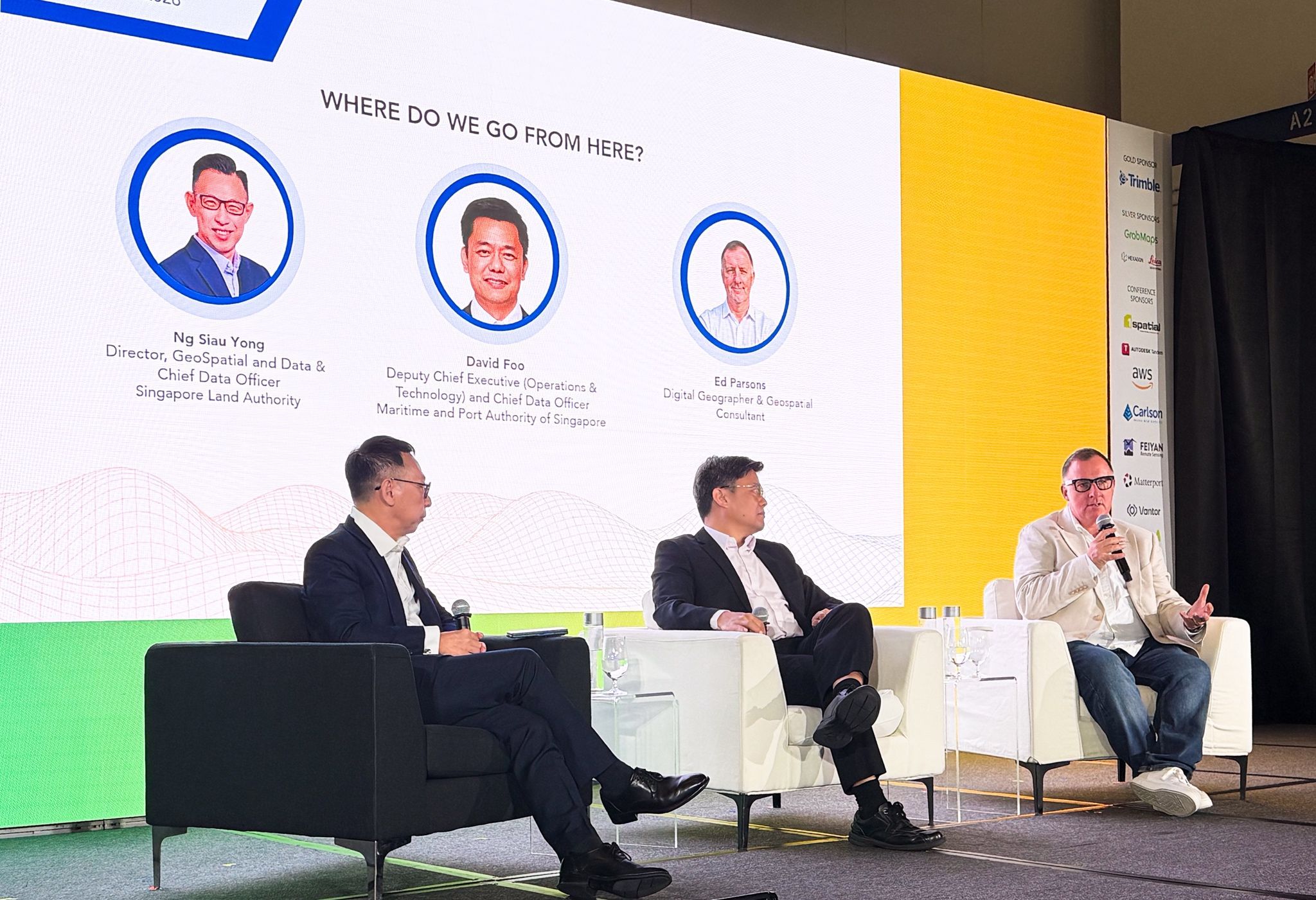
Foo presented the progress with Singapore’s first maritime digital twin at the Geo Autonomy Summit on March 31 in Singapore.
Launched last year, the digital twin was developed by MPA and GovTech Singapore.
This is a real-time virtual replica of the Port of Singapore integrating live data from different sources ranging from marine vessels, port operations and environmental sensors.
Aside from providing a common operating picture, the digital twin supports a strategy to de-risk innovation, Foo said.
According to him, the digital twin has helped MPA to refine its operational decisions and decide what trade-offs to make before they commit to capital.
MPA’s use cases for the digital twin
1. Mapping Singapore’s electric port ambitions
One such use case was to plan for the physical placement of charging infrastructure for electric harbour crafts.
“[The infrastructure] is expensive, and we want to make sure that the maximum number of harbour craft owners can benefit from that,” said Foo.
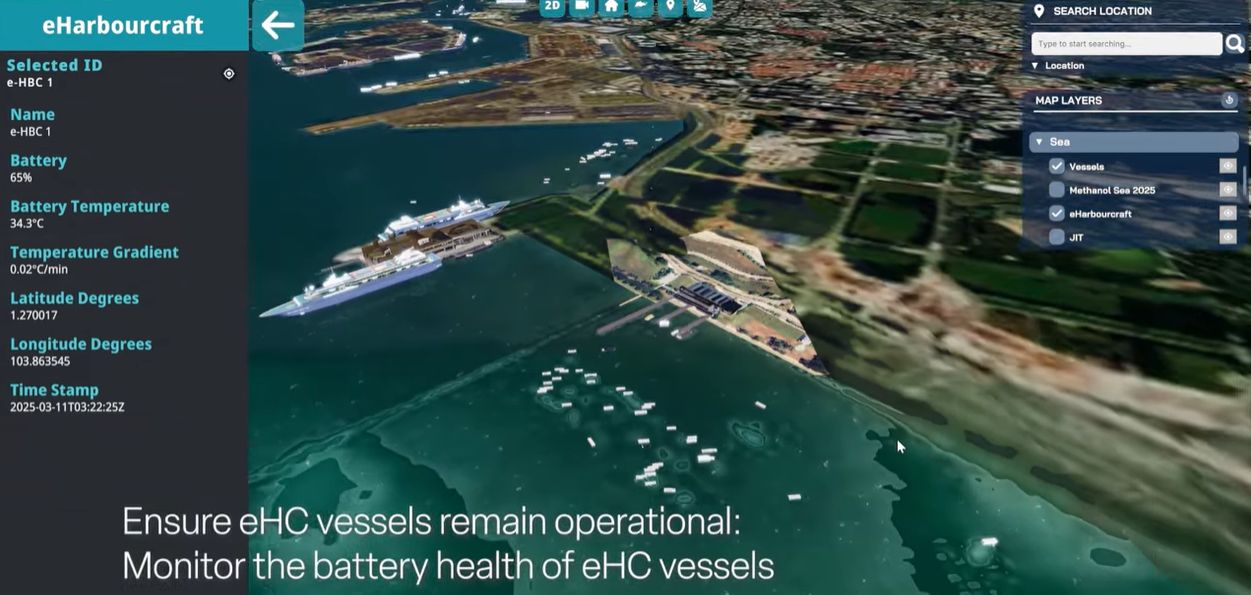
He highlighted that Singapore would eventually require all new harbor craft to be fully electric. For MPA to support this transition, it was key to look at the data to explore solutions, he added.
As a result, MPA used the digital twin to visualise the historical and real-time traffic density data of harbour craft, color-coding areas with different densities.
For example, red indicated high traffic, while green and yellow indicated lighter traffic.
Foo noted that the ability of the digital twin to do so could potentially lead to an app built for harbour craft owners, showing owners which charging stations were available.
“This allows us to invest our resources in places where it benefits the community the most,” he explained.
2. Enabling preventative efforts and protection of human life
The digital twin was also able to layer different data sources and models to effectively detect spills, define the hazard zones, and warn nearby ships early so they can move away.
Before using digital twin, it was challenging to use the naked eye to spot cryogenic liquid, which was a colorless but hazardous chemical, that polluted the seas.
Foo shared that MPA had worked with A*STAR’s Institute of High Performance Computing (IHPC) to integrate a computational fluid dynamics model into the digital twin.
Laying this model onto the digital twin has allowed MPA to see the formation and spread of this chemical in the water over a period of time.
When combined with real-time data on weather and sea currents, this also allows MPA to pinpoint the safest evacuation routes for ships during an emergency.
3. Unlocking cross-sector innovations
As with experimenting with drones, Foo explained how MPA first started to use them during the Covid-19 pandemic to deliver medication to sick crew members who couldn’t leave their ships.
Today, MPA uses it to transport lightweight spare parts and daily port surveillance to ensure compliance with safety regulations.
By integrating live drone feeds into the digital twin, this allowed MPA to not only incorporate actual views from the drones - but also have a single window view across the coastline in real time.
This digital oversight allowed MPA to safely manage the growing number of harbour crafts delivering goods throughout the port.
Foo also teased an innovative solution where MPA's digital twin could support small and medium sized enterprises (SMEs) that currently deliver goods to ships.
The visibility into SME delivery routes would allow them to shift from an “everyone for themselves” model to a shared system to coordinate these deliveries and drop them off in an efficient loop.
By collaborating, these businesses use less fuel and resources to serve their shipping customers, he explained.
You can watch a video of the maritime digital twin in action here.
AI as the next leap
“Just imagine if you can put artificial intelligence (AI) models into digital twins. Because of the limited space, can we actually use AI to park more vessels within the port?” Foo said.
He highlighted the potential for AI to be used to optimise parking spaces.
Noting that ships don’t just stay still, he highlighted that ships tend to drift in a “swing circle” because of tides and currents.
Due to this phenomenon, the ships generally need a larger parking area. The challenge is then how to fit the maximum number of “swing circles” within a limited port space.
While a human could only do so much to map the space, AI could calculate the tightest possible fit to allow more ships to park safely in the same amount of space, he explained.
Foo shared that more details would be unveiled in the Singapore Maritime Week (SMW) happening this week.
“My message today is about using these digital tools with the best of our abilities to make the best decisions,” he concluded.
As of early March this year, MPA announced that it will open access to the digital twin to selected marine services providers, port service operators and supply chain partners in Q1 2026.
It is also looking to develop a common developer toolkit with digital tools and application programming interfaces (API) to make it easier for companies and researchers to plug into MPA’s data stream and test new concepts before scaling.