Why Asia needs wastewater surveillance before the next pandemic
A whole-of-government approach to invest in such systems is likely the most sustainable model, as it creates mutual benefits across sectors.
-1789459420628.jpg)
Wastewater surveillance (WWS) offers a powerful way to “see” what traditional clinical systems might miss. Image: Canva
Asia’s healthcare systems, especially in resource-constrained settings, face persistent challenges in providing equitable access to healthcare.
Vulnerable groups, such as migrants and low-income communities, often fall through the cracks, resulting in epidemiological “blind spots” within national clinical surveillance systems.
These gaps mean that public health authorities may not see outbreaks coming before it is too late, undermining national capacity to prevent, detect, and respond effectively to infectious disease threats.
Wastewater surveillance (WWS) offers a powerful way to “see” what traditional clinical systems might miss.
WWS involves the systematic collection and analysis of wastewater samples from selected sampling sites, which can range from urban sewage plants to rural rivers.
For WWS to become a routine part of a country’s public health toolkit, there must be a collective, whole-of-government commitment – not limited to the Ministries of Health or Environment alone.
Wastewater surveillance: Filling in the blind spots
For WWS, a key criterion for selecting a sampling site is to ensure that it adequately represents the population of interest.
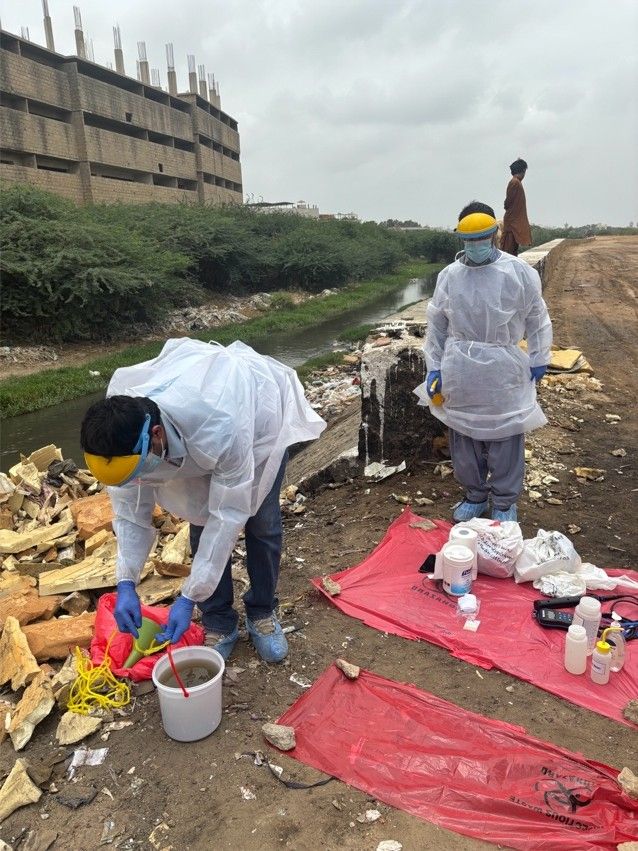
By testing the wastewater samples for traces of bacteria and viruses that people shed in their waste when they are infected, WWS provides a snapshot of the diseases that are circulating in the community.
Beyond filling in gaps where there is limited clinical surveillance infrastructure, WWS has the potential to provide early warning.
WWS has been reported to detect signals for Covid-19, seasonal influenza, and other seasonal respiratory viruses one to two weeks before clinical systems notice.
This lead time provides a crucial window of opportunity for public health authorities to prepare for and respond to imminent outbreaks before they spread further.
While the pandemic catalysed a surge of interest and investment in WWS, many of the pilots deployed during that period have since been put on hold or wound down.
This runs counter to the evidence: WWS can provide valuable ongoing, population-level insights for both routine and emergency public health threats.
For governments, the challenge and opportunity is to move from temporary pilots to sustainable, integrated systems that support everyday outbreak detection and pandemic preparedness.
WOG approach to invest in a national wastewater surveillance programme for public health in Asia
Implementing a robust and sustainable a national WWS programme is not something that can be done overnight, especially in resource-constrained environments or countries.
Beyond infrastructure, WWS requires trained personnel, adequate laboratory capacity, affordable detection assays, reliable national funding, and strong cross-sectoral coordination, all of which take years of investment to establish.
A whole-of-government approach to invest in a national WWS programme is likely the most sustainable model as it creates mutual benefits across sectors.
For example, the Ministry of Agriculture or Veterinary Services or equivalent could use WWS to monitor early signs of animal diseases affecting farms and wildlife animals, while the Ministry of
Environment could use it to monitor vector-borne, waterborne, or soil-related diseases.
-1789460895062.jpg)
Additionally, WWS can focus on epidemiologically at-risk subpopulations: the Ministry of Social Welfare or equivalent might use it to monitor infectious disease threats among elderly residents in nursing homes, the Ministry of Manpower, or human resources equivalent, for migrant workers in temporary housing, and the Ministry of Defence or equivalent for military personnel in camps.
WWS has the potential to be a powerful component in the public health toolkit - providing actionable intelligence for everyday disease control, and serving as a first line of “defence” in guiding vaccination policies and campaigns against vaccine-preventable diseases such as measles and typhoid.
Investing in WWS today means being better prepared for the future, while ensuring no one falls through our public health “blind spots” in the present.
Why regional approaches and partnerships are critical
In Asia, ever increasing numbers of flights and travellers across the region increase the risk of infectious disease transmission and outbreak occurrence.
Past pandemics have shown that infectious diseases cross borders easily, and responses are stronger when countries share information and expertise.
Inevitably, the ability to share information about potential emerging disease threats relies on robust, well-designed surveillance networks.
WWS can complement clinical and other surveillance systems to fill in information, but there are challenges in implementing such a system.
A 2025 workshop organised by the World Health Organisation (WHO) on WWS for public health in the Asia region found that common issues include:
- Sampling challenges, such as identifying representative sites, limited sewage infrastructure, sample transport logistics, and variation caused by seasonal climate change
- The need for standardisation of data, quality control, and protocols to enable comparability
- Real-time digital data management and visualisation to inform public health decision-making
- Legally grounded and ethically guided policy frameworks to enable utilisation of WWS while protecting privacy
- Integration of WWS into existing public health strategies and plans, instead of as a standalone effort
- Clear roles and responsibilities and strong coordination mechanisms, to enable multisectoral collaboration
- Sustainable and stable financing both during and between outbreaks, which requires compelling investment cases built on clear costing data
- Capacity development to ensure staff have the necessary training and skills to deliver WWS programmes
Regional partnerships enable countries to share knowledge and experience, and solve common challenges - such as high costs and supply chain delays for laboratory equipment - by negotiating together for better pricing and servicing.
Building sustainable systems: the role of ADWANCE-Asia
To help address these challenges, the Centre for Outbreak Preparedness at the Duke-NUS Medical School in Singapore has recently launched the ADWANCE-Asia programme, or Advancing Wastewater & Environmental Surveillance for Public Health in Asia.
Supported by the European Union (EU) through the European Commission’s Health and Digital Executive Agency (HaDEA) and Health Emergency Preparedness and Response Authority (HERA), the three-year initiative will support low- and middle-income countries on building sustainable WWS systems.
The programme will focus on four areas:
- Network collaboration: Strengthening the regional WWS network to support coordination and cross-border information sharing
- Capacity building: Delivering structured training on standardised laboratory and bioinformatics workflows for WWS
- Capability development: Supporting countries to pilot and scale genomics-based WWS for monitoring of multiple infectious diseases simultaneously within their national WWS programmes
- Strategic evidence and integration: Generating evidence and practical tools for WWS integration, including strategic planning frameworks, legal and ethical guidance, and mapping of existing WWS dashboards across Asia
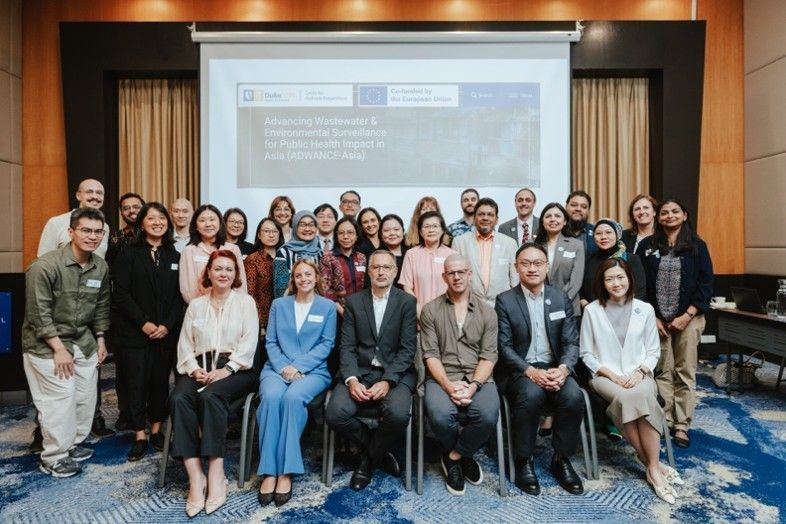
to launch ADWANCE-Asia, with representatives from EU HaDEA and HERA: Advancing Wastewater & Environmental Surveillance for Public Health Impact in Asia. Image: Duke-NUS Medical School
In collaboration with international, regional, and local stakeholders such as the WHO, International Pathogen Surveillance Network (IPSN), Africa Centres for Disease Control and Prevention (Africa CDC), EU-funded Global Consortium for Wastewater and Environmental Surveillance for Public Health (GLOWACON), and Singapore’s National Environment Agency (NEA), ADWANCE-Asia aims to help countries in Asia move from isolated pilots to robust, integrated and sustainable WWS systems that are ready to tackle vaccine-preventable diseases and emerging infectious diseases.
------------------
Ashley Tsai is a Senior Research Associate at the Centre for Outbreak Preparedness (COP) and Asia Pathogen Genomics Initiative (Asia PGI), building regional capacity to leverage pathogen genomics for increased health security and outcomes.
Assistant Professor Pang Junxiong Vincent is an epidemiologist at COP and the lead of the Asia PGI Wastewater and Environmental Surveillance and ADWANCE-Asia at Duke-NUS Medical School, National University of Singapore.