
Africa's biggest AI risk isn't being left behind. It's being misread
The decisive question for the continent is no longer who owns the largest models - it is whose languages, institutions, and economic realities the machines can understand. Rwanda is showing how to close the gap.
-1785992978635.jpg)
Left to right: Rwanda's High Commissioner to Singapore, Innocent Bagamba Muhizi, and Kilwa Technologies' CEO and Founder, Hinsley Njila. Image: Muhizi and Njila's LinkedIns
Artificial intelligence (AI) is moving from novelty to infrastructure. For Africa, the question is no longer whether AI will arrive. It already has.
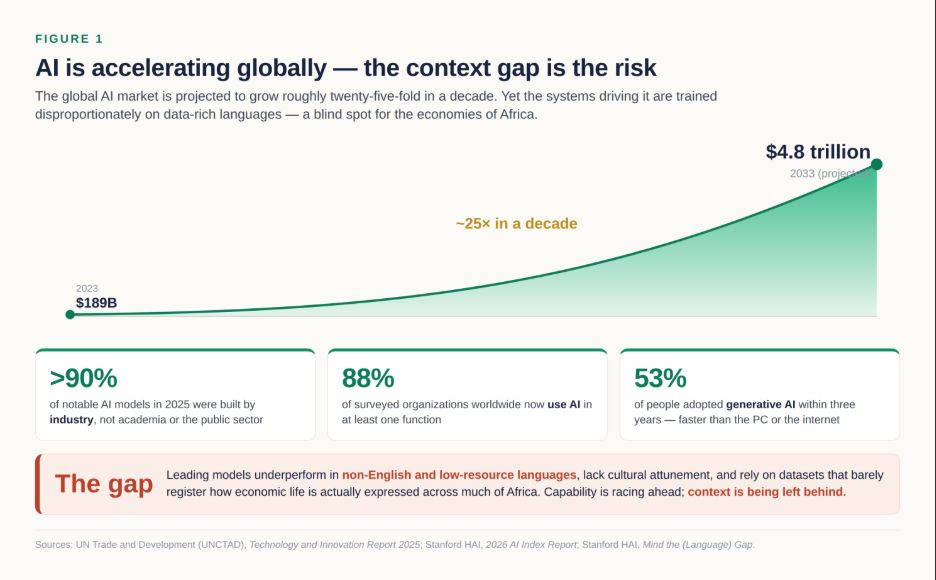
In 2025, industry built more than 90 per cent of the world's notable AI models, and 88 per cent of organisations reported using AI in at least one function.
UN Trade and Development projects the global AI market to grow from $189 billion in 2023 to $4.8 trillion by 2033 — a nearly twenty-five-fold expansion in a decade.
The opportunity is extraordinary. So is the risk.
The question is whether the systems that will shape credit, health, education, public services and investment can understand African societies well enough to serve them.
A model can be technically dazzling and still be contextually wrong.
That is the next divide. It will not be defined only by who controls data centers, chips or bandwidth.
It will be defined by whose languages, institutions and economic realities are legible to machines.
Africa's biggest risk is being misread
Most leading models are trained disproportionately on English and other data-rich languages.
Stanford researchers have documented how large language models (LLMs) underperform in non-English and low-resource settings, lack cultural attunement, and lean on datasets that are often scarce or unrepresentative.
In much of Africa, economic life is also conducted in local languages, through informal networks and relationships of trust that conventional datasets barely capture.
When context is missing, AI does not remove uncertainty. It automates it.
The consequences reach the balance sheet.
Investors misprice risk and overlook viable businesses. Policymakers receive feedback that is late or partial. Financial institutions design products around formal data and miss the lived reality of the customers they mean to serve.
This is why local-language capability and real-time data are not cultural niceties.
They are economic infrastructure. The World Bank's latest framework for AI readiness names four foundations: connectivity, compute, context and competency.
The global debate fixates on the first two. Africa cannot afford to neglect the last two: context determines whether AI is locally useful, and competency determines whether countries can govern, adapt and apply it.
Rwanda is moving from policy to execution
Rwanda's recent record shows how a small country can organise around these foundations - and why coherence beats scale.
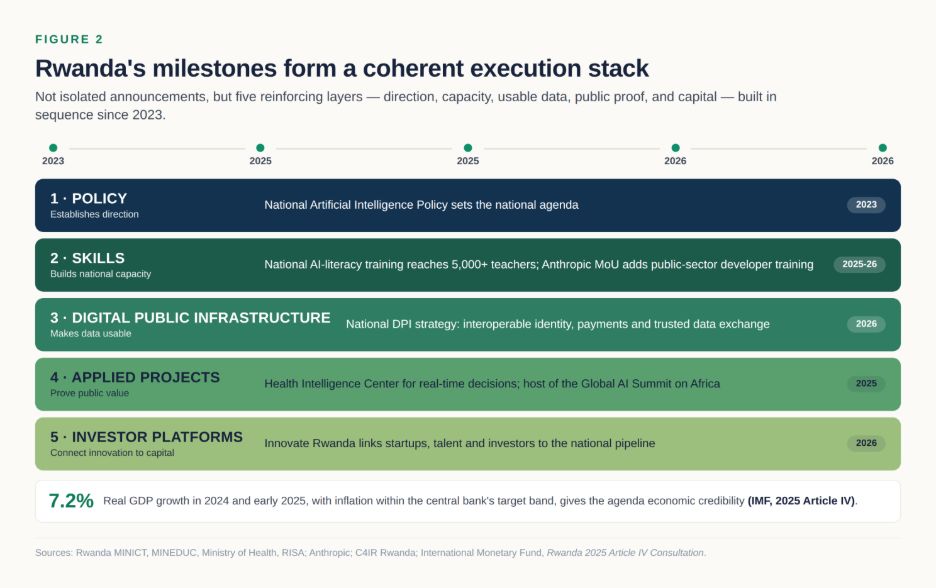
The country adopted a National AI Policy in 2023. The more instructive story is what followed.
In 2025, Rwanda hosted the Global AI Summit on Africa and launched a Health Intelligence Center to clean, analyse and interpret health data in real time, supporting early-warning systems and evidence-based decisions.
By the end of that year, the first phase of a national AI-literacy programme had trained more than 5,000 teachers across every district - designed not merely to introduce tools but to build critical, ethical use.
In March 2026, Rwanda and Anthropic signed a three-year memorandum of understanding to integrate AI across the country's public health, education, and government sectors.
It sought to enable capacity building for public sector developers and explicitly committed to aligning deployment with national priorities and local context.
That same year, Rwanda unveiled a national Digital Public Infrastructure (DPI) strategy involving interoperable digital identity, payments and trusted data exchange, tying high-quality, shareable data directly to the country's AI capabilities.
It also launched Innovate Rwanda, a platform connecting startups, investors and talent, and giving capital a clearer view of the national pipeline.
These are not isolated announcements. Together they form an execution stack: policy sets direction; skills build capacity; digital public infrastructure makes data usable; applied projects prove public value; and investor platforms connect innovation to capital."
The lesson is not that Rwanda has solved AI. It has not. It is that small states can compete through strategic coherence, regulatory clarity and a willingness to test ideas in the real world.
From imported capability to localised intelligence
African countries do not need to build every frontier model from scratch, nor should they reject the capabilities global firms have created.
The stronger path is adapting with agency: pairing frontier models with locally governed data, African-language capability, domain expertise and clear public-interest safeguards — and involving native speakers and affected communities as partners in development, not passive sources of data.
The payoff is faster, truer feedback loops.
Local-language, real-time systems can surface shifts in public-service experience, health risk, employment anxiety or household perceptions of inflation before they appear in conventional reports.
For financial institutions, they reveal how customers actually understand products and where trust is thin. For investors, they reduce the opacity too often priced, lazily, as "African risk."
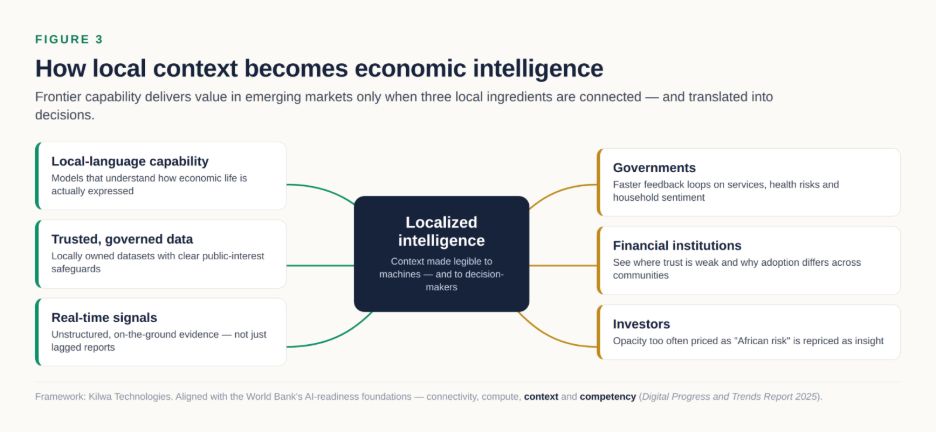
Kilwa Technologies builds toward exactly this: translating unstructured local data, demographic analysis and localised language models into investor-grade signals.
The aim is not to replace official statistics or human judgment, but to complement them with a more immediate view of how economic change is being lived on the ground.
The right next step is not another declaration, but disciplined proof-of-concept pilots with clear use cases, transparent governance, measurable outcomes, and a path to institutional adoption.
A call to investors and technology partners
Rwanda's invitation is clear: don't come just to sell technology or announce capital. Come to test, localise, share expertise, and build alongside Rwandan institutions.
For investors, Rwanda offers policy alignment, institutional coordination, and digital infrastructure that shorten the distance between an idea and evidence.
For technology companies, it is a chance to prove that responsible AI can be locally relevant, not merely globally scalable.
And for African policymakers, Rwanda's approach reframes sovereignty: Not one of technological isolation, but retaining the ability to shape how systems are trained, governed and used.
Africa will not miss the AI revolution for lack of ideas. It may miss it if the systems that define value cannot understand the continent accurately.
The next AI divide will be context. Rwanda is showing how to close it.
The original article was first published on Ambassador Innocent's LinkedIn page here , and then edited.
--------------
Innocent Bagamba Muhizi is Rwanda's High Commissioner to Singapore. Hinsley Njila is Founder and CEO of Kilwa Technologies and has nearly two decades of Wall Street experience. This is a personal opinion piece; it is not investment advice.