Agentic state vision requires an ecosystem-wide approach to data innovation and stewardship
Manuel Kilian, Founding Managing Director of the Global Government Technology Centre (GGTC), Berlin, shares his vision for the Agentic State, and how data and privacy underpin its operations.
-1777881677093.jpg)
Germany's story is one of those featured in the GovMesh Digest special report
GGTC Berlin's story is one of those featured in the GovMesh Digest special report. You can find the individual stories on the other participating governments at GovMesh 4.0 here.
As the founding Managing Director of the Global Government Technology Centre (GGTC) Berlin, Manuel Kilian has spent much of the last two years working with governments to imagine the future of digitalisation, an idea he calls The Agentic State.
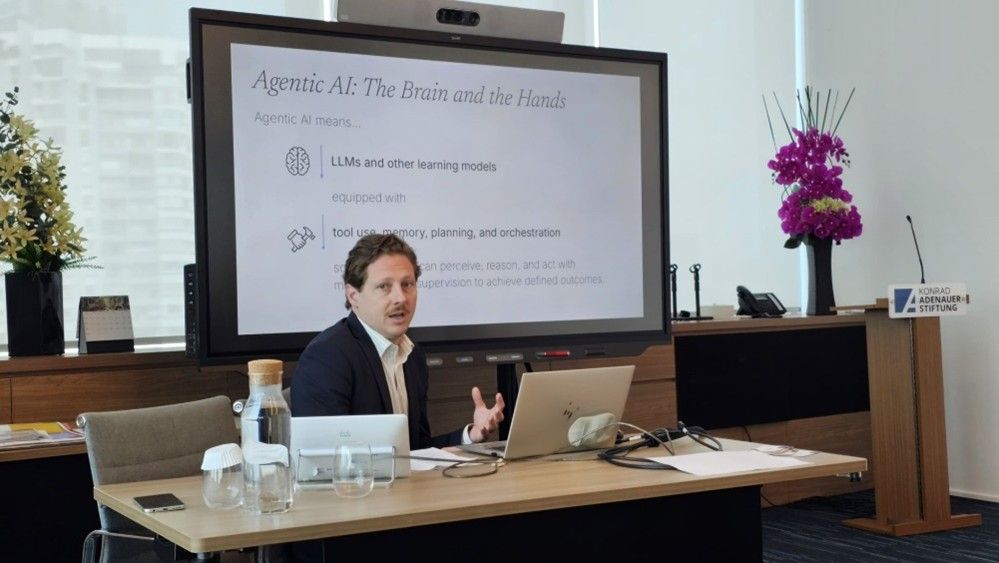
AI agents provide governments, he told the leaders convened for GovMesh 4.0 in Singapore, with “the brains and the hands”.
The intellectual forces that are large language models are equipped with tool use, memory, planning and orchestration – able to follow workflows and function autonomously.
“The brain alone is not so useful, and the hands alone are not so useful”, Kilian told participants.
“But through that combination, AI agents are able to receive reason and act with minimal supervision to get an outcome”.
In an interview alongside GovMesh with Civic Punks' Derek Alton, he describes agents as digital co-workers that will help civil servants by taking over part of their work, without taking it away.
The 12-component architecture of the Agentic State he presents is daunting in its breadth at first glance, but he reassures participants that much of what is needed to achieve it is inherent within governments.
“Government is a bundle of workflows”, he says, “regulations, laws, rules… a lot is codified workflows”. Achieving the Agentic state, he argues, means making those workflows automatic and proactive rather than slow, reactive and episodic.
It is a vision that governments are beginning to buy into, most notably in Ukraine, where former Minister of Digital Transformation Mykhailo Fedorov explicitly embraced the vision of moving towards the agentic state.
The data trends for an Agentic State
Within the contexts of data-driven government, the principal theme of GovMesh, Kilian identified several trends enabling the Agentic State.
As he does so, he anchors on a concrete use case – the birth of a child.
-1777881312746.jpg)
The last thing a parent needs when dealing with a newborn is government bureaucracy.
But there are numerous necessary points of interaction with the state needed after childbirth – registering the birth, or signing up for childcare benefits, for example.
In an Agentic State, the idea is that an agent – with the knowledge of the individual context of family – can trigger these necessary services automatically.
To do so, said Kilian, they need to adhere to three principles:
- Data as self-describing assets with rich metadata: When a birth is registered, or any other data point gathered, it comes with a semantic and metadata context. Is a birth a first or second child, or is this birth verified by a hospital, for example? In shifting to thinking about a data point as an asset for AI agents, not just a row in a database, Kilian encouraged the other participants to deliberately cultivate metadata context, provenance and permissions.
- Ecosystem-wide governance and stewardship: “A life event can trigger a cascade of public services”, Kilian said. A birth registry, for example, might need to be cross-checked against family income to test their entitlement to child databases. Governments are trying to find a balance between open-by-default ecosystems, where data and metadata can enable innovation and scrutiny, and a privacy-first mindset that guards data access.
- Privacy-preserving technologies for sensitive data: As governments attempt to find this balance, Kilian encouraged a privacy-first mindset. “To see if a family is eligible for housing support”, he says, “an agent doesn’t have to access the entire income situation of a family. It just needs to know whether it is above or below a threshold”. Agents need to have access to minimum viable data, able to expose insights without exposing individual records.
Taken together, said Kilian, these principles lay the foundation for a vision of “agents as data scientists”.
Practically this means agents automating data-ops end-to-end. This makes agents able – for example – to run policy simulations and explore what might happen if a government changes a threshold to child benefits.
It is a complicated balancing act, but a bold vision of what the next generation of public services might look like. It is also a vision that will continue to evolve, theoretically and practically.
A second white paper, written by the GGTC together with the World Economic Forum (WEF), will decode all of governments’ activities into 70 discrete workflows (see here).
Kilian also mentioned several governments that are already trialling the underlying approach.
Watch now:
- Fireside Chat: The Agentic Turn: Reimagining Governance for the AI Era
- FOI2026 interview with Global Government Technology Centre (GGTC)'s Manuel Killian on the Agentic State, April 2, 2026