
Before the next AI pilot, map what’s already on your network
By ViewQwest
AI governance starts with visibility, by knowing which AI tools, applications and connections already exist before adding more pilots, said Peter Molloy, Chief Growth Officer at ViewQwest, and Adam Hofeler, Vice President of Sales & GTM at Zero Networks.
-1792561599786.jpg)
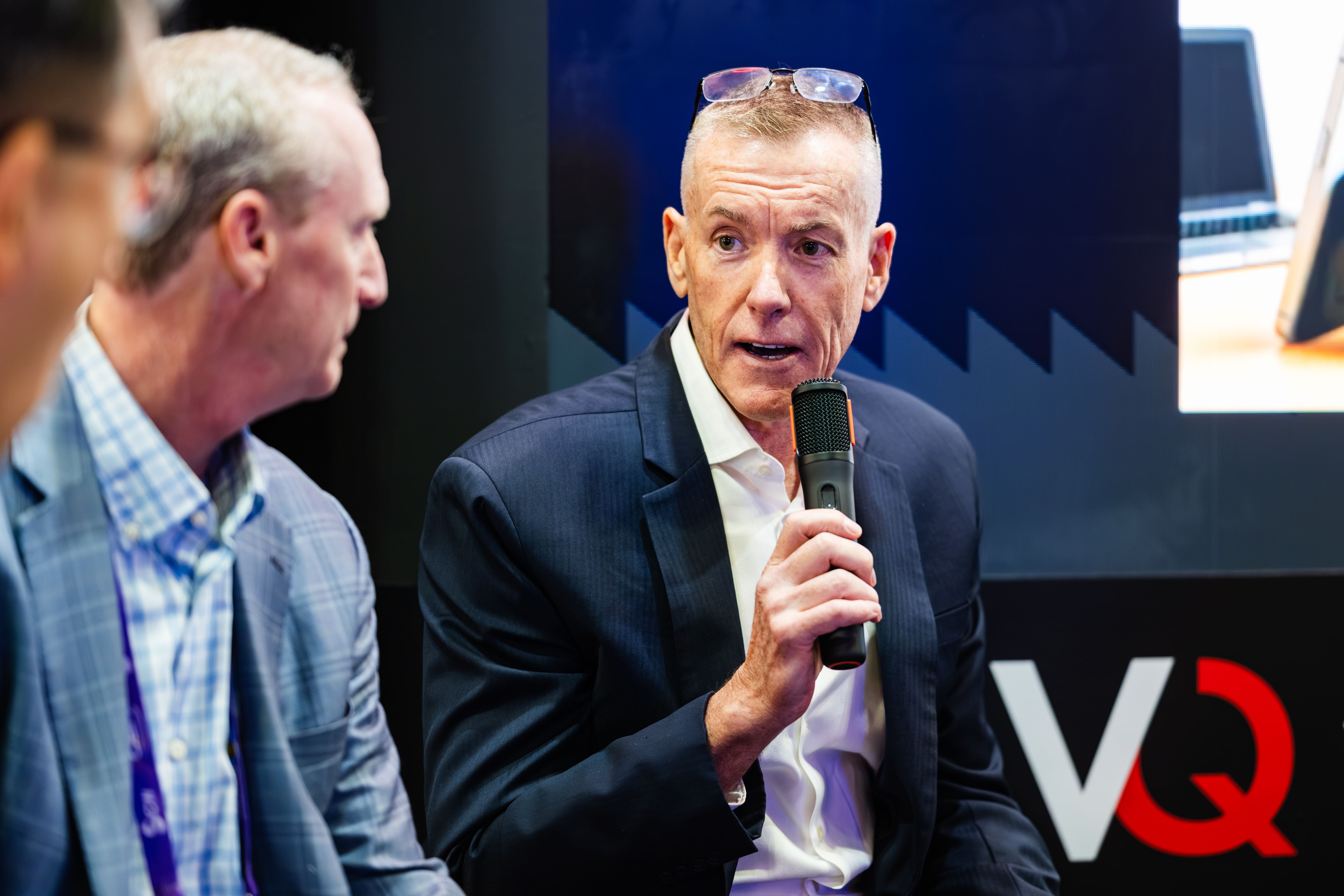
ViewQwest's Chief Growth Officer Peter Molloy, and Zero Networks' Vice President of Sales & GTM, Adam Hofeler, spoke at a product showcase presentation at the GovWare event in Singapore where they shared the importance of having clear visibility of the technologies running in an organisation's environment, for which segmentation capabilities are particularly useful. Image: ViewQwest.
While cyber attackers are using artificial intelligence (AI) to propagate threats without worrying about audits, compliance or rollback times, defenders need to worry.
The power imbalance was the starting point for a product showcase presentation at the GovWare event in Singapore on October 13, featuring Peter Molloy, Chief Growth Officer at ViewQwest, and Adam Hofeler, Vice President of Sales & GTM at Zero Networks.
Both companies have partnered to deliver automated microsegmentation and AI security controls to enterprises across key Asian markets.
The core takeaway for public agencies from their presentation was that AI governance starts with visibility, by knowing which AI tools, applications and connections already exist before adding more pilots.
You can’t govern the AI you don’t know is there
Most organisations don't have a clear picture of the technologies running in their environments, according to Hofeler.
That makes AI harder to govern, as he noted that “every application now has AI somewhere built in”, whether or not the organisation knows it.

He gave the example of customers not knowing that their applications have been equipped with AI assistants leveraging commercial, frontier models like Claude and Gemini.
He cited a platform update by CrowdStrike which detected more than 1,800 distinct AI applications running across enterprise endpoints.
Without knowing what exists, he said, these organisations ended up writing policy from assumptions.
The aim is therefore to “put roles and processes based on what you actually see, not what you think is going to happen.”
The new segmentation capability enabled by ViewQwest and Zero Networks helps organisations to map out and control shadow AI applications.
Hofeler said that the more controls an organisation puts in place early, the stronger its position would be later.
Instead of a new policy or platform, public agencies need an inventory of the AI applications already running in their environments, and the answer may change what an agency decides to pilot next.
Focused on what mapping reveals
“Have we found something in an environment that shouldn’t be there, or someone who shouldn’t have access? One hundred percent. That happens all the time," said Hofeler.
He described finding staff with access they shouldn’t have, such as sales or marketing employees able to reach servers that host financial data.
While teams often understand what an application should be talking to, Molloy said, “the ability to visualise it is incredibly difficult”.
Once a map is in place, an application contacting an external IP address that shouldn’t be there becomes easy to spot.
“People might stay for the automation, but they actually get enamoured by the visibility,” he emphasised.
The next question is then how quickly organisations act on the visible information.
“Your bad actors are issuing commands at light speed, and agents are running autonomously,” Molloy said. “Internally, you’re still making decisions by committee.”
He stressed that containment cannot wait for a meeting. “You don’t have the time to send an alert to get a human to make a decision,” he said.
“It needs to be an automated, immediate action.”
Hofeler described the approach Zero Networks takes, which closes privileged ports and access.
When someone needs access, they request it through a multi-factor authentication (MFA) prompt, and the access is granted for a short period.
Molloy added that automated containment only works if an organisation already knows its applications and how they depend on each other.
See first, then set the rules, then pilot
Both speakers recommended to begin with an inventory before building anything new.
One attendee at the showcase said their organisation, which serves financial sector clients, was about a year in and running three to five AI use cases. They asked what should come first.
Molloy said to run an assessment straight away, then classify assets in tiers, starting with the most critical systems.
If something goes wrong, this understanding tells an organisation what it can recover, contain or isolate.
Otherwise, the organisation would not know what to lock down, and acting on a suspected breach could cause unintended consequences.
Hofeler described a two-phase approach: Visibility, then writing policies for the applications, people and processes.
If an organisation has already decided which AI tools it will allow, the next step is to remove the others, he said.
Zero Networks offers a free assessment of an organisation’s “blast radius perspective”, meaning how far an attacker could spread from a single compromised system.
Across the region, Molloy expected a rising sense of urgency among governments to govern AI's use.
He pointed to the adoption of cloud computing among financial institutions, which took them five to seven years to adopt because the governance wasn’t in place.
AI will not follow the same path, he argued, because AI adoption and AI-powered threats are growing in tandem, so governments are working on the controls.