
Budget 2026 ushers in mission-led mandates for the ‘year of whole-of-government outcomes’
By James Yau
This year’s national priorities centred around sectoral AI missions, closer alignment of workforce needs and skills, as well as greater support for community participation.
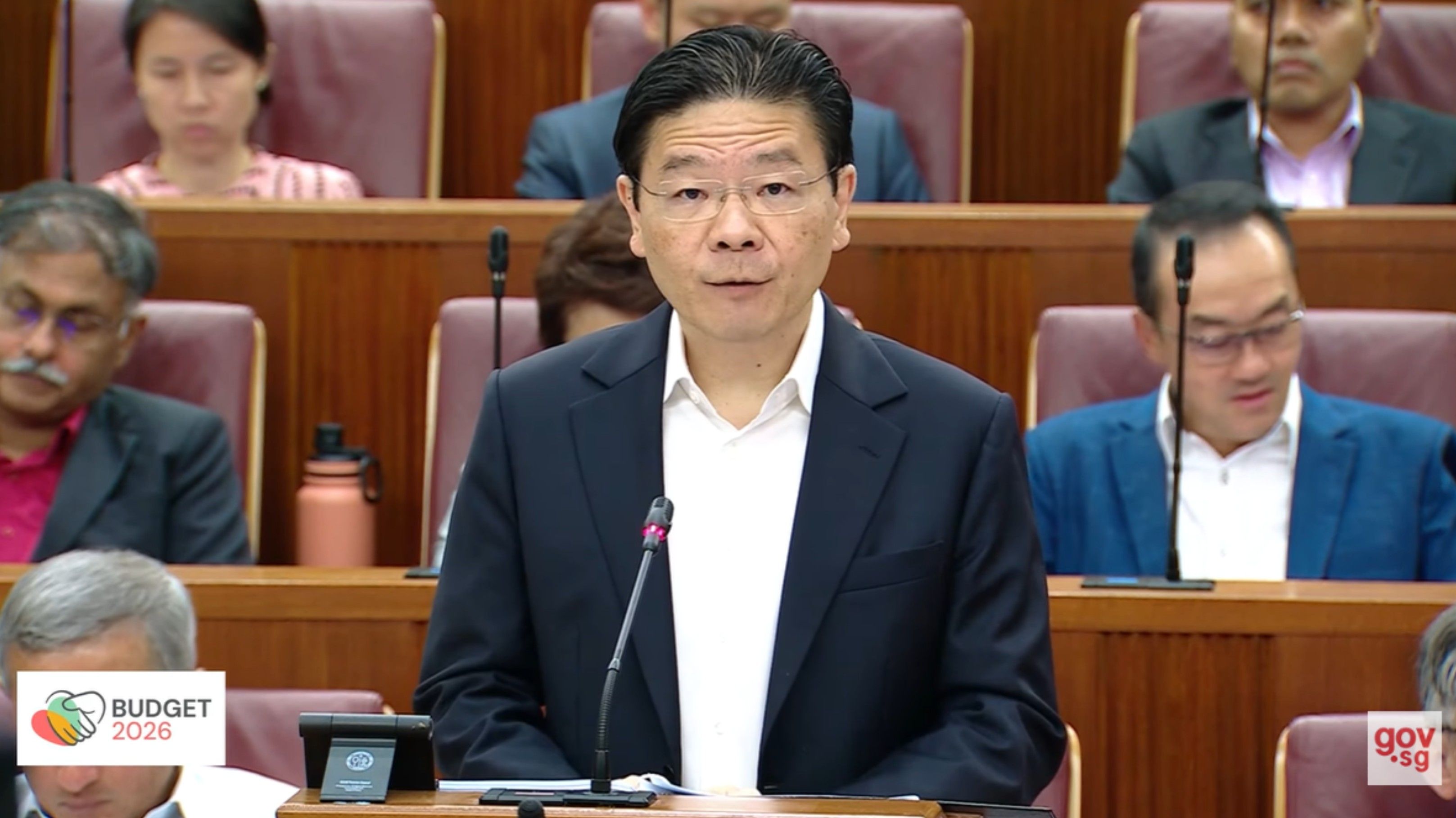
Singapore's Prime Minister Lawrence Wong delivered the Budget on February 12. Image: Gov.sg
It’s that time of the year again: cycles have closed (and opened), funds were released, and strategies refreshed.
Singapore’s Prime Minister Lawrence Wong delivered the first budget in the new term of government on February 12 amid the backdrop of economic uncertainty, job redesigns, and artificial intelligence (AI) displacement.
What was most telling about the annual affair was not the dollar amounts set aside for each ministry, but rather which agencies the receipts would be billed to.
For years, the phrase “whole-of-government (WOG)” has been a favourite buzzword in the halls of strategy groups and taskforces but struggled (and still do) to overcome frictions points in vertical siloes, data fragmentation, and legislative barriers.
From AI missions to agency mergers, the slew of announcement made by PM Wong yesterday seems to signal an end to the era of siloes and the start of mission-led governance.
Sectoral AI missions
PM Wong said that AI will be a strategic advantage for Singapore that could help in overcoming structural constraints like an ageing population, limited natural resources, and tight labour markets.
Singapore’s advantage, he added, was not in building the largest frontier models but deploying AI “effectively, responsibly, and at speed”.
This led to the launch of a new set of “national AI Missions” to drive AI-led transformation is key sectors with a focus in including finance, healthcare, connectivity and advanced manufacturing.
A new National AI Council, chaired by PM Wong, will be established to coordinate government-wide alignment across R&D, regulatory, and investments.
By placing this directly under the PM’s purview, the government is signaling that AI is no longer a vertical to be managed by tech agencies like GovTech Singapore or Infocomm Media Development Authority (IMDA).
Instead, it is a horizontal layer that must pierce through every ministry.
From WOG to whole-of-society, the message centres around AI for productivity and growth.
This will see the scale up of Lorong AI, which is a community hub set up by the Ministry of Digital Development and Information (MDDI) in January 2025 – as it moves from a shophouse in Chinatown to an established AI park at One-North.
This new cluster would catalyse ideas, forge collaborations, and translate AI initiatives into practical solutions for businesses and public services.
‘SkillsForce Singapore’
In an era of faster technological change and more frequent job transitions, systems must work more seamlessly together for stronger alignment is needed, said PM Wong.
SkillsFuture Singapore (SSG) and Workforce Singapore (WSG) will merge into a new statutory board, following recommendations from the Economic Strategy Review (ESR) committee to review job organisation and skills support.
Currently, the two agencies are located at different ministries – SSG under the Ministry of Education (MOE) and WSG under the Ministry of Manpower (MOM).
The merger places the new agency under the purview by both MOE and MOM as a one-stop shop for skills training, career guidance, and job matching services.
In doing so, the government is signaling to citizens that these are not two separate functions.
Moreover, the 2026 Budget could also spell a similar trajectory for service-chain consolidations across other government services.
National roadmaps like Healthier SG and Forward SG have moved towards multi-agency efforts and deployments across sectors like healthcare, early childhood education, and social aid.
More updates are expected from the Minister for Education, and the Minister for Manpower at the Committee of Supply in March.
Government-citizen collaboration
A standout from the budget this year was how Singaporeans could contribute to community needs.
By involving citizens in the design phase of services, co-creation can accompany WOG interventions to improve service delivery.
A S$50 million SG Partnership Fund has been launched to catalyse ground-up intiatives for sustained capabilities and impact.
The new fund will provide differentiated tiers of funding over different time frames, including grants of up to S$1 million for larger, multi-year projects.
This develops from the Our Singapore Fund initiative that has supported over 800 ground-up projects including municipal and digital readiness initiatives since its introduction in 2016.
The Singapore Government Partnerships Office (SGPO) launched in 2024 was meant to act as a central point for Singaporeans to propose ideas and partner on community projects to foster deeper government-citizen collaboration.
The budget also entails how the government will open more avenues for youth to be engaged shape Singapore’s future.
The next round of Youth Panels later this year, led by the National Youth Council (NYC), will enable more young people to step forward and make a difference.
More updates are expected from Acting Minister for Culture, Community and Youth at the Committee of Supply.
What else is needed for WOG outcomes
As Budget 2026 sets the tone year, the real challenge will be cultural.
The budget outlined allocates billions to AI and structural mergers, but the success of these missions rests on the shoulders of public officers navigating a era of public services that demands bilingual talents.
The takeaway for public officials is this: Don't just look at how your department’s budget has changed. Look at who your new partners are.