
Building accountability and literacy into healthcare AI governance
By Cindy Peh
Hundreds of AI projects are already underway across the healthcare cluster, and the next step is embedding AI more deeply into clinical workflows, says Changi General Hospital’s Deputy Director of Data Science & Intelligence, Narayan Venkataraman.
-1784884242407.jpg)
Changi General Hospital’s Deputy Director of Data Science & Intelligence, Narayan Venkataraman. Image: HealthTech X
With accelerating use of artificial intelligence (AI) in healthcare, AI governance has swiftly become a boardroom priority for industry leaders.
But simply having governance frameworks in place is not enough, said Changi General Hospital (CGH)’s Deputy Director of Data Science & Intelligence, Narayan Venkataraman.
CGH is a hospital under one of three Singapore’s public healthcare clusters, SingHealth.
Speaking at HealthTechX Asia 2026, Venkataraman shared the hospital’s journey in building AI governance, arguing that successful AI adoption depends just as much on digital and AI literacy – equipping healthcare professionals with the knowledge and confidence to use AI responsibly.
Governance must keep pace with AI advancements
Generative AI (GenAI) is creating new opportunities across healthcare, from clinical decision support to workflow optimisation.
Yet it also introduces new risks, including inaccurate outputs, bias and hallucinations.
Using an AI-generated image of Singapore’s skyline that mistakenly showed Marina Bay Sands with four towers instead of three, Venkataraman illustrated a simple but important point: AI can appear convincing while still being wrong.
“GenAI gets it wrong,” he said. “It’s not 100 per cent right. So you’ve got to have the systems in place.”
Rather than viewing governance as a barrier, he described it as an enabler that helps organisations deploy AI safely and consistently.
Governance begins with strong data foundations
CGH’s governance journey began with data governance nearly a decade ago.
Before organisations can scale AI, they must establish reliable data infrastructure, clear governance processes and enterprise-wide standards.
AI governance builds on this foundation. Venkataraman noted that governance, risk management and ethics are embedded across the AI lifecycle – from ideation, design, development, deployment, and monitoring.
Organisations can refer to publicly available guidance from the Infocomm Media Development Authority (IMDA), including the Model AI Governance Framework and Generative AI Governance guidelines, and adapt to their own environments.
The role of AI literacy in governance
Beyond guidelines and policies, a critical element of AI governance is that of shared accountability amongst all staff.
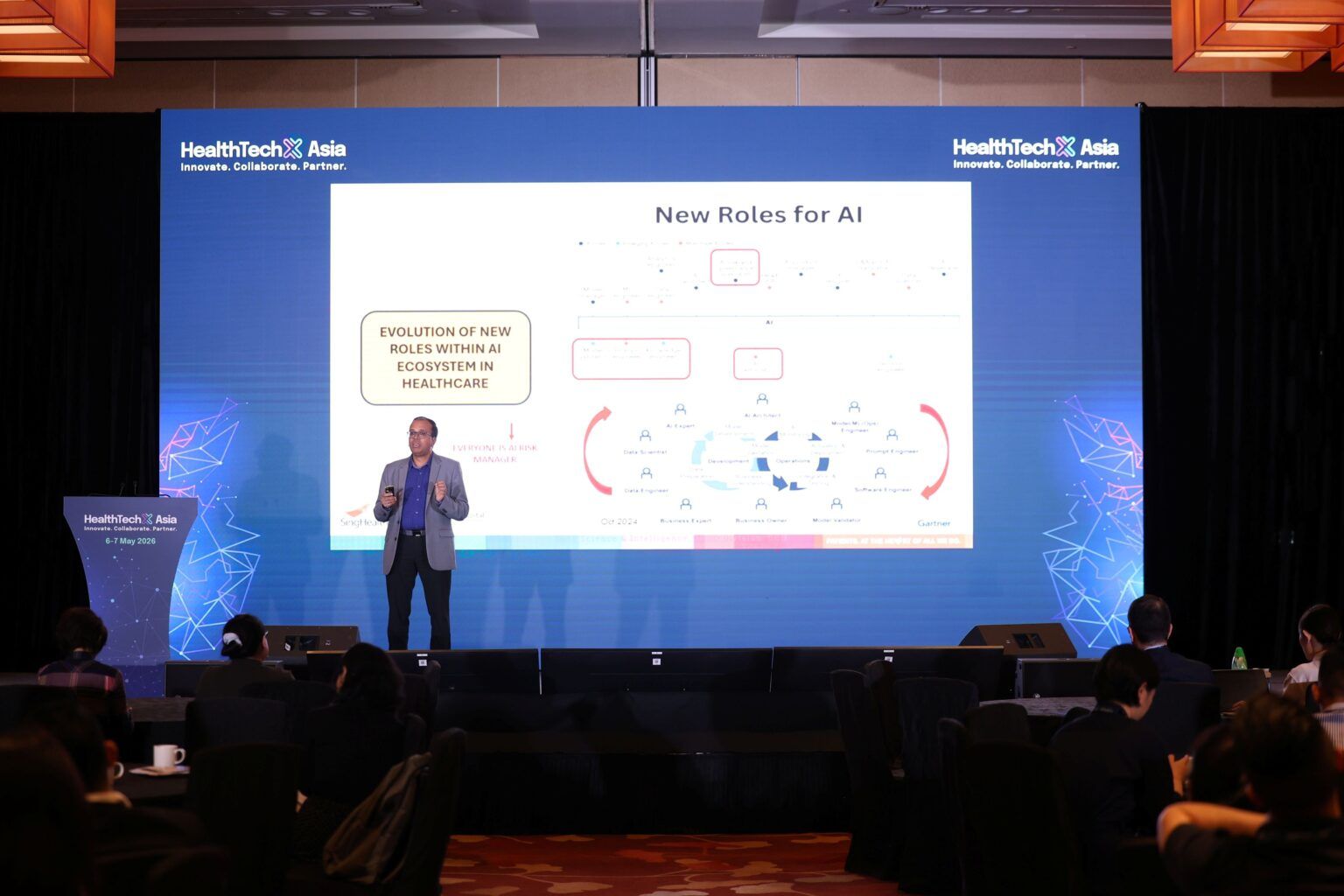
CGH’s approach is grounded in the principle that everyone has a role to play in managing AI risk.
Responsibility for AI governance does not sit solely with technical teams; clinicians, nurses, pharmacists, operational leaders and executives all share the responsibility of ensuring AI is deployed safely and appropriately.
Achieving this requires uplifting AI literacy and capability across the board.
The AI governance landscape is becoming increasingly complex, with numerous frameworks and guidelines to reference – from international standards such as ISO, to accreditation requirements and enterprise risk management plans.
“All these add up and becomes challenging for working professionals to digest,” said Venkataraman.
From AI literacy to fluency
As organisations move along their AI maturity roadmap, they will also need to develop AI fluency—the ability to apply AI appropriately, understand its limitations and exercise sound judgement when using AI tools.
One risky scenario is where staff become highly confident in AI despite lacking sufficient understanding of its limitations.
This mismatch between confidence and competence creates significant governance risk, particularly if users over-rely on AI-generated recommendations.
CGH conducts regular organisational pulse checks to assess AI fluency levels, usage behaviours, and knowledge gaps.
Tailored training and learning opportunities are then designed to bridge those gaps.
Hackathons encourage experimentation with AI tools, while hands on workshops examine real-world failures rather than success stories.
Participants analyse issues such as hallucinations, bias and inappropriate clinical recommendations, helping them understand Gen AI-associated risks.
AI fluency key to realising potential of AI in healthcare
Venkataraman noted that CGH is currently between the experimentation and integration stages of AI maturity.
Hundreds of AI projects are already underway across the healthcare cluster.
The next step is embedding AI more deeply into clinical workflows. The migration of Singapore’s public healthcare clusters to a national electronic medical record platform will support this integration.
AI literacy and fluency will be a key factor determining the success of AI transformation.
“AI literacy ensures the foundational understanding for responsible AI use, while AI fluency empowers organisations to fully leverage AI’s potential for transformation,” he said.
“Without organisation-wide literacy, AI transformation will fail.”
The article was originally published in Hospital Management Asia here, and edited.
-------------------------------------------
Cindy Peh is the Content and Community Manager at Hospital Management Asia, which showcases trends and best practices in healthcare management via in-person and digital events, as well as an online publication.