
Chern Choong Thum (Sean), Special Functions Officer to the Deputy Minister of Communications, Ministry of Communications, Malaysia
By Sol Gonzalez
Meet the young public sector officials in the inaugural Young & Official Report 2026.
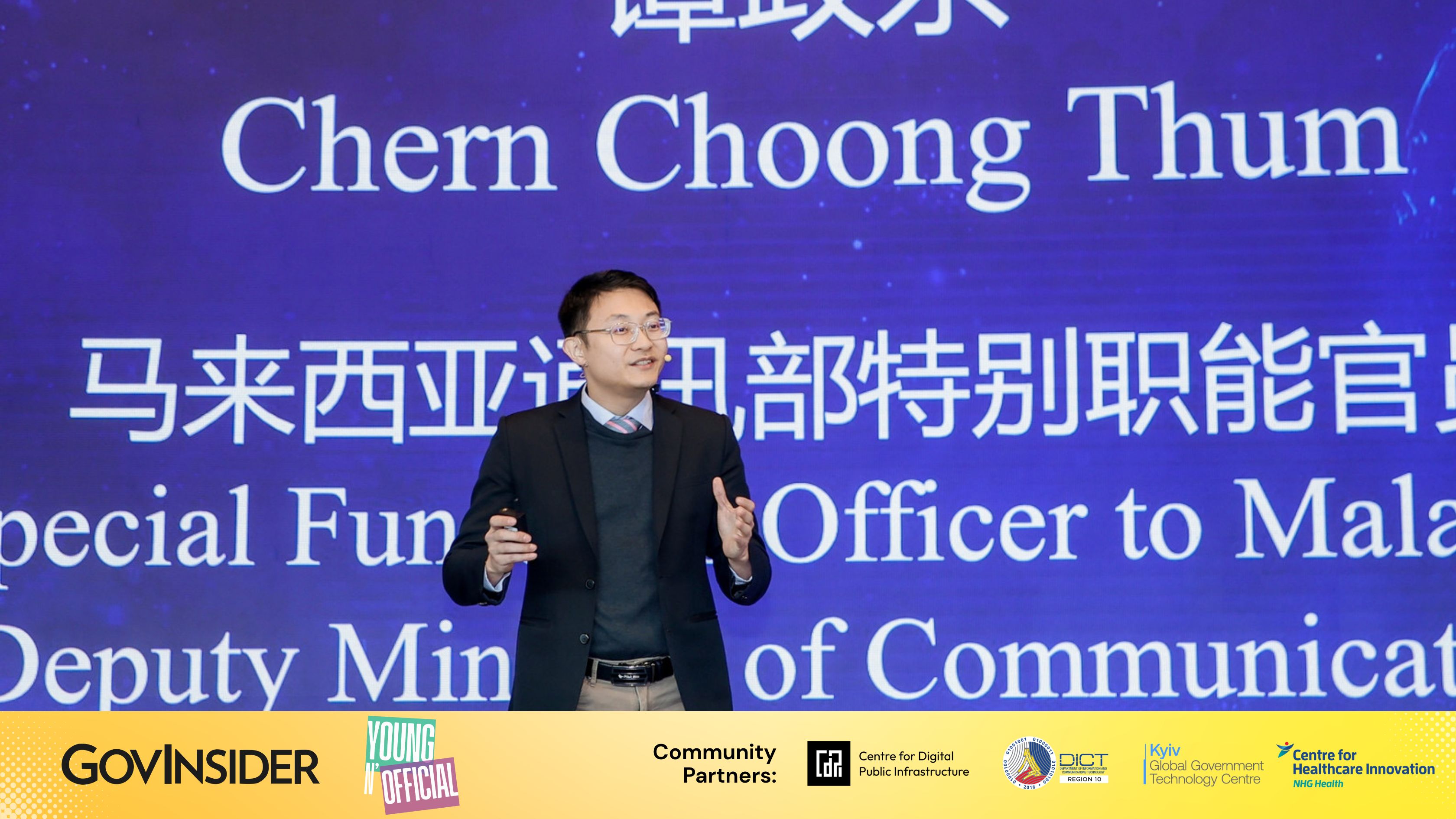
Chern Choong Thum (Sean), Special Functions Officer to the Deputy Minister of Communications, Ministry of Communications, Malaysia. Image: Chern Choong Thum (Sean).
1) What does public service mean to you? Can you share more about your role in the public sector?
To me, public service is the ultimate exercise in empathy at scale. It is the commitment to ensuring that the systems meant to support a nation actually reach the individuals they are designed for. My journey began on the frontlines as a medical doctor, where I served through the Covid-19 pandemic. That experience taught me that while a doctor can save a life, a well-crafted policy can save a generation.
I realized that many of the systemic issues I witnessed in the wards required solutions at the legislative level. This led me to advocate for more balanced health policies, eventually transitioning into my current role as the Special Functions Officer to the Deputy Minister of Communications.
Today, I work at the intersection of governance, policy, and parliamentary affairs, ensuring that communication strategies and digital policies are grounded in the real-world needs of the citizenry.
2) Tell us about a project you championed. What impact did it have on the community?
One of the most meaningful initiatives I was involved in was the development of the Guidelines for Reporting and Sharing of Suicide-related Content which was published in mid-2025. This issue carries real-world consequences. The “contagion effect” is well-documented, where certain types of reporting can contribute to copycat behaviour, particularly among vulnerable groups. Sensationalism, explicit detailing, or over-simplistic narratives risk doing more harm than good.
In this project, I focused on helping bridge technical knowledge with practical policy application. Working with a multidisciplinary team, we developed a framework that promotes accurate, non-sensationalised reporting, while embedding the importance of signposting support services.
Since its rollout, alongside continued engagement with media practitioners, there has been a gradual but important shift in tone. Coverage is becoming more responsible, with greater emphasis on prevention, awareness, and pathways to help.
What this demonstrated to me is that well-designed policy, when grounded in evidence and paired with sustained stakeholder engagement, can shape narratives at scale, and in doing so, influence outcomes across society.
3) As a young professional, how has your unique background or perspective allowed you to identify a solution that others in your organisations might have overlooked?
Bring a doctor in a political and communications environment gives me a “diagnostic” lens. Often, in bureaucracy, we focus on the symptoms of a problem such as a negative public reaction, low uptake, or a delayed rollout. My clinical training pushes me to look for the etiology or the root cause.
For instance, when discussing public response to policies or service adoption, I tend to look beyond messaging gaps to issues like trust deficits, behavioural friction, and accessibility barriers, which are nuances that can be overlooked if communications is treated purely as a PR function.
This interdisciplinary perspective allows me to advocate for more user-centered, behaviourally informed policy design, ensuring that our communication infrastructure goes beyond transmitting information to supporting decision-making in a meaningful way and ultimately, the well-being of the Malaysian public.
4) What is your personal strategy for maintaining your creative energy when faced with bureaucracy?
I have learned to reframe bureaucracy not as an obstacle, but as a system with its internal logic. Creative energy, in this environment, comes from understanding constraints deeply enough to work within (and occasionally around) them. That means investing time in stakeholder alignment, anticipating points of resistance, and breaking large ideas into implementable steps.
On a personal level, I also maintain proximity to the “ground” (public), whether through conversations, reading, or engaging through social media. It keeps the work anchored, and prevents the process from becoming purely procedural. This is important, because purpose sustains creativity more reliably than motivation.
5) If you had just one area to invest in to accelerate transformation in the public sector (regulation, technology, talent, etc.), which one would you choose and why?
I would invest unreservedly in talent development and retention. At its core, public service is a human system. Policies, guidelines, technologies, and regulations are only as effective as the people who design, interpret, and implement them. Empathy and compassion are human traits that ensure systems remain grounded in the people they are meant to serve.
Investing in talent therefore goes beyond recruitment. It means building interdisciplinary capability, creating pathways for mobility between sectors, and empowering officers to think beyond silos. It also requires cultivating a culture that tolerates calculated risk and iterative improvement over defaulting to rigid compliance.
Because a capable, trusted, and adaptive workforce can make imperfect systems work, and more importantly, steadily make them better.
6) What is your greatest ambition as you grow in your public service career?
My greatest ambition is to contribute to building a Malaysia that is consistently recognized for efficient, evidence-based governance. I hope to be a part of a leadership cohort that moves beyond siloed decision-making toward a more integrated model where ministries and agencies operate with shared intent, aligned data, and speak a common language of outcomes.
The ultimate benchmark is a government that works so seamlessly it becomes almost invisible in people’s daily lives, where services are accessible, predictable, and taken for granted not because they are trivial, but because they function as they should.
If I can contribute, even in part, to closing the gap between policy design and lived experience, that would be a meaningful measure of success.
7) What is a “universal value” that connects everyone in your department – from interns to directors – and how do you use that to drive collaboration?
The universal value is stewardship. Regardless of rank, we all recognize that we are temporary custodians of the public’s trust. I try to build on that by framing every task around this concept, no matter how administrative.
When we realise we are stewards of the people’s time, trust, and taxes, our aim shifts to providing the best service we can. Subsequently, collaboration becomes more natural and less transactional, because we understand the ultimate “boss” is the Malaysian citizen.
8) What is the best piece of advice you’ve got for the next generation of public servants?
Take ownership and set your own narrative. It is easy to become a cog in a gigantic machine and wait for instructions. However, the most effective changemakers are those who act as if they own the outcome of their projects. A wise senior once told me to not let the title define your impact, but let your impact define your title instead.
If you don’t define your role in public service, the bureaucracy will define it for you. And it will likely be much smaller than your actual potential.
9) What is a myth you wish to debunk about young public servants?
A common myth is that youth is synonymous with inexperience, and that limits how young people can contribute.
While experience is undeniably important, younger officers often bring different types of value such as proximity to emerging trends, fluency with new tools, and a willingness to question established assumptions.
The real opportunity is not to weigh one against the other, but to combine perspectives. When fresh thinking is paired with institutional memory, the result is often more adaptive, more relevant, and better suited to the challenges we face today.
Public service works best when different strengths are efficiently brought together toward a common goal.
10) Write a letter to your future self in 2035. Please keep it within 200 words.
Dear Sean,
As you read this in 2035, I hope you are living in a Malaysia where the digital and social divides have meaningfully narrowed, where access to healthcare, education, and basic welfare remains a guarantee people can rely on with dignity.
I hope you have not become too comfortable. I hope you still remember what it felt like to stand at the bedside, to witness systems fail people in quiet, unrecorded ways, and why you chose this path.
I hope you kept the instinct to see the human being behind every data point. You moved from the stethoscope to the pen to effect change at scale; I hope you have used that pen to shape policies that restored dignity, especially for those too easily overlooked.
By now, you would have faced many bureaucratic constraints. I hope they did not make you cynical. Stay creatively persistent. Keep building, even when progress feels incremental.
And I hope you are now guiding others, and reminding the next generation that public service is a responsibility to leave things better than we found them.
Stay bold. Stay empathetic.