
Collective stewardship as the path for AI sovereignty
Leaving AI to be managed by tech monopolies risks displacing democratic choice. Governments have a role to play instead, by enabling cooperation and collective stewardship, so that AI sovereignty stays rooted in the dignity and autonomy of societies.
-1783567229052.jpg)
The ability of the political class to design a future world where decision, knowledge and the structure of social order is becoming increasing crucial in the age of AI. Image: Canva
Technological capacity has always been entwined with economic growth. But artificial intelligence (AI) goes beyond being just another input into production.
New global hierarchies are being built based on mastery over the value chain of AI.
Nations and organisations that possesses the hardware and talent needed for general-purpose AI models have acquired the power to shape the destinies of nations whose gross domestic product (GDP) numbers may be larger than theirs.
In this new reordering of world order, the idea of AI sovereignty has been gaining increasing traction.
Whereas classical sovereignty has always focused on territory, law and the monopolies of violence and taxation, AI sovereignty has less to do with territorial control and more to do with mastery of the digital infrastructure and knowledge.
The politics of AI sovereignty
The ability of the political class to design a future world where decision, knowledge and the structure of social order is becoming increasing crucial in the age of AI.
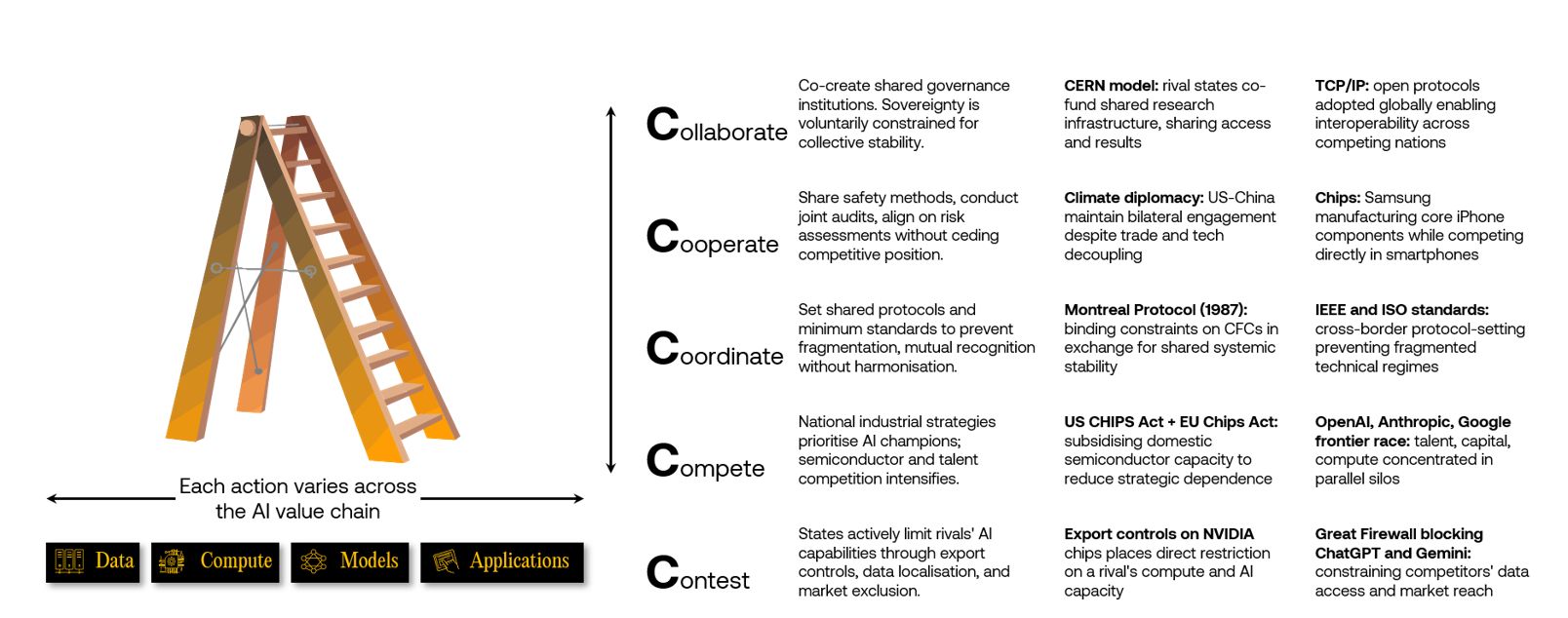
To get a sense of how countries navigate the AI terrain, it’s helpful to picture a basic ladder of engagement that nations climb.
At the bottom you have contestation, where states are trying to limit or sabotage each other’s AI development, typically by controlling access to chips, data sets or talent.
Just above it is competition, where countries compete to develop better models or control supply chains, supposing that dominance in AI offers the essence of long-term security and influence.

Coordination comes next, a small but important attempt to set protocols that stop the destabilising escalation: the diplomatic hotlines in a space where misalignment between systems could lead to things we barely comprehend.
Beyond that there is cooperation, where standards start to converge, safety regimes are shared, and mechanisms for managing the risk at a collective level are put in place - while capabilities still remain sovereign.
And at the top is collaboration – the mutual building of infrastructures, models or governance architectures that reflect a shared commitment to stewarding this technology to serve public good.
In classical sovereignty, nations climbed this ladder slowly and often grudgingly, usually in the wake of devastating failures of unilateralism.
The 20th century’s institutional architecture – the UN, the WTO, the International Atomic Energy Agency, regional unions – were born out of realisation that anything else led to an anarchic world too dangerous and too brittle to endure.
AI requires a similar reckoning, but this time the speed of change doesn’t provide the luxury of foot-dragging.
It is only natural that nations most able to charter the path to AI sovereignty will be those with massive computational resources, deep talent pools, and robust AI ecosystems both in terms of the hardware and the large language models (LLMs) that make AI possible.
Temptation towards AI monopoly than sharing
The more compute you have, the more data you can manage; the more data, the better your models; and those with better models win.
This creates a structural temptation towards monopoly rather than sharing.
If the world remains caught in a race for the bottom of contestation and competition, we are likely to end up with an order characterised by instability, fragmentation and moral hazard.
A planet in which each country rushes to scale models bigger and faster than those of its competitors would be one where safety is the enemy of ambition.
A world where a small number of powers control the dominant AI is one in which inequality transforms into structural dependence. The tragedy of such a world would be that it would have traded long-term security on the altar of short-term gain.
Thus, the best way forward would be to move up the ladder.
Coordination, no matter how minimal, ensures communication lines, without which crises multiply each other.
OpenAI CEO Sam Altman’s proposed forum, where access to AI is conditioned on compliance with shared safety standards, is one vision of what the coordination infrastructure could look like.
Cooperation means that countries can share safety methods and conduct audits over practices; work on risk assessments so there is less of a race to the bottom. It makes room for shared infrastructures and public-good architectures that provide services to climate, health, education and low-resource communities.
And as in classical sovereignty, it would be the combined labour of international institution-building that made it possible for states to overcome parochial fears and conceive of collective possibilities.
The role of governments to shape AI’s path by reimagining institutions
AI requires an analogous institutional imagination – the kind that is not content to simply author power but shape its path.
In this re-imagining, it is not only the great powers but countries such as India, the UK, Singapore, and the UAE that have a unique role to play.

These countries bring cross-cutting credibility. India, for example, has experience engaging the Global South, and has built large scale Digital Public Infrastructures (DPIs) such as Adhaar and UPI, which provides model for open-stack ecosystems.
The UK has built the depth of institutions and leadership to support AI safety.
Singapore has built a substantial international consensus on AI governance with its early development of AI governance frameworks.
The UAE is a leader in building AI capacity and convening Global South and Gulf countries.
These nations understand that the balance between autonomy and reliance; and have shown AI governance is not the result of a bilateral agreement with the Washington or Beijing.
They all have an important responsibility in shaping how AI governance can be realised through an architecture that is pluralistic, legitimate, and collective.
If sovereignty is to have a future rooted in the dignity and autonomy of political communities, rather than drifting inexorably toward a world where technological oligopolies displace democratic choice, nations will need to rediscover the virtues of restraint, cooperation and collective stewardship.
In fact, the ladder is not an abstract theory – it’s how we maybe avoid those dark futures in a lawless AI playground.
AI has changed geopolitics. But if politics is to still be a human enterprise, guided by judgment and not just computation, then we need to ensure that our institutions must embody our greatest aspirations rather than our smallest fears.
The journey from contestation to collaboration is challenging, but it’s the only route that provides hope of a future in which technology enhances human liberation rather than limits it.
------------------------------------------
The author is the country director of India at the Tony Blair Institute for Change (TBI). He heads TBI’s India practice and has overall accountability for developing the overall strategy, delivering engagements, and creating a culture of innovation. He specializes in issues on Technology and Governance.