-1783304403050.jpg)
CPT Laris Lim Shan Yi, Field Unit Commander, 165 SQN, Republic of Singapore Armed Forces (RSAF)
Meet the young public sector officials in the inaugural Young & Official Report 2026.
-1782790876208.jpg)
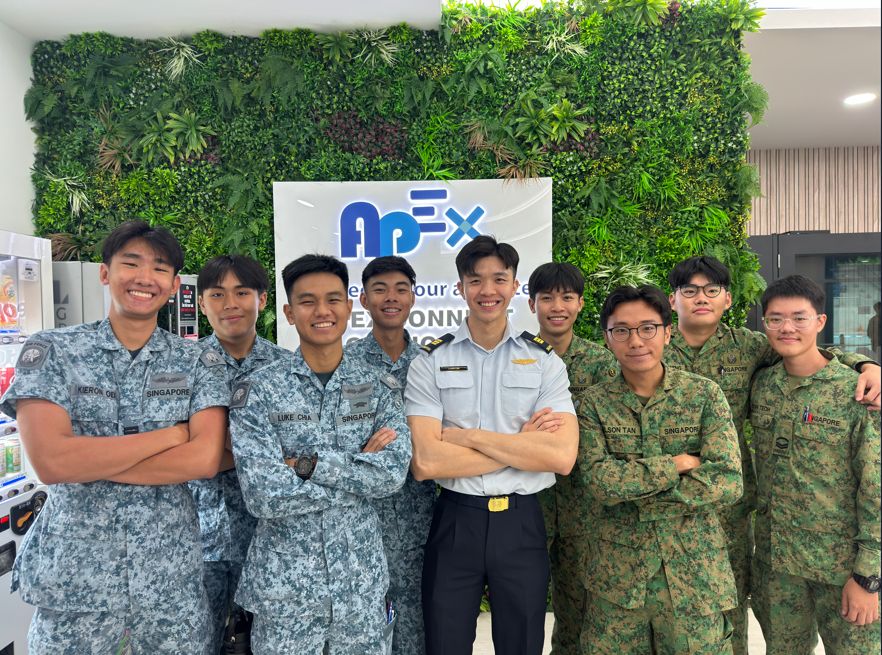
Centre: CPT Laris Lim Shan Yi, Field Unit Commander, 165 SQN, Republic of Singapore Armed Forces (RSAF). Image: Laris Lim
1) What does public service mean to you? Can you share more about your role in the public sector?
Public service, to me, is exactly that: service – genuine desire in serving the people around me and my community, contributing in any way I can.
And what keeps me going is the eye-opening journey of understanding what service truly means and the different ways it can be expressed, including through innovating.
As an Air Warfare Officer (Air Defence Weapons), I am part of the team that keeps Singapore's skies safe around the clock — operating ground-based air defence systems.
Alongside that, I build digital tools that make work smarter, faster, and more streamlined for the people around me.
What started as a personal side hustle has grown into a passion — my team and I have since built over 10 apps embedded into our daily operations, with some adopted by other units.
2) Tell us about a project you championed. What impact did it have on the community?
I developed an application called Spartan Keypress, which is a PowerApps solution to replace paper-and-pen based key management.
In the military, keys are used to access rooms, systems, and vehicles — and managing them has traditionally been a pen-and-paper based process.
This makes it prone to human error through illegible handwriting and inaccurate timestamps, and can lead to significant inefficiency, especially when keys are needed urgently.
With Spartan Keypress, borrowing a key and logging it takes no more than 15 seconds, compared to 60 with pen and paper.
The streamlined steps minimise human error — no more illegible handwriting or missed entries — and automatic timestamping creates a clear, auditable trail, so there is always accountability over who holds what, and when.
While seemingly minute in isolation, multiply that across multiple transactions, multiple personnel, every single day, and the time savings as well as overall benefits quickly adds up.
Since then, I have actively shared it with units across the SAF. That cross-unit adoption means more to me than any metric — it means that the project has truly addressed a need that existed across different parts of the organisation.
3) As a young professional, how has your unique background or perspective allowed you to identify a solution that others in your organisation might have overlooked?
In Officer Cadet School, we recited the Officers' Creed every day. One line never left me: “My duty is to lead, to excel, and to overcome”.
Not to accept. Not to work around. To overcome. That word now shapes how I approach the unassuming status quo.
My approach to any problem starts with questioning the premise entirely — not just how something is done, but whether it needs to be done that way at all.
Less about asking "what is 5+5?" and more about "what are all the ways we can get to 10?"
The destination — the intent — stays fixed. But the path is always open to reimagination. That reframe is where the real solutions lie.
And the answer is often closer than expected. Just a mobile phone and a digital tool most servicemen already carry. The tools are often at our disposal and all it takes is a fresh perspective.
4) What is your personal strategy for maintaining your creative energy when faced with bureaucracy?
Work with what you have, where you are. Experiment within your own lane. Small changes, real feedback, iterate.
That is how things shift — not just through large mandates, but through enough small proof that a better way exists.
And when frustration creeps in — return to the reason you started.
If anything, navigating organisational regulations has its silver lining: it brings you face to face with more people across the organisation, helps you understand why certain requirements are designed the way they are, and gives you the opportunity to explain and refine your idea along the way.
5) If you had just one area to invest in to accelerate transformation in the public sector (regulation, technology, talent, etc.), which one would you choose and why?
Cultivating a culture of innovation and the voice to champion it.
Within the RSAF, I have seen firsthand how a supportive culture unlocks innovation from the ground up — where people feel encouraged to surface ideas, take measured risks, and build solutions that genuinely improve operations.
Invest in culture and everything else follows. Talent thrives, technology gets used meaningfully, and people feel empowered to say — there is a better way, and I am going to find it. That, to me, is the investment worth making first.
6) What is your greatest ambition as you grow in your public service career?
My ambition is to grow in relevance – to my organisation, to the people I serve, and to the community around me.
As an officer, I know my career will take me across different roles and vocations.
What matters to me is that wherever I am posted, I leave things in a better state than I found them — whether that is a more capable team, a more efficient process, or simply a colleague who feels more confident to try something new.
And the best commanders I have seen are not just tactically sharp. They are the ones whose absence is felt not in the void they leave, but for the foundation they built.
If I can look back one day and say the culture shifted even a little because of the work I did and the people I brought along — that, to me, is a career well spent.
7) What is a “universal value” that connects everyone in your department – from interns to directors – and how do you use that to drive collaboration?
Mission.
In the RSAF, it is not a word on a wall. It is the reason we show up, the standard we hold ourselves to, and the common ground that cuts across every rank and role.
When I bring people together, the mission does the convincing for me — every app we build, every process we streamline, is ultimately in service of that shared purpose.
That common ground dissolves hierarchy naturally. Rank matters in the field, but in a room where everyone is working toward the same goal, the best idea wins — regardless of where it comes from.
8) What is the best piece of advice you’ve got for the next generation of public servants?
Don't forget what you're in it for. Because everything else follows from there.
Early in my innovation journey, I caught myself optimising for the numbers — how many projects, how many submissions, how many apps. It felt productive.
But somewhere along the way, I realised I had drifted from the original intent: to make things genuinely better for the people around me.
A long list of projects means little if none of them truly serve anyone. Such a reset or reflection is perhaps an important process for each individual to consider in their journey.
9) What is a myth you wish to debunk about young public servants?
That innovation is impossible when processes have long been set in their ways.
When I pushed my solutions through, the path was not always smooth.
There were multiple considerations and competing requirements, such as security concerns. But the answer was never to stop — it was to prepare for the journey to come.
Research thoroughly. Propose holistically. Anticipate objections before they are raised and show up with answers, not just ideas.
Conviction, preparation, and persistence will take you further than you think — inside any system.
10) Write a letter to your future self in 2035. Please keep it within 200 words.
Dear Laris,
I hope the instinct to question why you do what you do, and whether things should be done the same way, continues to burn bright.
Stay close to the ground and the people you serve — that is where the real challenges worth solving lie. Measure yourself not by what you built, but by how many others you brought along.
And when the noise gets loud, come back to why you started. That clarity is what will always carry you through.