
Data is transforming Indonesia’s national power utility
The challenge is turning discrete operational data into decisions that are faster, more accurate, and predictive, says Indonesia’s State Electricity Company (PLN)’s President Director Darmawan Prasodjo.
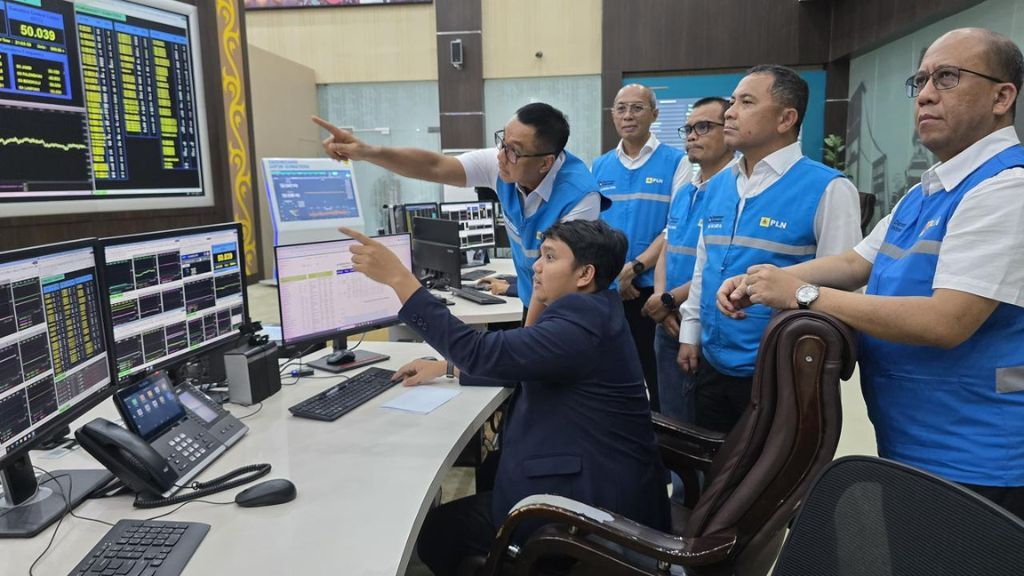
PLN President Director Darmawan Prasodjo (standing, pointing at the screen) monitors the electricity system in real time. PLN's Virtual Command Centre serves as the central hub of the national electricity system's digital ecosystem. Image: PLN
Managing Indonesia's electricity system is not just about keeping the lights on.
As an archipelagic nation with thousands of power plants, transmission lines, and distribution networks not only serving major cities but also distant islands, every operational decision must take into account a system that is both highly complex and constantly changing.
This complexity has driven the State Electricity Company (PLN) to pursue a digital transformation strategy that goes beyond just digitalising business processes to fundamentally shifting how the company manages the nation's electricity infrastructure.
"PLN's transformation lies in a shift in organisational mindset: from decisions based on reports to decisions based on data, from working in silos to moving as a single system, from being reactive to becoming increasingly predictive," says PLN’s President Director Darmawan Prasodjo to GovInsider.
According to Prasodjo, the organisation began its transformation by asking one question what problem needs to be solved, rather than what technology should be used.
"Technology is merely an enabler. From the outset, we never viewed PLN's digital transformation as a technology project, but as a transformation in how we manage the nation's strategic infrastructure," he adds.
The operational chain works from the same information
Prasodjo emphasises that data occupies a strategic position in transforming the national electricity system.
"PLN generates millions of operational data every day, from generation, transmission and distribution through to customer service. The challenge is turning that data into decisions that are fast, accurate, and aligned across the whole organisation," he says.

To that end, PLN has built a single digital ecosystem that connects its end-to-end business process.
Its common data foundation has integrated various technologies, ranging from the Internet of Things (IoT), Supervisory Control and Data Acquisition (SCADA), Geographic Information System (GIS), Advanced Distribution Management System (ADMS), analytics platforms, and the Virtual Command Center.
This approach helps to deliver a single source of truth, allowing decisions to be made with a greater degree of confidence and much faster.
"What we have built is a digital nervous system for the national electricity system. When one point in the system detects a change, the entire operational chain can respond in a coordinated way," he notes.
Prasodjo says that the Virtual Command Centre is one of the key nodes in this approach.
Through this control centre, the conditions of the national electricity system can be monitored directly, so that coordination between units no longer depends on a long chain of reporting.
Putting data to work for predictive analysis
The next stage of this transformation is not just using data to only explain what has already happened, but help forecast what is likely to happen next.
According to Prasodjo, PLN integrates outage history, asset health conditions, load profiles, weather data, and field operational data into a single analytics system.
Once all this information is combined, artificial intelligence (AI) helps to identify patterns, such as peaks in electricity demand, that are difficult to detect through maual observation.
With this information, power plants can prepare additional supplies, the transmission system can optimise power flow, distribution networks can raise their operational readiness, while field personnel can be positioned in advance at locations expected to require a faster response.
This approach has also changed the philosophy behind network maintenance.
Where PLN previously waited for a disruption to occur before acting, the company is now moving towards predictive maintenance – identifying risk and intervening before customers are impacted.
A system ready for future complexity
For Prasodjo, predictive analysis will become increasingly important as Indonesia's electricity system ramps up generation using renewable energy, among other sources.
Under the 2025-2034 Electricity Supply Business Plan (RUPTL), Indonesia will add around 69.5 GW of generation capacity, roughly 76 per cent of this new capacity will come from new and renewable energy.
The growth in solar, wind, and other clean energy generation means the system must be able to maintain a balance between supply and demand in a far more dynamic way than before.
"That is why we are building an end-to-end smart grid as the backbone of the future electricity system, so that the operational chain is connected within a single digital ecosystem exchanging data in real time," he says.
The same approach has been applied to PLN Mobile. Where customer reports previously stopped being no more than a complaint ticket, they are now part of the company's operational data flow.
When a customer reports a disruption through the app, the information is passed directly to the operational system and the Virtual Command Centre.
The nearest technician is automatically assigned and responds quickly, while the handling process can be monitored until power is restored.
With more than 70 million users, PLN Mobile has expanded PLN's ability to understand network conditions through information coming directly from customers.
Strengthening cyber resilience
Prasodjo shares that the growing reliance on data has also made cyber resilience an inseparable part of the national electricity system.
As a result, PLN has strengthened its digital security architecture through real-time threat monitoring, improved detection and response capabilities, and collaboration with government, regulators, security agencies, the cybersecurity community, academia, and digital industry players.
"Where digital systems used to run more separately, opening up more points of risk, the entire architecture is now built to be far more integrated, with increasingly strong layers of protection," he adds.
However, he acknowledges that facing cyber threats cannot be done alone.
The ability to counter constantly evolving threats requires cross-sector collaboration, spanning government, regulators, security agencies, the cybersecurity community, academia, and other strategic partners.
PLN's transformation journey is not simply about producing more applications or adopting AI. The more fundamental change lies in how the company has redesigned the way the organisation makes decisions.
"Our vision is simple yet ambitious: to make PLN not just an electricity provider, but the orchestrator of a national energy ecosystem capable of safeguarding energy resilience, driving economic growth, and strengthening Indonesia's competitiveness in the future," he concludes.