
Digital government is levelling the playing field, highlights new podcast
GovInsider recently joined a global government innovation panel on the Civic Punks podcast, with representatives from five regions to share how AI is transforming public sector innovation.
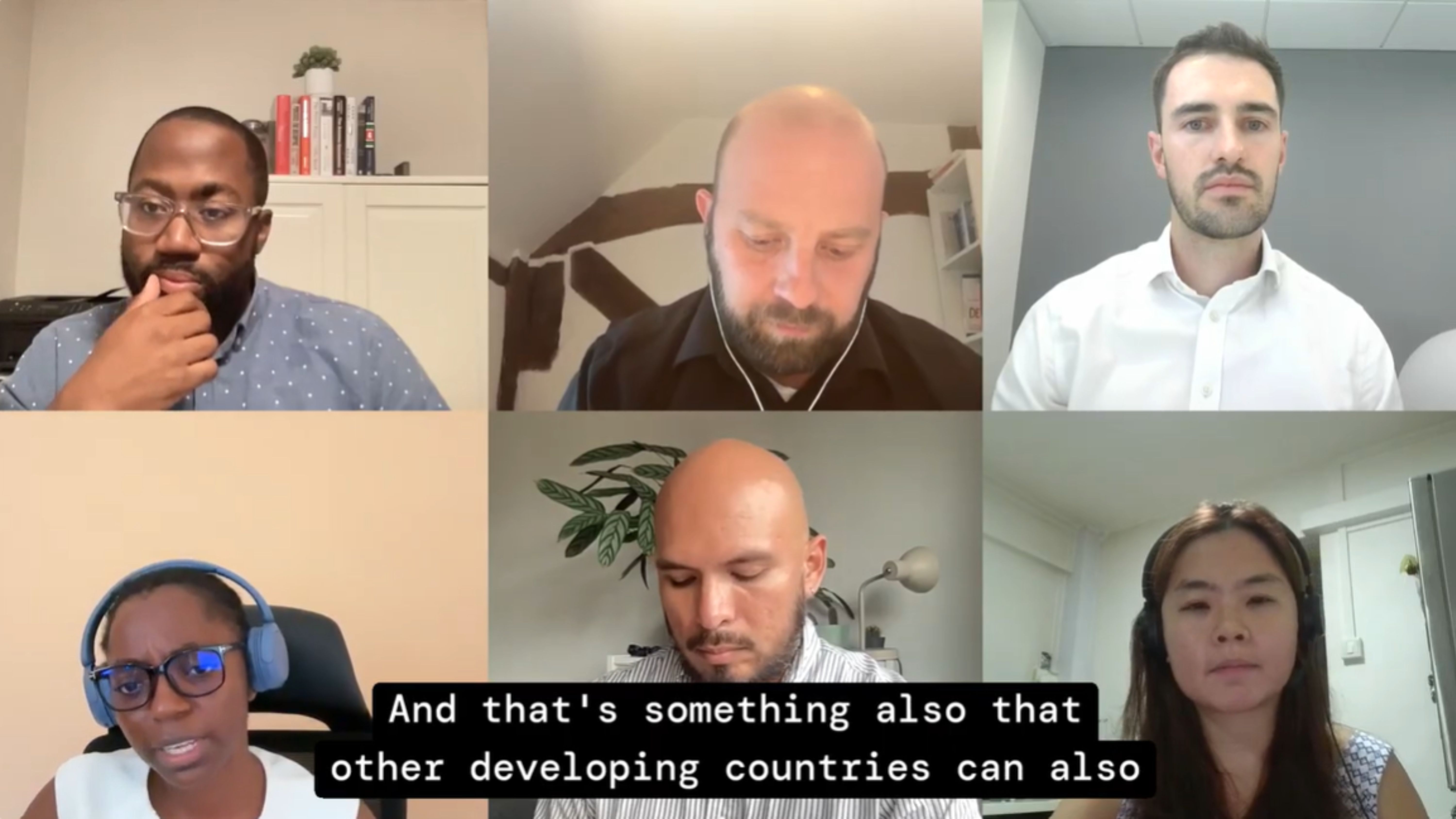
(left to right) Humans of Public Service’s Brian Whittaker representing North America; Civic Punks' podcast host Derek Alton; interweave.gov's Luke Cavanaugh representing Europe; Public Digital’s Blessing Oluwatosin Ajimoti representing Africa; FuturoPublico’s Jose Diaz Mendoza representing South America; and GovInsider's Si Ying Thian representing Asia in the global government innovation panel podcast.
Separated by a vast distance with distinct governance models, the United States (US) and Singapore might appear to diverge when it comes to how each approaches digital governance.
Yet, a crucial similarity prevails: Both are strategically committing to building centralised government AI tech stacks, such as the USAi and Singapore Government Tech Stack (SGTS).
These tech stacks provide public officers with the protected spaces and tools needed to safely experiment with and integrate artificial intelligence (AI) capabilities into their daily work.
Digital governments around the world share more in common than they differ.
My recent experience on a global panel podcast, featuring representatives from five regions, highlighted that despite the diverse technological landscapes, the core challenges and strategies for success consistently converged on a few key themes.
These include prioritising user needs starting small with digital initiatives, and the critical discussions around digital sovereignty.
The episode was titled “Experiments in AI from around the world - Global Government Innovation Panel – Pilot" hosted by Derek Alton from Civic Punks podcast, who is also Apolitical’s Community Insights Lead.
Fellow speakers include Public Digital’s Blessing Oluwatosin Ajimoti representing Africa, interweave.gov's Luke Cavanaugh representing Europe, FuturoPublico’s Jose Diaz Mendoza representing South America, and Humans of Public Service’s Brian Whittaker representing North America.
Here were some key takeaways from the discussion:
Whittaker (US) provided the perspective of the government as a responsible AI learner, not just a regulator or a customer, as well as keeping AI adoption “thoughtful” by centering technology around the people governments serve.
Mendoza (South America) pointed out that AI and innovation should not be viewed as isolated domains. When innovation establishes the foundational environment, with its agile teams and experimentation spaces, it creates the ideal setting for AI's analytical capacity and operational depth to thrive.
Cavanaugh (Europe) views digital government as a space where leadership in innovation is being decentralised - “it’s not just your traditional economic powerhouses that are setting pace in this space,” he said. Global South is actively setting the way when it comes to digital public infrastructure (DPI), and willingly sharing lessons globally.
Ajimoti (Africa) stressed the need to “start small”, moving away from massive, complex overhauls. By launching pilot projects or working within a manageable scope, agencies test assumptions and determine what is effective. This initial, small-scale work serves as the data to gradually inform the institutional, regulatory, and cultural changes needed to make the broader digital transformation successful.
Thian (Asia) highlights that with policy now becoming an iterative product, civil servants need to develop horizontal skills in design thinking, user research and facilitation. While coding knowledge isn't necessary, the ability to ask user-centric questions and manage an adaptive team is now essential.
Watch the full podcast episode below: