
Digital transformation main driver of economic growth, says Vice-Minister
At the opening of the Digital Transformation Indonesia Conference and Expo (DTI-CX) 2025, Indonesia's Vice-Minister of Communications and Digital, Nezar Patria, highlighted the crucial role of digital transformation as a key enabler for economic development.

Vice-Minister Communication and Digital, Nezar Patria (centre) accompanied by Managing Director Clarion Events Asia, Richard Ireland (third from right), and industry leaders at the opening of DTI-CX 2025. This event brings together the government and industry players to promote Indonesia's digital transformation. Image: DTI-CX
The Indonesian government reaffirmed its commitment to accelerate the country’s digital transformation to achieve its economic goals, emphasising a collaborative approach between the public and private sectors.
This was highlighted at the opening session of the two-day Digital Transformation Indonesia Conference and Expo (DTI-CX) 2025 event in Jakarta, which started on August 6.
Speaking at the opening ceremony, Vice-Minister Communication and Digital (Komdigi) Nezar Patria stated that digitalisation was no longer optional, but a strategic imperative to boost the national economy.
“Under President Prabowo’s leadership, Indonesia is targeting eight per cent economic growth. To achieve this, we cannot rely on conventional methods alone.
“Digital transformation must be the main engine to drive economic growth,” he said.
Patria added that Indonesia is aiming to become a leading digital economy in Southeast Asia.
“Our goal is to become a leading digital force that delivers innovative solutions to real-world challenges, guided by the principle of inclusivity so that no one is left behind,” he said.
Organised by Adhouse Clarion Events, DTI-CX is Indonesia’s the largest digital transformation exhibition and conference, designed to bring together stakeholders from government and the information and communication technology (ICT) industry players to accelerate digital progress nationwide.
In its fourth edition, DTI-CX 2025 featured over 150 technology companies, 300 speakers from both Indonesia and abroad, and more than 12,000 professionals from the public and private sectors.
To subscribe to the GovInsider bulletin, click here.
A shift toward market-driven innovation
To propel Indonesia into the ranks of digital economic powerhouses, Patria called for a strategic shift: from government-led digitalisation to a dynamic, market-driven innovation ecosystem.
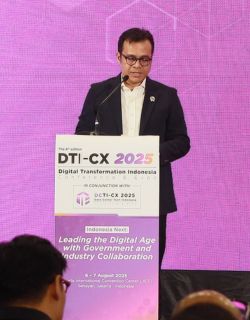
He highlighted that the government’s role should focus on fostering a reliable, secure, and enabling environment that supports sustainable innovation and investment.
As a concrete step, the Ministry of Komdigi launched the strategic initiative Indonesia Digital Vision 2045.
This initiative placed digital infrastructure as a core foundation, while also strengthening digital governance and human capital. Its three priority areas are digital governance, digital economy, and digital society.
According to Patria, a strong and inclusive foundation was key to a successful digital transformation.
“That’s why our strategy includes expanding infrastructure to the most remote areas through initiatives such as the 10,000 Digital Villages programme, the extension of the Palapa Ring network, and the rollout of 4G base stations in frontier, outermost, and underdeveloped (3T) regions,” Patria explained.
The government is also working to prepare digital infrastructure for next-generation technologies, including the development of a national data centre, artificial intelligence (AI) adoption, and a robust 5G ecosystem.
At the end of his speech, Patria called on all stakeholders, both public and private, to collaborate and support Indonesia’s digital transformation agenda.
“Reaching eight percent economic growth cannot be achieved through business as usual. It will require exceptional commitment and cross-sector collaboration,” he concluded.
Cross-sector collaboration in focus
Several industry leaders also gave speech at the opening ceremony, including Indonesian Internet Service Providers Association’s (APJII) Chairman, Muhammad Arif; Indonesia Data Centre Provider Organisation’s (IDPRO) Chairman Hendra Suryakusuma; Indonesian Telematics Society’s (MASTEL) Chairman, Sarwoto Atmosutarno; and President Director of Adhouse Clarion Events’ President Director, Toerangga Putra.
Industry leaders voiced their readiness to collaborate with the government in building a more inclusive, equitable, and forward-looking digital ecosystem.
APJII’s Arif highlighted the need for cross-sector collaboration and regulatory reform to improve internet quality and ensure that “fast internet access is not concentrated in specific regions but widely distributed across Indonesia”.
IDPRO’s Suryakusuma said that the data centre industry would continue growing to support Indonesia’s digital economy, with a target of 1.3 gigawatts of capacity in the next five years.
Adhouse Clarion Events’ Putra underscored DTI-CX’s role as a key platform for fostering collaboration between industry, government, and tech providers to accelerate digital transformation.
MASTEL’s Sarwoto Atmosutarno noted that the strong presence of global exhibitors – over 60 per cent of whom represent foreign private sector players – demonstrates the tech ecosystem’s support for advancing Indonesia’s digital aspirations.