
Digitalised differently: Why some governments move faster than others
What seems to make the greatest difference is whether public institutions can act as a single system, make decisions at the pace circumstances demand and abandon established ways of working when those approaches no longer serve citizens.
-1791942314644.jpg)
What determines how quickly a government can transform? And why do countries with stronger economies, greater resources and decades of political stability often move more slowly than those operating under far more difficult circumstances? Image: Canva
When digital government is discussed internationally, the same examples tend to come up: Estonia, Singapore and, increasingly, Ukraine.
What determines how quickly a government can transform? And why do countries with stronger economies, greater resources and decades of political stability often move more slowly than those operating under far more difficult circumstances?
These questions came up during a conversation I had with Daniel Korski — co-founder of the GovTech company PUBLIC and former adviser to UK Prime Minister David Cameron — and Oleksandr Iefremov, CEO of Kitsoft, a Ukrainian GovTech company, creators of Liquio.
We began by comparing different national approaches to digital government, and exploring the factors that shape the pace and success of digital transformation.
If economic indicators were the best predictor of digital success, Ukraine would hardly be the country attracting international attention today.
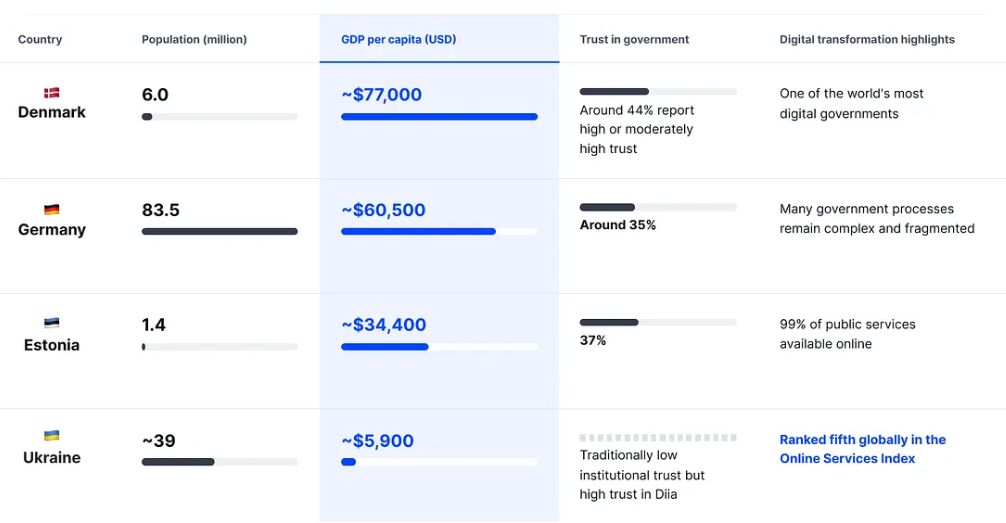
Ukraine’s experience challenges one of the assumption that countries with larger budgets and stronger economies naturally move further and faster.
Daniel Korski returned several times to an idea that stayed with me long after the recording ended: That governments rarely undergo fundamental transformation simply because they decide it’s time to modernise.
Constant change as a driver of digital government
More often, change is driven by a much stronger force: sustained public demand, a clear political mandate or a crisis that makes existing ways of working impossible to maintain.
Looking at countries now regarded as digital leaders, that pattern appears remarkably consistent.
Estonia began building its digital state after regaining independence, creating new institutions almost from scratch.
Ukraine accelerated digitalisation during the Covid-19 pandemic and then again after Russia’s full-

scale invasion.
What crises do create is urgency — something governments often struggle to generate under ordinary circumstances.
Ukraine’s digital state was not born in 2022.
Its foundations — digital identity, interoperable registries and experienced delivery teams — had been developing for years before the full-scale invasion.
What changed dramatically after February 2022 was the pace of decision-making.
When millions of people suddenly need financial support, identity documents or compensation for damaged homes, governments cannot rely on implementation cycles measured in years.
New services have to be designed, approved and launched while the crisis is still unfolding.
One of the most important lessons from Ukraine’s experience is how the way government works can change when it can no longer afford to move slowly.
Existing institutions shaping digital government progress
During the podcast, Daniel Korski pointed to Germany as an example of a country with enormous resources that has taken a much more cautious approach to digital transformation.
The reasons have little to do with technology.
They are rooted in history, institutional culture, attitudes towards personal data and the complexity of changing long-established public institutions.
The more examples we discussed, the clearer it became that technology is rarely the hardest part.
The real challenge lies in changing institutions that have been designed to operate in entirely different ways.
Another observation from my conversation with Oleksandr Iefremov stayed with me because it sheds light on why so many digital transformation programmes produce only incremental change.
In many countries, governments are investing heavily in digitalisation, modernising public services and launching new online platforms.
The difficulty is that these efforts often evolve within individual institutions rather than becoming part of a broader transformation of government itself.
Ministries, agencies and municipalities all have their own priorities, responsibilities and delivery plans.
Yet citizens experience government very differently. They are far less interested in institutional boundaries than in whether the entire journey feels seamless.
If accessing a public service still means navigating multiple websites, verifying the same identity several times or repeatedly submitting identical information, the underlying structure of government becomes visible in exactly the wrong way.
Measuring digital governance
This discussion made me think about how we measure digital transformation.
Governments understandably celebrate the number of services they launch or the volume of digital transactions they process.
Citizens, however, tend to judge success by whether interacting with the state feels coherent from beginning to end.
That may also explain why Diia has attracted so much international attention. Its greatest contribution is that citizens no longer need to understand how the government itself is organised before they can access those services.
Trust is another dimension of digital transformation that, in my view, deserves far more attention than it usually receives.
Ukraine has never been associated with particularly high levels of confidence in public institutions.
That is precisely why the findings of a joint UNDP and KIIS survey on digital public services caught my attention.
According to the survey, 85 per cent of Ukrainians positively evaluate their experience using government digital services.
To me, that figure suggests that trust is often built through everyday interactions with the state.
Every application completed without unnecessary paperwork, every service delivered on time and every process that works exactly as expected gradually changes how people perceive the state.
These interactions reshape expectations of what the government is capable of delivering.
Daniel Korski touched on the same idea during our conversation.
Public services that function well rarely receive much recognition because people quickly begin to regard them as normal.
Failures, by contrast, attract immediate attention and can undo years of progress in building public confidence.
For that reason, reliability may ultimately matter just as much as innovation.
Citizens are unlikely to remember every new feature a government introduces, but they rarely forget whether a service was there when they genuinely needed it.
Foundations matter more than we think
Where governments have already established interoperable systems, trusted digital identities and efficient service delivery, artificial intelligence (AI) has the potential to make those capabilities significantly more powerful.
AI can accelerate systems that already function well, but it cannot replace the difficult work of building institutions that share information, coordinate decisions and operate as a coherent whole.
This column began with a simple question: why do some countries transform faster than others?
Engineering talent, public investment and technology undoubtedly influence the pace of digital transformation, yet none of them fully explains why some governments are able to deliver profound change while others spend years discussing reforms that never quite materialise.
What seems to make the greatest difference is whether public institutions are capable of acting as a single system, making decisions at the pace circumstances demand and abandoning long-established ways of working when those approaches no longer serve citizens.
The article was originally published on Kitsoft Insights here, and edited.
----------------------
The author is the International Program Lead at the Ukrainian govtech company, Kitsoft, and host of the Code the State GovTech podcast.