
Driving intelligent decisions with data and AI
By SAS
The SAS Innovate on Tour event in Singapore showcased the latest real-world data and AI innovations, highlighting how trustworthy AI solutions can drive tangible results for Singapore’s public service.
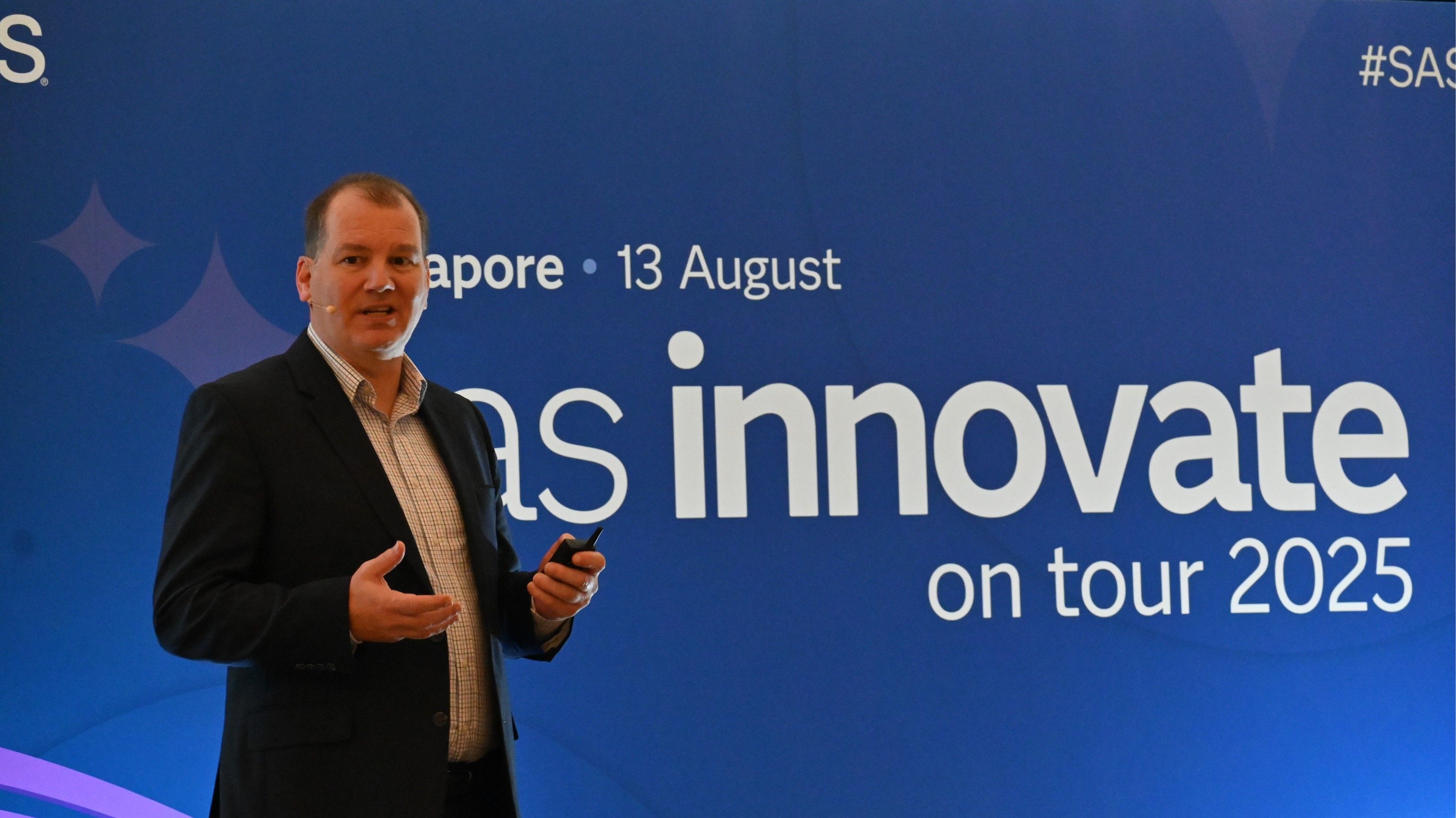
SAS’ Director, Fraud and Compliance, Asia Pacific & Japan, Keith Swanson, speaking at the government track of the SAS Innovate on tour 2025. Image: GovInsider
What if?
What if a manufacturing plant could simulate the optimal movement routes and speeds for autonomous vehicles in a real-time digital replica of its factory?
What if digital renders of plant employees could be inserted in the simulation to build better injury prevention models in relation to the vehicles?
Leveraging real-world data and artificial intelligence (AI) innovations, SAS’ Senior Vice President, Marketing, Patrick Xhonneux showcased how the concept of digital twins were being brought to life at the opening keynote at the SAS Innovate on Tour event on August 13 in Singapore.
“We are achieving these solutions today - not 10 years from now,” said Xhonneux.
These innovations were not limited to just digital twins. From agentic to quantum AI, Xhonneux highlighted how despite the rapid pace of innovation feeling “overwhelming”,
one constant is the ever-present need for intelligent decisions and outcomes.
“It's all about what's possible and what's practical with data and AI, whether you're just at the beginning of your journey or scaling AI across your enterprise,” Xhonneux added.
Decisive data
With the ever increasing digital immediacy of government services, what will decisioning look like in the public sector?
SAS’ Director, Fraud and Compliance, Asia Pacific & Japan, Keith Swanson posed this question at the event’s government track that explored how analytics and decisioning were powering innovation, trust, and impact across the public sector.
“Decisioning is the critical catalyst to drive immediate value actions and outcomes from data and AI,” he explained.
Swanson defined decisioning as automating the choices that businesses or governments make, in a manner that “sustains control” and “moderates impact” to drive adoption of projects.
An example of decisioning in government, Swanson shared, was intervention.
“We find out from the data that we have that a convicted child molester has moved in next door to a five-year-old who's previously been subject to abuse.
“Decisioning can automatically trigger that a police officer casework, social worker, should go visit to find out the safety of that fund,” he explained.
Decisioning also enabled governments to engage in prevention, Swanson added, sharing examples of fraud cases where government processes have the autonomy to reject or approve transactions based on information that was authenticated prior.
He explained that the digitalisation roadmaps of many governments, including Singapore’s Smart Nation 2.0 vision, pertained to the “online” stage of process analysis.
This is where analytics and AI are driving immediate interactions, including the various steps and decisions made through a means of orchestration, said Swanson.
“Decisioning gives you the ability to act on and drive greater variability within automation, and also to drive greater variability within that.”
At the intersection of process automation, AI analytics, and decisioning, Swanson continued, was agentic AI, which could drive a more digitalised, smarter engagement.
“We're not at full digital immediacy, but we're feeding into a process a set of steps together.”
To subscribe to the GovInsider bulletin, click here.
HDB's data transformation
A presentation from Singapore’s Housing & Development Board (HDB) expanded on the impact of data-driven transformation in the public sector, detailing its vision and strategy for data and analytics cloud migration.
Data is central to HDB’s mission, informing how the housing authority designs and builds homes that meet residents’ evolving needs, while also supporting sustainable and smart town planning, and enhancing the quality of everyday living.
HDB’s Deputy Director of Data Management & Data Science Tay Jun Jie explained that the vision is to be “data-driven to the core” – making reliable data more accessible to HDB officers, so that they can make better, faster decisions in planning and delivering homes and services.
Since 2023, HDB’s data-related functions were reorganised under a CDO (Chief Data Officer) Office and DSAI COE (Data Science & AI Centre of Excellence).
The CDO Office was overall responsible for setting policies and governing data across HDB, while the DSAI COE comprised teams for data science, data engineering and platforms, and data capability and engagement.
Tay added that HDB’s data and AI strategy was made up of five key thrusts: implementation of ARK (Analytic Repository of Knowledge), introduction of data stewards, capitalising on government GenAI tools, strengthening the hub, and uplifting capabilities.
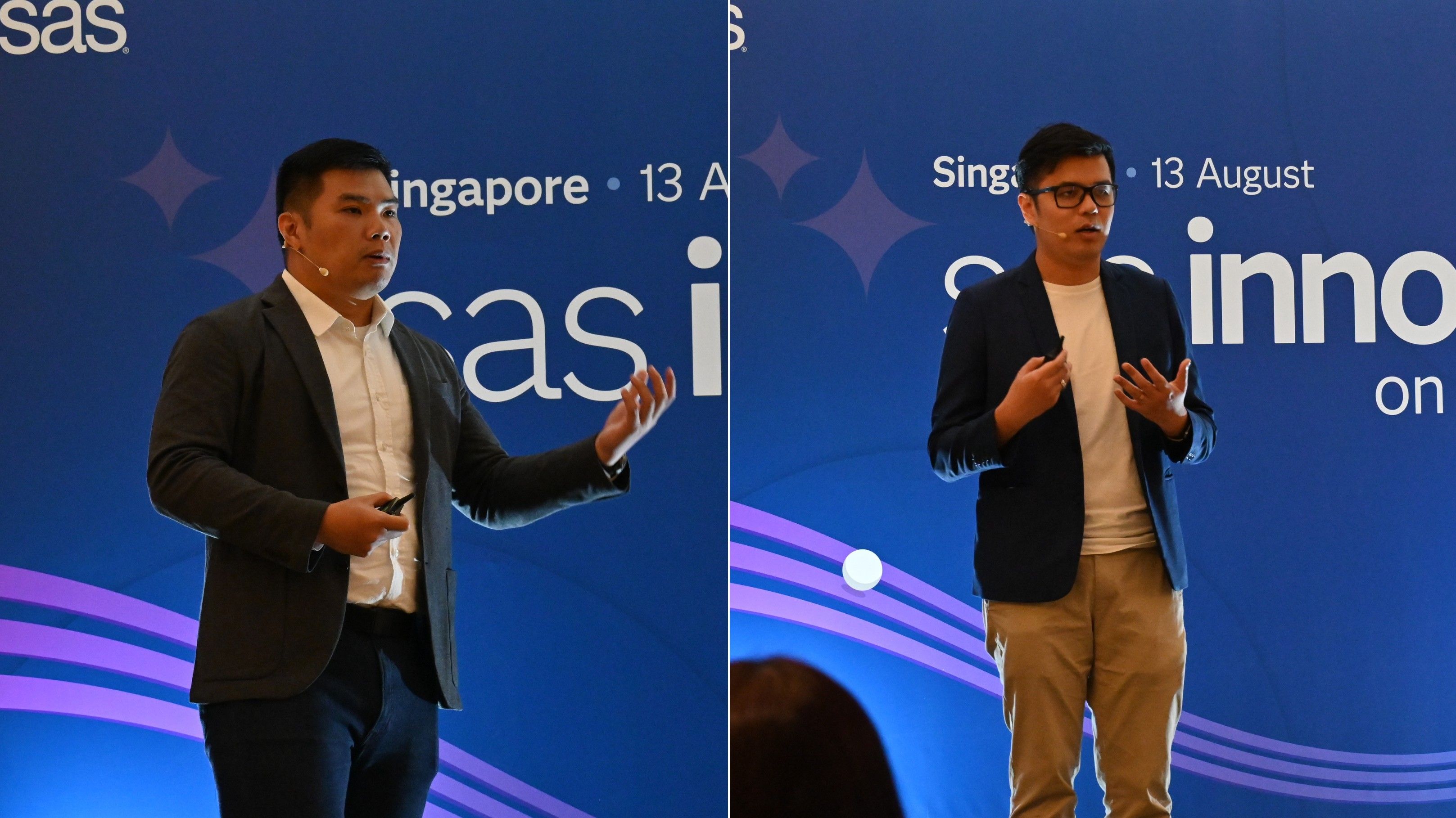
Co-presenter Timothy Peh, who is HDB’s Principal Data Engineer & Team Leader, Data Engineering & Platform, explained that a key principle during this journey was to view data as a “first-class citizen”.
Referencing ARK, Peh stressed the importance of understanding and analysing the behaviour of data across its lifecycle and procedure needs in an end-to-end fashion, starting from data acquisition and ingestion till data exploitation.
“As part of our whole cloud migration and modernisation journey, our focus is ensuring that we get good working data on a robust and resilient platform, and HDB officers can gain the insights they need to better serve our residents and Singaporeans,” he said.
He added that other principles included a DataOps culture, cloud-native architecture, federated data mesh operating model, and a data-as-a-service business model.
Decisioning for real outcomes
Across the event’s learnings, SAS’ Industry Lead for Public Sector (Asia-Pacific), Ensley Tan emphasised the need for tangible outcomes amid the public sector’s adoption and integration of new innovations.
“AI by itself is not very useful - the important thing is to tie AI an outcome. We call this decisioning where the result of a model gets put into an email or outcome to prosecute or tax somebody,” he said.
He advised government officials not be caught in reverse when thinking to deploy AI solutions or large language models (LLMs).
“It’s more important to think about the problems that aren’t going away. It’s more useful to consider how AI or LLMs can solve those problems to have the awareness of what is real and are empty promises is a lot clearer,” he added.