
Empowering APAC law enforcement agencies in a digital world
By Quantexa
Quantexa’s recent whitepaper asserts that APAC law enforcement agencies must turn fragmented data into decision-ready intelligence to keep pace with the growing complexity and reach of crime.
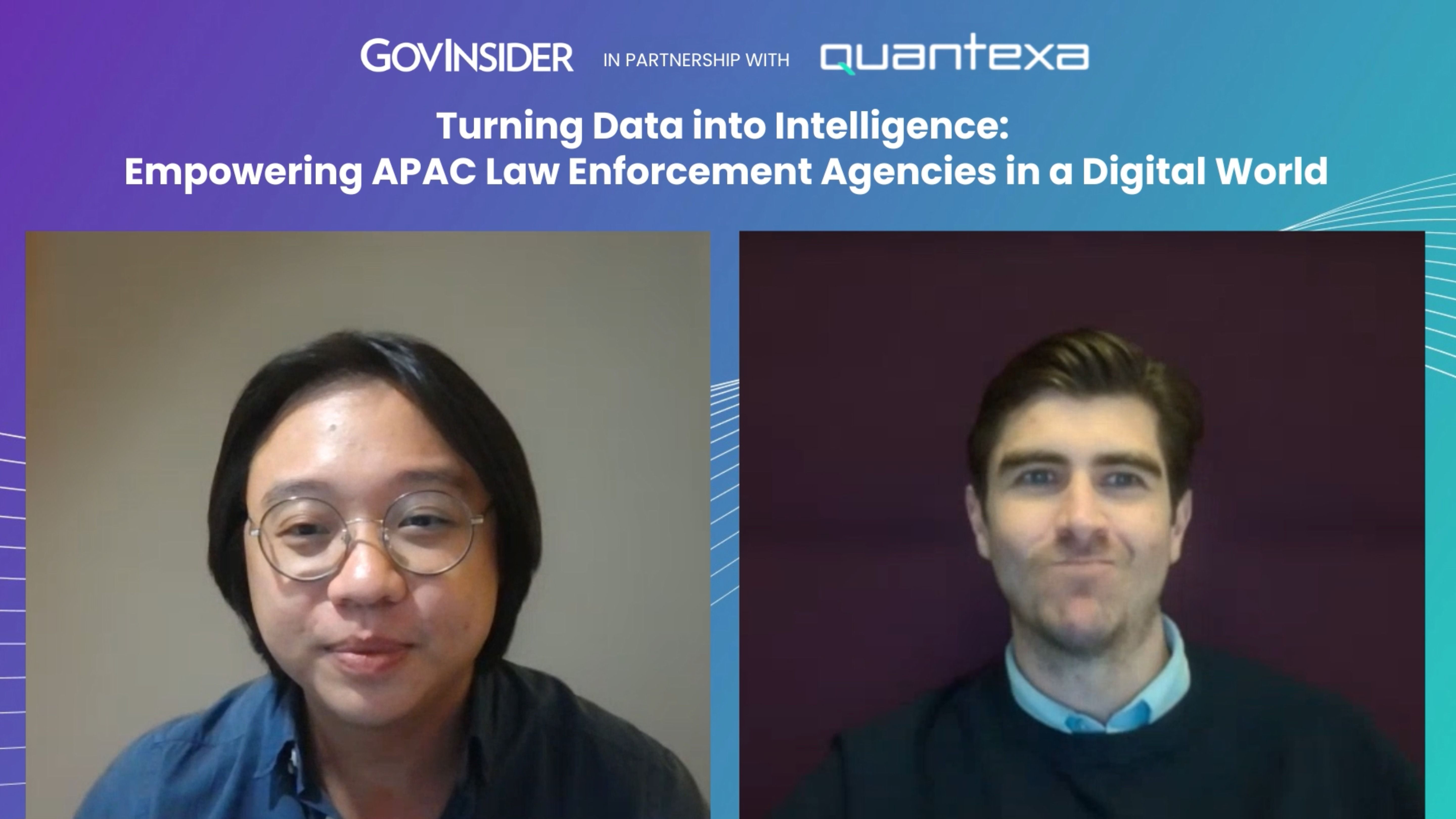
Quantexa’s Global Head of Government Solutions, John Harms (right) says that the success of law enforcement rests upon a whole-of-government approach to increasingly complex crime networks. Image: Quantexa
Think about the face of crime today and what image comes to mind?
Criminals are increasingly operating on a global, digital, and networked scale as crime syndicates take on deliberately obscure, faceless forms.
Because of this, law enforcement agencies operate in a fundamentally changed threat environment, says Quantexa’s Global Head of Government Solutions, John Harms.
“As crime becomes more complex and faster moving, the difference between success and failure will ultimately be [determined by] how quickly agencies can turn raw data into trusted decisions,” he explains.
Speaking at a fireside chat with GovInsider, Harms shares insights from a whitepaper he authored detailing the challenges APAC law enforcement agencies are up against and how unified data can help disrupt criminal operations.
Connecting the dots with data
Harms says that investigations which used to take years or months can be sped up into a matter of days or hours, but only when agencies unify and contextualise the data they have.
“The real challenge isn't about the access to data, it's turning that fragmented and siloed information into trusted data,” he explains.
He identifies speed, complexity, and the sheer volume of data as three main challenges that investigators need to solve.
First, investigators lose critical time collecting, cleaning, and connecting data before they can begin investigating crime. Meanwhile, criminals exploit this lag time to adapt their methods.
This ties into the concept of decision velocity, Harms highlights, which measures how quickly and effectively an investigator can transform raw information into actionable steps.
Second, data is made more complex as criminals operate across multiple jurisdictions.
Harms explains that crime networks are increasingly using shell companies, money mules, and cryptocurrencies to obfuscate the origin of their activities.
Moreover, this exposes a gap in traditional enforcement operations as disconnected data systems obstruct investigators’ ability to connect evidence that resides in disparate sources.
Third is the immense volume of data that investigators sift through.
While enforcement agencies today have access to more data than ever before, Harms highlights that investigators spend up to 80 per cent of their time wrangling data and the remaining 20 per cent on investigations.
Transforming data into intelligence
To combat these challenges, Harms proposes the concept of “decision intelligence”, an operational platform which enables agencies to turn data into decisions.
The model enriches data with real world context by placing fragmented records into a single, contextualised, and trusted view of “people, organisations, digital personas, and networks”, he explains.
This provides a transparent provenance of information for enforcement agencies to confidently use in court disclosures.
Decision intelligence also gives investigators the ability to prioritise and focus resources on high value targets.
Advanced data matching tools like entity resolution and knowledge graphs are built into Quantexa’s Decision Intelligence platform so that investigators can proactively identify hidden influencers, facilitators, and linchpins, Harms adds.
He cites a real-world example of a large-scale scam operation that operated from Cambodia.
The scam centre used hundreds of front-end operators, layered-shell entities, crypto wallets, mule accounts, and telecommunications infrastructure to distance the actual crime leaders and beneficiaries involved from the operation.
Harms explains decision intelligence would have been instrumental in uncovering key relationships between data points across scam scripts and victim reports, financial flows and crypto transactions, and ownership structure within shell companies.
“You can move beyond arresting individual scammers and identify the organisers, facilitators, and controllers of these operations.
“A contextualised network view is what allows authorities to trace illicit proceeds, expose cross-border criminal control and most importantly, dismantle and disrupt the criminal ecosystem from the inside out,” he notes.
The human element
While advocating for advanced technological capabilities, Harms pays the same attention to importance of the human element in the fight against crime.
“The human element will always be the backbone of law enforcement. Technology augments and empowers investigators and officers. It doesn't and won't replace them,” he says.
Harms highlights the importance of operational capabilities and investigative judgement in the battlefield of both digitally charged crime operations and enforcement measures.
The ability to operate confidently across complex crime networks using technology while separating signal from noise enables investigators to make accountable decisions under pressure, he explains.
Transforming data into decisions is no longer optional for law enforcement agencies as criminal tactics become more sophisticated.
Harms notes three key shifts he sees over the next five years: network-centric views, decision-driven outcomes, and proactive disruptions.
Together, these shifts ultimately reflect the underlying evolution of threat actors where APAC law enforcements need to adapt towards more collaborative, decisive, and pre-emptive operating frameworks.
Modernising capabilities under these shifts will make a significant impact in the region's security posture, Harms stresses.
He adds that building these capacities fundamentally enable enforcement agencies to act faster without sacrificing trust.
The success of law enforcement ultimately rests upon a whole-of-government approach to crime, as Harms underlines the persistent need for investigators to stay two steps ahead of criminals.
“We want to help scale insights across jurisdictions and help agencies stay ahead as these criminals evolve.
“The future of enforcement isn't just about information sharing; it's about decision sharing - a shared understanding of criminal risk and networks across governments.”