
Establishing the premier digital hub in Central Asia
Uzbekistan’s Minister of Digital Technologies, Sherzod Shermatov writes about how the country is investing in the future of digital government and information technology.

Uzbekistan’s Minister of Digital Technologies, Sherzod Shermatov. Image: The Ministry of Digital Technologies of the Republic of Uzbekistan
Anyone who has been watching Central Asia over the past few years is aware of the rapid rate of growth and transformation going on in the region, particularly in Uzbekistan.
With over 6 per cent of gross domestic product (GDP) growth last year and a similar level expected in 2025, the economic reforms underway in the country are bearing fruit by supercharging the local economy.
What is less well known is that, alongside this economic liberalisation, another transformation is underway: the establishment of Uzbekistan as a regional hub for information technology. The country is investing heavily in its private-sector IT infrastructure, has a thriving start-up community, and has already produced two “unicorns”.
Investing in digital infrastructure and digitalisation is a key goal of our Uzbekistan 2030 Strategy. Adopted in 2023, it is a long-term development plan designed to improve government, attract investment, foster sustainable growth and expand our economy over the course of this decade.
Uzbekistan is a landlocked country, and our main resource is our people. Since independence in 1991, our population has grown by over 16 million. President Shavkat Mirziyoyev 's vision of turning Uzbekistan into an IT hub means that instead of sending people to work abroad, we bring remote jobs here.
We offer significant tax benefits. If you have an IT company here, you pay no taxes. This makes it attractive to outsource to Uzbekistan.
This year we expect to reach US$1 billion (S$1.29 billion) in IT services exports, up from just US$700,000 in 2017. Our target is to reach US$5 billion by 2030.
If, in 2017, we had about four IT companies with foreign capital, we now see about 30 new ventures with foreign connections opening monthly.
People who left Uzbekistan seeking opportunities abroad are coming back and launching their own startups here.
We now have 15 venture capital funds, and Tashkent has been ranked the fastest-growing startup city in the region. Our IT-Park special economic zone now has over 3,000 resident companies, including more than 800 foreign firms.
We are investing in people to make sure that we have the well-trained workforce required to take advantage of this growth in the IT sector.
With assistance from the United Arab Emirates (UAE), we have launched the “One Million Uzbek Coders” programme and, more recently, the “One Million AI Prompters” initiative.
The “El-Yurt Umidi” programme, which translates as “Hope of the Nation”, sends students from various disciplines abroad to the top 100–300 universities globally, in the US, Europe, Japan, Korea, and more.
To subscribe to the GovInsider bulletin, click here.
Digitising the public sector
One thing we have understood is that, in order to have a thriving private sector, we need to lead by example by creating a government that is technology-based and responsive to the needs of our citizens and our business community.
Uzbekistan’s ancient city of Samarkand recently hosted the 2025 edition of the United Nations Public Service Forum, which this year focused on how digital transformation and innovation can serve as key drivers for improving public services.
With only five years remaining for nations to achieve the UN’s Sustainable Development Goals, it is especially important to focus on practical government transformation and how technology is tangibly improving the interaction between governments and citizens.
In Uzbekistan, we are implementing this approach through concrete administrative reforms and a range of digital-focused projects and programmes. These reforms are guided by key principles articulated by President Mirziyoyev – that it is not the people who should serve government but the government that must serve the people.
In this context, Uzbekistan operates a unified portal for interactive public services, My.gov.uz, which gives citizens and businesses with access to over 760 types of e-government services.
The country has 208 public service centres that provide offline access to administrative services even in remote regions. We have introduced the Unified Identification System, 1ID; integrated over 200 government information systems into an inter-agency platform; and implemented a unified billing system to simplify service payments.
Other programmes include the e-parliament system, which allows citizens to participate in legislative discussions, and the digitisation of customs, which has reduced cargo clearance times three times.
All document exchange between government agencies is now conducted through a unified electronic document management system using digital signatures. This has automated internal processes and saved over 1000 tons of paper every year. We use digitisation not as a goal in itself, but as a tool to enhance public trust and citizens engagement.
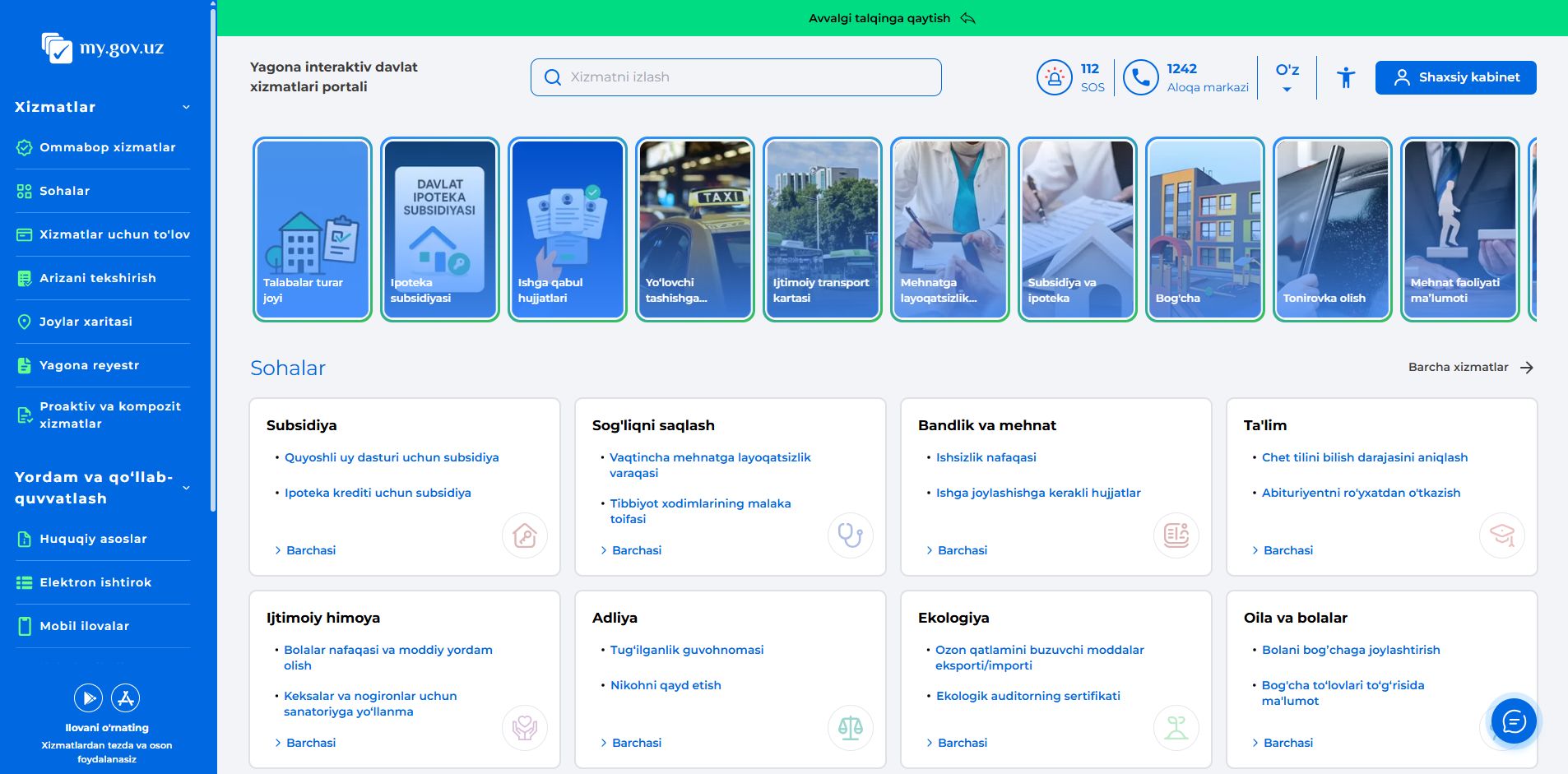
A modern government for a modern economy
Another pillar of our digital government strategy is employing artificial intelligence (AI) to improve our ability to deliver services. Among the more notable examples is Mukhlisa, the voice assistant of the public service portal, which has already processed over 1 million user requests.
We use the Davron voice assistant within the tax system to assist citizens in calculating and paying their taxes. A third assistant, Odil, operates in the field of justice and is designed to search for and analyse legal information. An intelligent search engine has been implemented in the national legislation database, lex.uz, making legal information more accessible to all.
And lastly, we have introduced intelligent use of biometrics to facilitate payments and other functions. The My ID Palm system enables contactless payments through palm recognition and has been introduced in the Tashkent metro. The broader MyID biometric technology is also being applied in banks, marketplaces, and fintech platforms to ensure secure customer identification.
The progress we have made over the past few years has not gone unnoticed.
In 2024, Uzbekistan achieved a major milestone by joining the list of countries ranked as having a “very high” E-Government Development Index. It also rose 37 places in the UN’s GovTech Maturity Index, entering the top “A” category.
All this is to say that a modern economy requires a modern government with a customer-focused attitude, efficient information systems, and effective service delivery.
This is vital not only to make citizens’ lives better, but to help fuel economic growth by making it easier for businesses to thrive. Any country that aspires to be a hub for innovation must ensure that innovation is as much a part of the DNA of the public sector as it is for the private sector.
It is necessary not only to reach the UN Sustainable Development Goals, but also to support the growing range of technology companies that call Uzbekistan home.
---------
The author is the Minister of Digital Technologies of the Republic of Uzbekistan. You can find other articles published about the Ministry of Digital Technologies of the Republic of Uzbekistan here.