
Five lessons from a decade of behavioural science in Singapore
By BIT
Singapore public sector speakers at the GovInsider and BIT’s event shared how the use of behavioural science in policymaking has evolved in the last decade, the lessons learnt, and what's next.
-1793839200057.jpg)
Dr Serene Koh, head of Singapore’s BIT, recounted some early collaborations with government – listening at a call centre, workshops with public servants, and interviews with citizens – trying to fix problems at the last mile. Image: GovInsider
Back in 2016, the Singaporean public service was starting to explore how behavioural science could help people make better choices for themselves - with various ministries looking at nudges in Singapore.
Dr Serene Koh, head of Singapore’s Behavioural Insights Team (BIT), recounted some early collaborations with government – listening at a call centre, workshops with public servants, and interviews with citizens – trying to fix problems at the last mile.
That sometimes meant a day helping to print letters, using coloured post-it notes to randomise an experiment in nudging that was an agency’s first-ever randomised controlled trial (RCT).
Dr Koh was speaking at Beyond the Nudge, a Behavioural Science Day held on October 28 to mark 10 years of behavioural insights (BI) in the Singapore government.
Today, behavioural science has become business as usual in the public service, said Dr Joanne Yoong, Founder of Research For Impact, in her presentation.
“From my perspective, the biggest shift is that we’re starting to be brought in sooner, more upstream, before the solution is fixed and to work on bigger questions," said Dr Koh.
Here are five lessons on making that shift.
1. Diagnose the system before designing the fix
Other speakers described when they had first moved beyond the nudge. Often, it was because talking to the users showed that the problem they had been asked to solve was not the real one.
Leong Wai Yan, now Principal Economist at the Civil Aviation Authority of Singapore (CAAS),
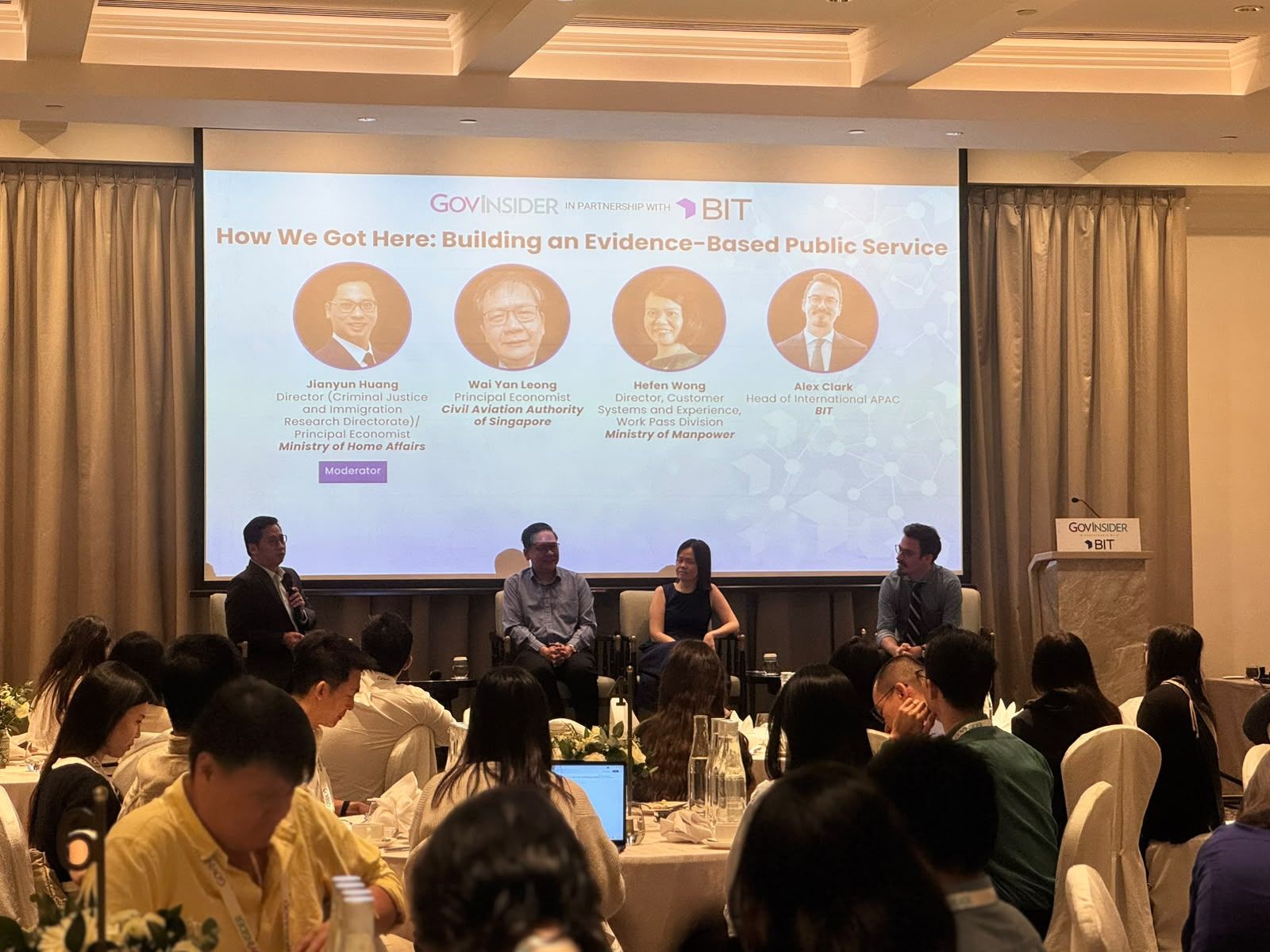
sharing in his personal capacity and not on behalf of his agencies, recalled a Land Transport Authority (LTA) study on students who tapped in but not out of buses.
At that time, LTA’s management was keen to explore the possibility of adding a small penalty for not tapping out, which the evidence often supports.
But his team spoke to students and found many did not know the data helped LTA plan its services.
Whilst penalties worked, they realised that information explaining reasons to tap out worked almost as well.
Focusing solely on solving the immediate problem would not have identified that there could be a better strategy.
Wong Hefen, Director of Customer Systems and Experience at the Ministry of Manpower (MOM)'s Work Pass Division, highlighted the trade-offs they had to make to complete the modernisation of a legacy system.
Even though her team's redesigned digital services scored above 90 per cent in customer satisfaction, the employee satisfaction was much lower.
Wong's team then spent about a year and a half prioritising system enhancement that effectively raised the productivity and employee satisfaction.
2. Treat trials to learn, not a finish line
A decade ago, BIT's Head of International for Asia Pacific, Alex Clark said that the RCT was the end of a project.
"You run the RCT, hooray, you declare victory." Today, the field has "graduated a bit from thinking of RCTs as the finish line," he said.
Research For Impact Singapore's Dr Yoong said applying evidence from trials often assumes that that other conditions stay the same, which may not hold especially when intervention itself leads to systems change.
Evidence now includes qualitative, ethnographic and big data.
Speakers also agreed that data has limits.
"Big data, quantitative data is really good at telling you where to look, but you still have to go and look," Clark said.
CAAS’ Leong said officers should not unduly fixate on statistical significance, which was indicated in the "stars" that mark a strong result in a trial.
"As an economist, I worry about the stars. As an applied behavioural scientist in government advising policy makers, maybe not so much," he said, noting that the learning journey matters as much as the end goal.
3. Build capability, and design for scale from day one
One of BIT's Dr Koh's favourite examples was an enforcement letter being sent by the Singapore police.
After BIT had helped with the first few revisions, the public officers kept testing and improving it without BIT.
"That's what a test and learn culture looks like," she said.
She added that much of Singapore's behavioural science "was nurtured by officers who don't actually have behaviour in their job title."
Behavioural science has moved from the opt-in to the default.
BIT's Clark advised agencies to choose projects with a pathway to scale. "You should do something core business." The goal is to build scale into the pilot from the start.
MOM's Wong added that operations colleagues now ask to join user research and testing, seeing how enhancements to the customer experience resulted in reducing enquiries.
4. Use AI to sharpen judgement
Kee Wei Lam, Head of Engineering at Open Government Products (OGP), acknowledged that artificial intelligence (AI) "isn't a solution to most of your problems", but can "amplify as well as accelerate" professional judgement.
Treat it like an intern, he said. In practice, that means define the outcome, ask it to explain its work, and build in feedback.
BIT's Liew, however, recognised that the human-in-the-loop principle is vague: "What do you want me to check?" is the question he hears most often.
He added that government teams are now trying to understand how humans are collaborating with AI, including the productivity gains and challenges faced by staff.
Tampines GRC's Dr Chen warned that juniors who skip tedious groundwork may lose the ability to discern.
BIT's Dr Koh said that when AI use is low, it is worth asking "what officers tend to lose" before assuming they need more training.
An AI agent can summarise thousands of surveys in seconds, she said, but the hard part is understanding the people at the end of it.
5. Ask 'should we?', not just 'can we?'
Behavioural science is now expected, so the questions get harder.
Research For Impact's Dr Yoong said officers must weigh harms, spillovers and cost-effectiveness, not just whether behaviour can change.
"The complexity of the problem is a feature; it is not a bug," she noted.
Dr Charlene Chen, Member of Parliament for Tampines Group Representation Constituency (GRC), said that policymakers need to ask themselves three questions when considering nudges.
These questions include: Whose interests does it serve? Would people be uncomfortable if they knew about it? Can they opt out?
BIT's Principal Advisor in the Singapore Office, Liew Sai Ming, added that personalising services across agencies depends on trust. He suggested asking citizens directly how comfortable they are.
As the day’s speakers described it, the edge in tapping into BI for public policymaking comes from pairing in-house capability with outside expertise.
As the day concluded, BIT’s Dr Koh celebrated the journey of the last decade, and invited practitioners to continue sharing what’s working, where they’re stuck, and what they wish they could test.
Singapore public officers who want to learn more should seek out the behavioural insights community of practice within government, or reach out to BIT to pair in-house capability with behavioural science expertise gained from more than ten years working with the Singapore public service.